April 2021

What’s this, a court invalidating an attempted taking because it isn’t necessary? What gives, Appellate Court of Illinois?

Well, in City of West Chicago v. Pietrobon, No. 2-20-0174 (Apr. 28, 2021) (unpub.), the court affirmed the trial court’s determination that the taking of a strip of the owner’s property might qualify as a future public purpose, but the facts showed otherwise.

A taking of property for a road seems like one of those “classic” public uses, no?  Here, the city and the developer (the neighbor of Pietrobon) apparently believed that the property on which the road was contemplated was public property. Not so. It turned out that Pietrobon actually owned the land. So condemnation followed.

The first time the case went up to the appellate court, it concluded that the condemnor had established a prima facie public purpose taking. Yes, the taking was for the benefit of the neighbor
Continue Reading Ill App (unpub, unfortunately) Strikes Down Taking For Road To Be Owned By The Public

What’s up with that (sorta) snarky headline, you ask? After all, isn’t the PennEast v. New Jersey case, heard yesterday by the Supreme Court, a real honest-to-goodness eminent domain case about a pipeline?

Doesn’t the transcript show terms like “in rem,” “takings,” “eminent” and “eminent domain” were used a whole lot? Aren’t a lot of the media reports saying this is a big eminent domain case (see here and here for example)?

Pages from 19-1039_8758

But read the transcript or a listen to the recording (stream above or download the mp3 here) and see what you think, eminent domain mavens.

If you are like us, you understand that the case isn’t going to tell us a lot about eminent domain generally, or about valuation, or the power to take (except in very limited circumstances). After all, the case asks whether the State of New Jersey – not some mere private landowner –

Continue Reading Listen (Or Read) As SCOTUS Hears Arguments In A (Sorta) Eminent Domain Case

20180805_155746_HDRThat rail crossing in Chicago

We’ve noted before that gun cases have life of their own, often divorced from strict legal logic. Throw in takings, and you’ve got a recipe for a difficult challenge.

But add to the mix a Supreme Court überlawyer, and maybe your chances go up. Who knows for sure. Only the nine at 1 First Street, NE do. 

So it is with this cert petition, filed yesterday, raising both Second Amendment keep-and-bear-arms and Fifth Amendment takings questions. The issue is New Jersey’s decision to make large capacity magazines illegal (well, technically to lower the already-limited capacity of rifle and pistol magazines from 15 to 10). The problem, the petition argues, is that the ban didn’t just apply prospectively, but covered legally-possessed magazines also, and requires owners to give them to the government, transfer them to third parties who may legally possess them, or

Continue Reading New Cert Petition (Clement): Making It Illegal To Keep High-Capacity Magazines Declared Contraband Is A Taking

We post the D.C. Circuit’s opinion in Ivanenko v. Yanykovich, No. 20-7033 (Apr. 23, 2021) more for its interesting fact pattern than the holding (which doesn’t tell us a lot about “takings” since is this is a case under the Foreign Sovereign Immunities Act, but hey, it did ping our “eminent domain” radar).

Under FSIA, foreign countries are mostly immune from being haled into an American courtroom. But there is an exception for “expropriation,” when property is “taken in violation of international law.” As the opinion put it:

Appellants first maintain that the FSIA’s expropriation exception permits their lawsuit against Ukraine. In their view, Ukraine’s “total destruction” of their property was a taking in violation of international law, particularly because Ukraine acted with the “discriminatory intent” to punish the Ivanenkos for promoting Western business interests. Relevant here, the FSIA’s expropriation exception divests a foreign state of its immunity

Continue Reading Destruction Of Ukrainian’s Property By Ukraine Not Within FSIA’s Expropriation Exception

Here’s the recently-filed cert petition in a case we’ve been following.

Rather than attempt to sum it up, we suggest you read the petition, especially the Questions Presented:

Montana Dakota Utility (hereinafter MDU), a private corporation, employed the power of eminent domain to procure an easement on Vern Behm’s farmland immediately along a pre-existing county road but outside the right-of-way. This taking by a private entity was for the purpose of extending an underground natural gas pipeline for the sole use of another private company, Burlington Northern Santa Fe. The district court dismissed the action, finding that the purpose of the pipeline (heating a switch during the winter months) was already being met by the use of propane tanks and that MDU’s refusal to use the township thirty-three foot easement that follows and parallels the existing county road demonstrated that the subject easement was not necessary and was indeed

Continue Reading New Public Use Cert Petition: Overrule Kelo!

Titles

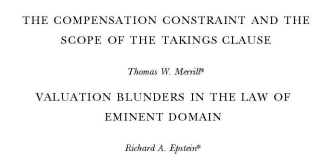
Two very interesting law review articles (essays) by well-known property experts are now available in the Notre Dame Law Review:

  • Thomas Merrill, The Compensation Constraint and the Scope of the Takings Clause, 96 Notre Dame L. Rev. 1421 (2021). Professor Merrill asks “whether the established methods for determining just compensation can shed light on the meaning of other issues that arise in litigation under the Takings Clause.” This idea is worth exploring in much greater detail, and amplifies a thought we’ve long had: instead of trying to forge new ground when trying to figure out whether a government action results in a taking, might it not be simpler and more consistent to look at an established body of law that truly informs the subject, valuation and just compensation? For example, see our thoughts on Murr v. Wisconsin, in which we suggested that instead of a new federal


Continue Reading Your Friday (And Weekend) Reading: Merrill On Compensation; Epstein On Valuation

Order

This In Chambers Order recently issued by a federal district judge may just be the most unusual, flat-out wild judicial opinion we have ever read.

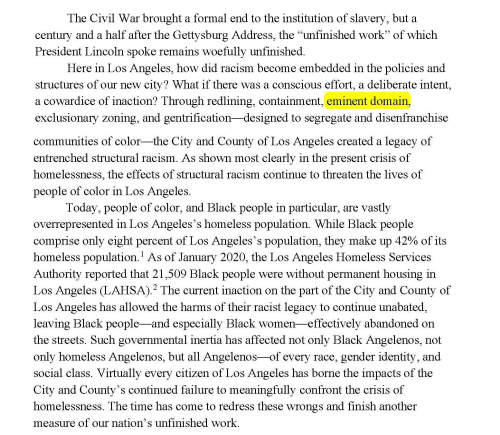
Citing the Gettysburg Address, Brown v. Board of Education, systemic racism (including eminent domain) systemic sexism, and a slew of newspaper articles, the Central District of California (without even holding a hearing), issued a preliminary injunction ordering Los Angeles to immediately address the homeless problem, including ordering that “$1 billion, as represented by Mayor Garcetti, will be placed in escrow forthwith, with funding streams accounted for and reported to the Court within 7 days.” Order at 107.

The city is also ordered to halt any public land sales, figure out how to use said land for the homeless, and report to the court how to address “structural barriers (including but not limited to redlining, highway construction, eminent domain, and health exposure)[.]” Id. at 108.

Continue Reading A Federal Court’s Extraordinary Shot Across The Bow: LA’s Massive Homeless Problem Is Caused (In Part) By Eminent Domain

IMG_20180720_152126_1

Under a Massachusetts statute, local redevelopment agencies have the power to respond to “decadent, substandard, and blighted open areas” either by creating an urban renewal project (redeveloping an area pursuant to a “detailed” and “comprehensive” plan; the statute expressly includes the power of eminent domain for urban renewal projects), or by a “demonstration” development (a term not defined by the statute, and therefore lacks an express delegation of eminent domain power).

In Cobble Hill Center LLC v. Somerville Redev. Auth., No. SJC13028 (Apr. 22, 2021), the Supreme Judicial Court addressed an issue left open the last time it dealt with the power of redevelopment agencies: do they have the power to take property by eminent domain when they choose to undertake a “demonstration?” 

Cobble Hill had intended to do its own private redevelopment on its vacant property in Somerville, Massachusetts. But due to some internal disputes, construction

Continue Reading Mass SJC: New And Improved Means For Blight Elimination Uses Old And Worn Method: Eminent Domain

Like a lot of jurisdictions, Kentucky allows (or requires upon demand) the jury to view property being taken by eminent domain. In Kentucky, it’s a matter of statute, which requires the court to allow a jury view upon the demand of any party, unless “unusual or extreme circumstances” are present.

In Comm’w of Kentucky v. PTL Warehousing, LLC, No. 2019-CA-388-MR (Apr. 2, 2021), the trial court did not approve of the condemnor’s request that the jury view the site and the warehouse taken. The court concluded that a view would not be helpful to the jurors because “the jurors had likely eaten at an Arby’s which was located across the street from the subject property.” Slip op. at 3. The court asked the jurors whether they indeed had eaten at Arby’s. The court concluded they were already familiar enough with the property (the condemned property, not the Arby’s).

Trial

Continue Reading Google Maps And Arby’s Visit Aren’t Enough To Overcome Jury View

Here are the amici briefs supporting the property owner’s cert petition in a case we’ve been following for a long time, Eychaner v. City of Chicago, No. 20-1214.

This is the one in which the Illinois courts concluded that Chicago’s desire to prevent “future blight” is enough of a public use to support the taking of private property. Yes, you read that right: future blight.


Continue Reading SCOTUS Amici: Preventing Future Blight Is Not Public Use