



May 2021

Screenshot_2021-05-15 18th Annual Brigham-Kanner Prize Recipient

Mark your calendars for September 30 – October 1, 2021, and join us at the William and Mary Law School in Williamsburg, Virginia for the 18th Annual Brigham-Kanner Property Rights Conference. It’s planned to be in-person, so when we mean “join us” we really mean join us.

This year the Conference will recognize the lifetime work of Professor Vicki Been (NYU Law) with the Brigham–Kanner Property Rights Prize. As noted in the Law School’s press release:

The Brigham-Kanner Property Rights Prize is named in honor of the lifetime contributions to property rights of Toby Prince Brigham, founding partner of Brigham Moore, LLP, and Gideon Kanner, professor of law emeritus at Loyola Law School in Los Angeles. Brigham died earlier this month in Miami. A true legend in the law, he was esteemed by colleagues for the invaluable counsel, knowledge and skills he possessed and shared so generously. The prize
Continue Reading Mark Your Calendars: 2021 Brigham-Kanner Property Rights Conference, Williamsburg, Virginia, Sept 30-Oct 1 (in-person)

You might think that a statute the legislature adopted to allow more recovery than under constitutional takings law, that requires the DOT to pay landowners whose lands abut a change-of-grade project for the value of “any damages to said lands occasioned by such change of grade,” would include the situation where the DOT converted a property owner’s at-grade driveway into a rampless bridge. The DOT refused to include offramps as the owner requested, and as a result, the business tanked and the value of the property dropped precipitously.

If so, you’d be wrong according to the majority of the Wisconsin Supreme Court in United America, LLC v. Wisconsin Dep’t of Transportation, No. 2018AP2383 (May 18, 2021).

There, the court concluded that because the impact was not to “the lands” because the change of grade project did not actually touch or damage “the land” of the owner, only the owner’s

Continue Reading There’s A Difference Between “Land” And “Property” Under Wisconsin’s Change-of-Grade Damages Statute

2012-02-06_11-19-51_574

A private pipeline did what pipelines often do: it started negotiating with property owners for the property needed, but at the same time pressed forward. It reached agreement with some owners, others not. It filed “expropriation” lawsuits (for it is in Louisiana that our scene lies). It started to build, even before judgments of expropriation.

Aaslestad, owner of 38.00 acres (more or less) sued the pipeline to enjoin further construction. He also asserted in the expropriation case a counterclaim for due process and trespass (again, this is Louisiana, so they call that a “reconventional demand). Trial followed.

The trial court issued a judgment of expropriation and concluded the takings were for a public purpose. But it also upheld the property owner’s trespass counterclaim. The owner’s interest was pretty minor, so the total award was a whopping $150. Seventy five bucks for the expropriation and the same amount for the trespass.

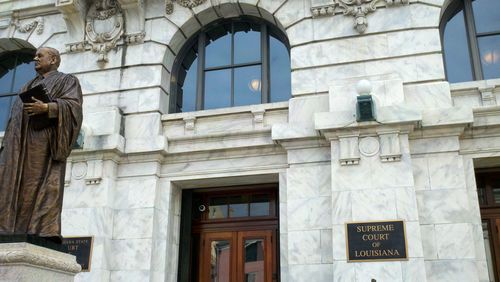
Continue Reading Louisiana SCT: No Statutory Attorneys’ Fees For Pipeline Taking – But LA Constitution’s Just Comp Clause Requires Owners Recover “The Full Extent” Of Their Loss (Which Includes Fees)

67-day bench trial. 84-page decision. Check out the Superior Court’s Tentative Statement of Decision in a case in which a property owner has successfully challenged the Town of Apple Valley’s attempt to take a private water company so the Town could operate it itself.

There’s a lot going on, and to understand the decision you should understand the statutory requirements under which the case is operating. A California statute sets out the requirements for what we might call “public use” challenges generally (or maybe “power (right)-to-take” challenges):

The power of eminent domain may be exercised to acquire property for a proposed project only if all of the following are established:

(a) The public interest and necessity require the project.

(b) The project is planned or located in the manner that will be most compatible with the greatest public good and the least private injury.

(c) The property sought to be acquired is necessary


Continue Reading California Trial Court: No Greater Public Interest In Town Seizing Private Water Company To Operate It Itself (Generic “Vision Statements” Don’t Count)

Check out the U.S. Court of Appeals for the Sixth Circuit’s opinion in Harrison v. Montgomery County, No. 20-4-51 (May 11, 2021). It’s short, readable. And, most importantly, involves a subject that’s near and dear: takings, and the myriad potential traps that await an unsuspecting property owner making such a claim.

If you’ve ever asserted a takings claim, you know what we mean. The other side may argue you are too late (statute of limitations, for example), or too early (ripeness, in one form or another), or, remarkably, you are both too early and too late (yeah, that happens). Or simply that property questions are not worthy of the court (abstention). And these arguments are often not presented in a clear way — more like “here’s a bunch of reasons to throw this case out Judge, see which one you like” — and

Continue Reading Sixth Circuit Says No To Res Judicata As The Latest Williamson County Workaround

In this recent decision, the North Carolina Court of Appeals held that when a condemnation is invalidated a court — but the condemnor has, by quick-take, already built the project for which it (wrongly) took the property — the owner is not limited to an inverse condemnation remedy (compensation), but may also bring a claim for plain-old trespass (ejectment).

On the same day the court issued that ruling, it produced a second opinion in related litigation stemming from the same facts: Town of Apex v. Rubin, No. COA20-305 (Mary 4, 2021).

As in that case, this one involved the sewer line the Town wrongly installed on Rubin’s land. After the court invalidated the taking of the land, the Town still claimed the sewer line belonged to it, and in addition to raising that argument in the (now failed) eminent domain case, it brought a separate action (this second

Continue Reading How “Res Judicata” Is A Failed Condemnation?

OK, we get that law is a serious business and that one should never make light of others’ situations. Each person’s claim is important to them, at the very least.

But after reading today’s Federal Circuit opinion (unpublished, nonprecedential) in Bench Creek Ranch, LLC v. United States, No. 20-2151 (May 7, 2021), we couldn’t help but make a couple of lighthearted movie references.

First, the above clip from one of the “Bill and Ted” movies is there because the Bench Creek case alleged that the feds are liable for a taking due to its failure to prevent wild horses from invading their land where they drank Bench Creek’s water.

Bench Creek alleged in its complaint that, after a wildfire in July 2017, hundreds of wild horses on federal lands—owned by the United States and managed by the Bureau of Land Management—drank water that belonged to Bench Creek under a

Continue Reading Fed Cir (unpub.): Feds Not Liable For Taking When Wyld Stallyns Drink Your Milkshake

We’re hoping that someone can explain the Florida District Court of Appeal’s recent opinion in Bondar v. Town of Jupiter Inlet Colony, No. 4D19-2118 (May 5, 2021) in a way that makes sense other than the old apocryphal tale of “I don’t know why we do things this way, except that we’ve always done things this way.”

Before we get to the details, a slight detour. This is another one of those cases about substantive due process. Now don’t get us started on that one — we get that it might seem odd to suggest that the Fourteenth Amendment’s Due Process Clause limits the government’s power beyond requiring fair procedures. After all, the words are right there in the text: “nor shall any state deprive any person of life, liberty, or property, without due process of law.” But work with us here: we’ve always viewed the phrase much

Continue Reading Fla App Doubles Down On That Weird Property Isn’t “Property” Thing

R.S. Radford’s most-recent article, Knick and the Elephant in the Courtroom: Who Cares Least About Property Rights? in the latest issue of the Texas A&M Journal of Property Law, should be next on your to-read list. 

Here’s the summary of the article:

Throughout the thirty-four-year history of Williamson County, one fact was taken for granted. Never directly mentioned but always looming in the background of two rounds of oral argument before the Supreme Court in Knick was the premise that relegating takings claims to state court made it less likely that property owners would prevail on those claims than if they could be filed in federal court in the first instance. This Article examines that premise and finds little support for it in the historical record.

Part I of this Article discusses Williamson County and highlights the logical, doctrinal, and procedural confusion associated with the opinion, both in its

Continue Reading New L Rev Article: Knick Won’t Mean Much Until Federal Courts Get Over “Strong Distate, If Not Outright Contempt” For Land Use Matters