August 2021

The hits keep coming. There have already been complaints alleging takings against the feds for the CDC eviction moratorium, and against the State of California for its moratorium. 

Now this, a complaint against the City of Angels alleging that its version of the moratorium works a taking, either a per se physical invasion taking, a regulatory taking, and a taking under California law.  

Not much more to say about it, unless you want to check out the LA Times’ report on the filing, “Landlord sues L.A. for $100 million, saying anti-eviction law caused ‘astronomical’ losses.”

Barista’s note: sorry about the potty-mouth movie clip at the top, but we’ve always thought this character’s sardonic comment about an ongoing situation (the 1968 Tet Offensive) really encapsulated the burden-spreading vibe of Armstrong v. United States, 364 U.S. 40, 49 (1960) (“The purpose of the Takings Clause is to “bar

Continue Reading New Complaint: LA’s Eviction Moratorium Is A Taking
Untitled Extract Pages

Here’s what we’re reading today. And this is one of those articles that you should not miss.

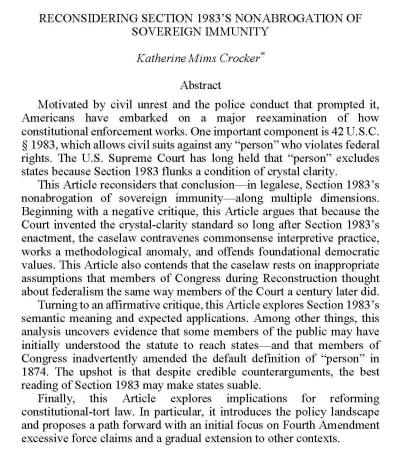
Our W&M colleague Katherine Mims Crocker has published “Reconsidering Section 1983’s Nonabrogation of Sovereign Immunity,” 73 Fla. L. Rev. 523 (2021).

Why is this a “must read” you ask? Because Professor Crocker concludes, “[t]he preceding Parts have revealed substantial arguments for reading Section 1983 to abrogate sovereign immunity, which would make state governments susceptible to damages actions for violating constitutional rights.”

There’s not a mention of our friend the Takings Clause in the article (it focuses mostly on excessive force cases), but it doesn’t take much to see how the analysis Prof Crocker sets out can include section 1983 takings claims.

Here’s the Abstract:

Motivated by civil unrest and the police conduct that prompted it, Americans have embarked on a major reexamination of how constitutional enforcement works. One important component is

Continue Reading New Must-Read Article: Katherine M. Crocker, “Reconsidering Section 1983’s Nonabrogation of Sovereign Immunity,” 73 Fla. L. Rev. 523 (2021)

The U.S. Court of Appeals for the Fourth Circuit’s opinion in Zito v. N.C. Coastal Resources Comm’n, No. 20-1408 (Aug. 9, 2021) is just the latest in a growing list of decisions about an issue we’ve been following (see here, here, here, here, and here for example), including the District Court’s decision in this very case.

That issue is whether a property owner can sue a state for just compensation for a taking in federal court.

You know how that works. Knick held that local governments and officials can be sued in federal court for violating the federal constitution and for civil rights violations. Check. But it didn’t expressly say anything about whether there’s something different about a state or a state official (in their official capacity) that prohibits the same thing. After all, the Eleventh Amendment has been interpreted, it prohibits federal court

Continue Reading CA4 Tells Landowner To Beat It (From Federal Court): 11th Amendment “Sovereign Immunity” Bars Suing State For Fifth Amendment Compensation In Federal Court

According to that trustworthy source Wikipedia, in drama, the term deus ex machina (“God from the machine”) “is a plot device whereby a seemingly unsolvable problem in a story is suddenly and abruptly resolved by an unexpected and unlikely occurrence. Its function is generally to resolve an otherwise irresolvable plot situation, to surprise the audience, to bring the tale to a happy ending, or act as a comedic device.” It is mostly considered a “lazy or cheap” trope.

And that takes us to the various federal, state, and local eviction moratoria that are (or were) in effect at various points in the covid epidemic. To us, those have mostly seemed like cases of kicking the can down the road (to use another overworn trope) because although couched as merely temporary withholding of the usual eviction remedy for nonpayment of rent, in a great number of cases the practical effect

Continue Reading What The Deus Ex Machina? – Federal Court Complaint: California’s Eviction Moratorium Is A Taking

The U.S. Court of Appeals for the Eleventh Circuit’s recent opinion in A Flock of Seagirls LLC v. Walton County, No. 20-12584 (Aug. 5, 2021) isn’t about judicial takings, or even about eminent domain (even though a straight condemnation turned up in the factual background).

But this blog’s frequently flyers might want to take a read anyhow because it involves public and private rights of use in the dry-sand beach along the Florida coast. We know those issues are closely related to our faves like public trust, judicial takings and the like, so read on.

Here are the facts. The county holds an express easement along two beachfront lots for “a way of passage, on or by foot only” that the State of Florida earlier had exacted from the owners in the course of eminent domain proceedings. But if the county tries to use the easement for some

Continue Reading We Already Have An Express Easement Allowing Public Foot Traffic On Private Beach. Walton County: Hold My Beer!

Babe_ver1

We’re not entirely sure if this is “for real” or just an elaborate tongue-in-cheek spoof, but hey, there’s a website (“Give No Quarter!” and an invitation to “Become a Third Amendment lawyer”), a blog (“The Runt Piglet Squeals!”*), and the brief seems signed by an honest-to-goodness real lawyer and sure looks like it has a genuine CM/ECF stamp on the top, so we’re going to take it at face value.

[*The Third Amendment has been called the “runt piglet” of the Bill of Rights: short, overlooked, the butt of jokes.]

The Third Amendment Lawyers Association (ÞALA) [yes, that’s a thorn, not a “P” or a typo.] filed a short brief in the pending challenge by the Alabama Association of Realtors to the CDC’s eviction moratorium. Thanks to our colleague — a fellow Third Amendment admirer — for passing the brief along.

As you may (or more likely may

Continue Reading Third Amendment Lawyers Association (“ÞALA”): Eviction Moratorium Violates … The Third Amendment

A short one from the South Carolina Supreme Court. In Ray v. City of Rock Hill, No. 28045 (Aug. 4, 2021), the court held that the city’s re-connecting its pipe that had previously flooded Ray’s property qualified as the “affirmative, positive, aggressive act” required by S.C. law as an essential element of a new inverse condemnation claim.

Short version of the facts. The city ran a stormwater pipe under Ray’s property. No record of any easement for the pipe. Ray’s property had “a history of sinking and settling[,]” and this went on for many years. Slip op. at 2. Eventually she sued for inverse. The lawsuit alleged that the flooding and damage to her property and home was caused by the deterioration of the city’s pipe.

Apparently unrelated to this, at about the time of the filing of the lawsuit, the city began maintenance work on a sewer line.

Continue Reading South Carolina: City Reconnecting Stormwater Pipes That Previously Flooded Land Is The “Affirmative, Positive, Aggressive Act” Triggering Inverse

Check out this recently-filed cert petition, which asks the Court to review a California Court of Appeal decision about exactions.

It’s a somewhat odd situation: the county issued a building permit, but conditioned it (yes, the county tried to put a condition in a ministerial building permit!) on the property owners recording a deed restriction that they will forever preserve the natural vegetation on a portion of the lot. “Visually important ridgelines” and all that.

Land use types will immediately understand our puzzlement. Building permits are the classic ministerial (“shall issue”) development permits. Meaning that the issuing official has no discretion to deny a permit if the applicant meets the straightforward requirements of the building code, and certainly doesn’t have the authority to grant a permit with conditions. That’s way outside the building department’s authority, and the applicant should be able to get a court to issue a

Continue Reading New Cert Petition: Building Permit That Comes With Requirement To Preserve Plants Is An “Exaction”

You just have to love any case that starts with the sentence, “Dried mangoes form the core of this commercial dispute, which involves a Fifth Amendment challenge…” Shades of Horne!

Well, you can add mangoes to your “healthy snack” list (hat tip CJ Roberts) and include the Supreme Court of Guam’s opinion in Western Sales Trading Co. v. Genpro Int’l, Inc. (Guam), No. CVA19-023 (July 28, 2021), in your oeuvre of fruit/takings cases, because the court held that a territorial statute permitting a judgment creditor to take property from a third party (who obtained it from the judgment debtor) violates the Takings Clause. The court concluded that Guam Code Ann. §§ 23401-23406 (the “turnover statute”) works an unconstitutional taking in violation of the Fifth Amendment and the Guam Organic Act. Follow along.

The statute allows a judgment creditor to apply to the Guam courts for an

Continue Reading Inorganic Fruit: Statute That Allows Creditor To Seize Property From Third Party Rec’d From The Debtor Is A Taking

Programming note: as we noted here, we’ve recently moved our email subscribers to a new service. If you are already subscribed to our email updates you should not need to do anything, except look for the emails coming from Feedblitz, not Feedburner. If you want to sign up for email updates anew, go here. If you experience technical issues, or receive duplicate email notifications, please let me know.

Now back to your regularly scheduled programming…

20151205_150106

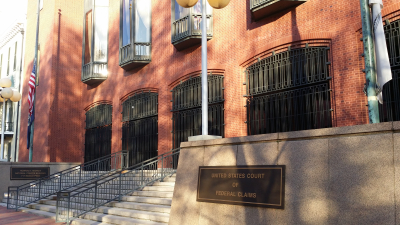
Check out this Complaint, filed last week which asks the U.S. Court of Federal Claims to award property owners an unspecified amount (noted as $26 billion in the cover sheet) in just compensation for the taking of the plaintiffs’ property by the Center for Disease Control’s order temporarily halting residential evictions.

The Complaint alleges a physical invasion taking because it precludes “property owners from excluding [tenants] and leasing

Continue Reading New Takings Complaint: $26 Billion For CDC’s Eviction Moratorium