2021

Here’s a new law journal article, just published, which we recommend everyone read.

Michael M. Berger, “Whither Regulatory Takings,” 51 Urban Lawyer 171 (2021). Available online here.

If you need encouragement to read it, here’s a sample:

The thrust of this article is severalfold. First, Holmes was right. His simple conclusion on behalf of eight Justices encapsulated the crux of modern government: while government needs to be able to regulate, zealous regulators can “go too far” and, when they do, regulation becomes a taking. The Constitution drew a line in the sand that may not be crossed without consequences. Second, a cautious Supreme Court thereafter left the Holmesian standard intact and nibbled around the edges, adding alternative descriptors that confused and confounded the situation. Third, the solution to the problem of how to define a regulatory taking lies in the simplicity of the common law. One of

Continue Reading New Article (Must-Read): Michael Berger, “Whither Regulatory Takings”
Check out the U.S. Court of Appeals’ opinion in F.P. Development, LLC v. Charter Twp. of Canton, No. 20-1147 (Oct. 13, 2021), in which the court affirmed the district court’s grant of summary judgment to the property owner on its unconstitutional conditions takings claim. 

Short story: Canton’s tree ordinance prohibits property owners from removing trees on their land without Canton’s permission, and also requires owners to either replace any trees removed, or pay between $300 – $450 into the tree fund.

In the course of developing its property, the owner cleared a county drainage ditch of trees and debris after the county refused to do so. But it didn’t get a permit, “someone” dropped dime, and Canton issued a NOV.

The owner sued, alleging all theories of takings: (1) a per se Horne-type taking, (2) a regulatory Penn Central taking, and (3) an unconstitutional conditions Nollan/Dolan taking. After

Continue Reading City’s Tree-Preservation-And-Mitigation Scheme Is A Dolan Taking

Here’s the latest in a case we’ve been following (one in which we guessed from the beginning was headed where it is today).

The Zitos claim that their property was taken without compensation. They sued for compensation in federal court. Knick tells us that this is okay, right? Well, the problem for the Zitos is that they claim the State of North Carolina did the taking. And you know what that means: 11th Amendment “immunity.” You can’t sue a State for money in federal court without its consent. And North Carolina didn’t consent.

The District Court dismissed. It concluded that it might have allowed the takings claim for compensation to proceed in federal court except that the Fourth Circuit already concluded that a federal court is barred from considering a takings claim against a state if state law recognizes a takings claim. See Hutto v. South Carolina Retirement System

Continue Reading New Cert Petition: The Self-Executing Fifth Amendment Abrogates 11th Amendment Immunity

It’s already the law in Georgia that the Georgia Constitution’s Takings Clause waives whatever sovereign immunity the government may enjoy when it comes to monetary relief in a takings claim. See Ga. Dept. of Nat. Res. v. Center for a Sustainable Coast, 755 S.E.2d 184 (2014).

But it remained an open question whether the Georgia Constitution also allows property owners to seek injunctive relief for a taking (in this case, a claim of inverse condemnation). In Dep’t of Transportation v. Mixon, No. S20G1410 (Oct. 5, 2021), the Georgia Supreme Court gave us an answer.

There, the DOT’s road project allegedly caused flooding on Mixon’s land. Mixon brought an inverse condemnation claim, seeking both just compensation and a permanent injunction to prevent future flooding and trespass. The trial court and the court of appeals rejected DOT’s claim of immunity (based on the 2014 decision noted above). The Georgia Supreme

Continue Reading Georgia SCT To Govt: If You Take Or Damage Property, The Court May Order You To Fix The Problem Until You Pay Compensation

Untitled Extract Pages

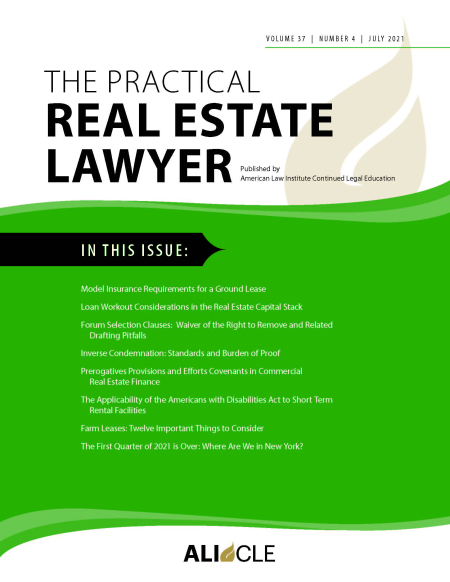
Worth reading: an article in ALI-CLE’s Practical Real Estate Lawyer, authored by our friends and colleagues Steve Clarke, Justin Hodge, Jeremy P. Hopkins, and Christian Torgrimson, “Inverse Condemnation: Standards and Burden of Proof.”

A subscription to PREL costs, but for this issue the good people at ALI have made it available for free. Lucky you. But you really should get a subscription — PREL publishes useful articles like this frequently.

And since we’re on the subject of ALI-CLE, we can’t resist reminding you that registration for the 2022 ALI-CLE Eminent Domain & Land Valuation Litigation Conference is underway (including reservations for the limited room block at the Scottsdale Resort). Please register and make your plans to join your colleagues (including the authors of the article!) in January in Scottsdale.Continue Reading New Article: “Inverse Condemnation: Standards and Burden of Proof” (ALI-CLE Practical Real Estate Lawyer)

We don’t read the New York Times all that much these days, but we couldn’t resist commenting on the recent op-ed authored by a former federal government lawyer that takes issue with recent decisions by the U.S. Supreme Court, “The Supreme Court Has Gone Off the Rails” (Oct. 4, 2021).

On one hand, the op-ed might not be anything new because the NYT doesn’t try hard to hide where it stands on the Supreme Court (see here and here, for example), and yet another opinion piece questioning the Court’s legitimacy might be just piling on. But this one is authored by a fellow who was “was a U.S. attorney and principal deputy solicitor general in the Reagan administration and deputy attorney general in the George H.W. Bush administration” as well as a law clerk for William Rehnquist. Which means, we suppose, that he’s not yet another

Continue Reading The Buried Takings Lede In NYT Op-Ed That SCOTUS “Has Gone Off the Rails”

As we’ve said before, you don’t need to know much about takings doctrine to understand that a challenge wherein the property alleged to have been taken are “bump stocks” — devices that allow rapid activation of a semi-automatic rifle such that it roughly imitates a fully-automatic weapon — to understand that courts may be inherently reluctant to limit the government’s authority to regulate their use and ownership even to the point of outlawing it. There’s a long judicial history of courts not getting in the way when it comes to the other branches’ response to the problem du jour. The judicial reluctance many not be rational, it may not be doctrinally consistent. But, in our view, it just is, and that’s something that owners of such property and those of us who seek doctrinal clarity have to take into account.  

Here’s the latest in a

Continue Reading Fed Cir Tries To Avoid “Police Power” Takings Exception In Bump Stock Case By (Unsuccessfully) Finessing The Property Interest

PXL_20211001_131054682Joe Waldo leading off the Conference with a remembrance of
Toby Prince Brigham, for the eminent property rights practitioner
for whom the Conference is named.

I was honored to speak today at the 2021 Brigham-Kanner Property Rights Conference, and here’s a rough transcript of my remarks.

Seeking Justice Through Just Compensation

Dean Spencer, Professor Been, Professor Butler, and colleagues.

The title of our session is “The Relationship between Eminent Domain and Social and Racial Injustice,” and my colleagues have ably covered the ways in which limitations on the power to take can move us towards justice. And there is little I might add to their contributions, except to note this, a quote from a commentator in a recent story about historical “slum clearance” in the Tampa, Florida, area:

“If you want to know where historic Black neighborhoods were once located, look for a sports arena or

Continue Reading Seeking Justice Through Just Compensation: 2021 Brigham-Kanner Property Rights Conference

IS WM

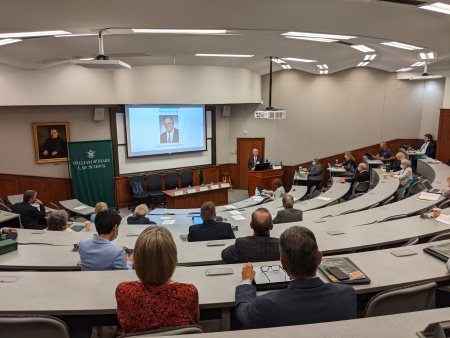
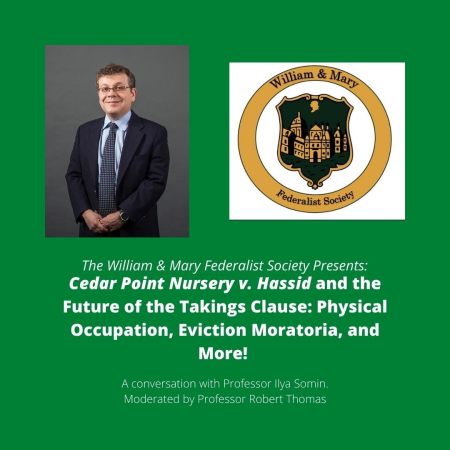
Next Tuesday, September 28, starting at 12:50pm ET, we’ll be moderating a talk sponsored by the William and Mary Law School chapter of the Federalist Society.

Professor Ilya Somin, a nationally-recognized expert in eminent domain, takings, and related topics, is zooming in to speak about “Cedar Point Nursery v. Hassid and the Future of the Takings Clause: Physical Occupation, Eviction Moratoria, and More.”

And guess what? You can Zoom in too. It’s open to the public, and it’s free.

So mark your calendars and join us for Prof Somin’s thoughts on the cutting-edge issues in property rights. Here’s the Zoom link: https://us02web.zoom.us/j/89365248145. See you on Tuesday!Continue Reading Join Us (For Free!): Lawprof Ilya Somin On “Cedar Point Nursery v. Hassid and the Future of the Takings Clause: Physical Occupation, Eviction Moratoria, and More” (Tues. Sep. 28, 2021, 12:50pm ET)