January 2022

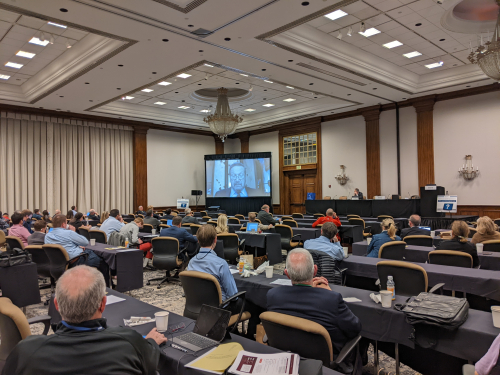
PXL_20220129_162455836.MP

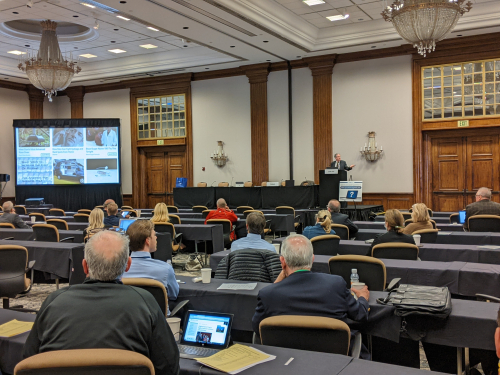
PXL_20220129_170753652

As usual, Michael Berger and Jim Burling kept the room filled on a Saturday morning, and informed and entertained.

After their presentations, and the National Forum at which practitioners from around the country briefed us all about the issues in their respective jurisdictions, we wrapped up the 39th ALI-CLE Eminent Domain & Land Valuation Litigation Conference.

We’ll have a more in-depth after-action report on the Conference next week for those of you who could not attend in-person (we had a very successful meeting, but nonetheless missed you), but for now, we ask this: reserve the time on your 2023 calendars now. The date? The usual dates in late January or early February 2023, between the playoffs and Super Bowl. 

ALI-CLE is in the final stages of securing a venue, and when it becomes official we’ll announce it here and elsewhere.

Stay tuned.Continue Reading That’s A Wrap For The 39th ALI-CLE Eminent Domain & Land Valuation Litigation Conference. See You At The 40th In 2023 In 2023 In …

Screenshot 2022-01-24 at 11-03-28 “Equitable Compensation” as “Just Compensation” for Takings

An article, from the just-published issue of the Brigham-Kanner Property Rights Journal, about a rarely-covered academic topic, just compensation.

Brian A. Lee (Brooklyn), “Equitable Compensation” as “Just Compensation” for Takings, 10 Brigham-Kanner Prop. Rts. J. 315 (2021).

Here’s the Abstract:

The Fifth Amendment’s requirement that the government pay “just compensation” to owners of taken property is typically assumed to mean “full” compensation, equivalent to the taken property’s fair market value. In this symposium contribution to the Brigham-Kanner Property Rights Journal, I explore an often overlooked alternative understanding of “just compensation” for takings, one freed from automatic equation with full, fair-market-value compensation. Rooted in traditional equity, this “equitable compensation” alternative has significant historical roots, starting with the Fifth Amendment’s drafters’ striking choice not to follow the Northwest Ordinance of 1787’s requirement of “full” compensation, and running through a line of cases and commentary that has emphasized takings compensation’s equitable

Continue Reading New Article: “‘Equitable Compensation’ as ‘Just Compensation’ for Takings” (Brigham-Kanner Property Rights Journal)

A quick one from the Federal Circuit, in a rails-to-trails takings case.

The holding of the court in Anderson v. United States, No. 21-1445 (Jan. 20, 2022) (when a deed says it conveys “land,” under [Texas law, that is a grant of fee simple), isn’t all that groundbreaking. But the opinion contains a concise summary of rails-to-trails takings cases, and for that alone is worth a couple minutes of your time. See slip op. at 2-3.

The first step in a takings case, of course, is to identify the private property allegedly being taken. If the original right-of-way conveyance to the railroad by the plaintiffs’ predecessor was limited (such as an easement), and the plaintiffs possess the “reversionary” right when the right-of-way ceases to be used for a railroad purpose, then pow!, the designation of the property as a recreational trail is a taking of that interest. If

Continue Reading CAFED: There’s Right Way And A Wrong Way To Convey A Right Of Way (Under Texas Law)

A short one from the Oklahoma Supreme Court.

In Rocket Properties, LLC v. LaFortune, No. 120000 (Jan. 18, 2022), the court issued an order that, in effect, reverses the trial court’s dismissal of an inverse condemnation case (we say “in effect” because the Supreme Court was considering a writ of prohibition, not an appeal). The trial court concluded that the inverse claim was governed by the procedural requirements of the Oklahoma Governmental Tort Claims Act.

The Oklahoma Supreme Court has long held that “[c]ondemnation proceedings do not involve a tort.” Oklahoma City v. Wells, 91 P.2d 1077 (Okla. 1939). But recently, the legislature amended the statute to change the definition of “tort” to include a legal wrong or violation of a “duty imposed by general law, statute, the Constitution of the State of Oklahoma …[,]” to specify that the tort claims statute governs “tort suits alleging constitutional rights.”

Continue Reading Inverse Condemnation Isn’t Tort, OK

If you ever get the opportunity to teach in a law school — either as a full-time legal scholar, or part-time as an expert adjunct practitioner — take it if you can. You might think you know a lot about a particular subject, but there’s nothing like spending time at the lectern in a law classroom in front of sharp and eager lawyers-in-training to sharpen your thoughts, and get you to truly understand a subject.

And folks calling you “professor” can evoke a smile.

Sensei

But if there’s one downside to the law school experience from the teacher’s side of the lectern, it’s grading. Especially at a law school like William and Mary that has a pretty strict mandatory curve. In upper-division courses that we handle like Eminent Domain and Property Rights Law and Land Use — where we’re dealing with some very high-level stuff and the quality of the

Continue Reading The Circle Is Now Complete: A Sampling Of Final Paper Topics From William and Mary Law’s Eminent Domain & Property Rights, And Land Use Courses

Screenshot 2022-01-16 at 10-15-33 Alexander Hamilton letter at center of legal fight returned
we tried to come up with a “Hamilton” reference
but
have not seen the show

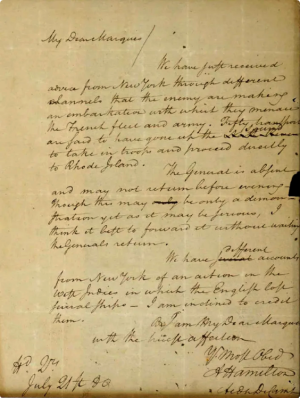
The Crane family has, for decades, had in their possession — if not their outright ownership — the “Hamilton Letter,” which Alex wrote to no less than the Marquis de Lafayette 1780.

Ownership, however, seems to be disputed, and Massachusetts claims that as a “public record,” it owned and once possessed the letter, which it alleges was five-finger discounted by a “kelptomaniac cataloger” at the Commonwealth’s Archives back in the 1940s. The Cranes argue they purchased the letter “from a reputable antiques dealer in Syracuse,” are bona-fide purchasers for value, and that the letter has been with the family ever since. 

Until the day, that is, that the feds, pursuant to a seizure warrant issued by a Virginia federal court, grabbed it. The Cranes had put the letter up for sale at a

Continue Reading New Like A Boss Cert Petition: Govt Took The Hamilton Letter It Claims Was Stolen

A developer alleged that the city didn’t live up to its contractual obligations.

The city thought it would be a good place for a new headquarters for something called “Perfect Game Incorporated.” The usual plans ensued, including agreements between the city, a non-profit redevelopment facilitator, and Preston Hollow, a “finance company that funds economic development projects for municipal governments and development corporations.” These agreements dealt with loans by Preston to the city and the facilitator; the loans were used by the facilitator to purchase two parcels in the city for the project, with some of the money remaining in escrow subject to disbursement when certain things happened.

That’s when things allegedly went awry. As the Fifth Circuit put it, “trouble ensued.” Preston claimed that the facilitator insisted on disbursement, even tough it has not yet complied with the conditions. Preston sent a notice of default, and requested that the escrow

Continue Reading When City Busts A Redevelopment Deal, It Might Face The Wheel (But Not For A Taking)

It’s already settled in Michigan (Rafaeli) that a homeowner has a property interest in the equity in her home, and that if she fails to pay the full amount of her property taxes and the government forecloses, the government can’t keep the proceeds in excess of the amount of the tax delinquency.

But that case didn’t account for those tax foreclosures already underway when the Michigan Supreme Court issued its decision in July 2020. Nor did the case account (obviously) for the subsequent legislative amendments providing a limited procedure by which the former homeowner may claim the excess proceeds.

Thus, we get Proctor v. Saginaw County Bd. of Comm’rs, No. 349557 (Jan. 6, 2022), which involves plaintiffs who

Skip over the court’s discussion of the immunity argument (unless that interests you, of course), and go to page 9 where it gets to our stuff: the takings and

Continue Reading Michigan: Legislature Can’t Abrogate Long-Existing Property Rights Without Compensation

A short trial court decision. But because it deals with an interesting question, we’re posting it.

Check it out: in this order, the U.S. District Court for the District of Minnesota denied the city’s motion to dismiss in a case alleging, inter alia, a Fifth Amendment taking.

The property owners’ complaint alleged that their property, located in Tonka Bay, Minnesota, was taken by the neighboring city of Shorewood. The back of the property, you see buts up against the Shorewood border, and the owners have an unpaved driveway to access Timber Lane. The owners have used the driveway for a dozen years. 

But Shorewood neighbors “took issue with the [plaintiffs’] use of the unpaved driveway.” Slip op. at 3. (Thank goodness for neighbors, what would we do without them?). They asked Shorewood to install a barrier along the city boundary to prevent drivers from using Timber

Continue Reading A Tale Of Two Cities: A City’s Road Barriers Might Be A Taking, Even Though The Property Taken Is In A Neighboring City

Minebook

We’ve talked about the “playground constitution” before (and written about it). You know this stuff:

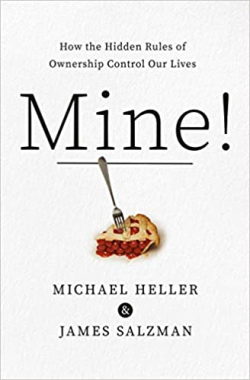
The third constitution is what has been labeled the “popular constitution” that exists, unwritten, in the broader culture. I call this the “playground constitution,” embodying rules that a broad swath of the populace believes are part of the legal canon, and which often contain a grain of accuracy but do not capture the nuance of the actual legal rules. For example, “finders keepers, losers weepers,” and possession being “nine-tenths of the law.”

You snooze, you lose. Whomever smelt it, dealt it. Come on, you have surely experienced it. Even you law mavens have, right? There’s all sorts of levels of this stuff, from clients who just “know” that the law says something (when in reality it doesn’t – they can’t take my property!), or judges who assume that a land

Continue Reading What We’re Reading: “Mine! How the Hidden Rules of Ownership Control Our Lives”