


September 2022

Screenshot 2022-09-11 at 21-59-15 Northwestern University Law Review Vol 117 Iss 1

Be sure to check out Northwestern Law Review’s symposium issue on “Reimagining Property Rights in the Era of Inequality.” which brought together “scholars of legal history, property, tax, land use, fair housing, environmental law, natural resources and water rights, family law, education, and constitutional law, to highlight new scholarship at the intersection of these fields.”

We found the essay by Professor Fennell (“Streamlining Property,” and the essay by Timothy Mulvaney (“Compulsory Terms in Property“) to be of particular interest. Full list of essays above, or here.Continue Reading New Symposium: Northwestern L. Rev.’s Property Issue
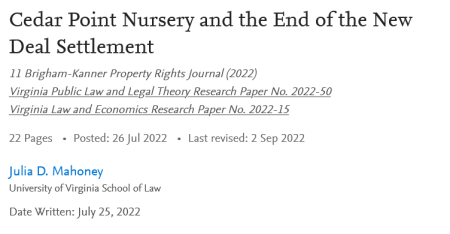
Screenshot 2022-09-08 at 11-03-58 Cedar Point Nursery and the End of the New Deal Settlement

Here’s your must-read for today, a new article from U. Va. lawprof Julia D. Mahoney, “Cedar Point Nursery and the End of the New Deal Settlement.”

Disclosure: we show up in footnote * along with others for offering “comments and conversations” about the piece. 

Here’s the Abstract:

In Cedar Point Nursery v. Hassid, the United States Supreme Court ruled that a California state regulation granting labor organizations a limited “right to take access” to agricultural employers’ property constitutes a per se physical taking. Cedar Point has sparked intense criticism, with critics arguing that the decision threatens to transform the law of property rights so as to “hobble” government land use regulation and even undermine democracy. This Article explains why the objections of Cedar Point’s detractors are misplaced. Far from disabling government regulation or fomenting stasis by favoring the “already haves,” Cedar Point is best understood as another

Continue Reading New Must-Read Article: “Cedar Point Nursery and the End of the New Deal Settlement” – Property Rights Are Civil And Human Rights

Be sure to check out Anthony Alderman (MRICS, SR/WA, CRE, Senior Managing Director at Cushman & Wakefield), who guests on Episode 98 of Clint Schumacher’s Eminent Domain Podcast, “Eminent Domain in Pop Culture.”

You know we are going to really appreciate an episode “about depictions of eminent domain in popular culture – often a juror’s only prior exposure to condemnation law.” Whether it’s the vibe of contitution, or how eminent domain can show up in novels, Netflix, Russian and Australian movies, memes (and meme briefs), or nerding out on Star Trek metaphors. We love this topic.

But it’s not all distractions, because the episode also covers “what makes appraising for eminent domain acquisitions different from other appraisal projects as well as current issues of interest in the appraisal field.”

What a fun episode. Don’t miss it. Continue Reading It’s The Vibe! – Eminent Domain In Pop Culture

Here’s the latest in a controversy we’ve been following.

In 624 Broadway LLC v. Gary Housing Authority, No. 22S-CT-140 (Aug. 29, 2022), the Indiana Supreme Court held that the Authority failed to provide the property owner adequate notice that it would be taking its property as part of a redevelopment project.

The Gary Housing Authority wanted to redevelop 624 Broadway’s commercial property in downtown Gary into mixed-use residential. The Authority instituted an “administrative taking” under Indiana law, which is “an alternative to the ‘traditional’ lawsuit route” that “occurs when an authorized governmental body condemns property and awards damages through resolutions.” Slip op. at 2.

The administrative taking statute only requires notice to the property owner by publication. And that’s exactly the notice the Authority gave 624 Broadway. “It twice published notice of the resolution and upcoming meeting in two area newspapers of general circulation.” Id. Broadway’s agent found

Continue Reading Indiana: Before Taking Property, Condemnor Must Provide Notice Reasonably Calculated To Put The Owner On Actual Notice