2022

Here’s your must-read for today, the latest journal article from Michael Berger, “Theft, Extortion, and the Constitution: Land Use Practice Needs an Ethical Infusion,” 38 Touro L. Rev. 755 (2022).

Here’s the Abstract:

There are many ways in which property owners/developers interact with regulators. To the extent that texts and articles deal with the ethical duties of the regulators, they tend to focus on things like conflicts of interest. But there is more. This article will examine numerous other ways in which regulators may run afoul of ethical practice in dealing with those whom they regulate.

And if that isn’t enough to grab you, there’s this:

There may be more to the issue than how to act in narrow circumstances. For one thing, there is the idea that government and the governed need to deal with each other on a level playing field. As one court put
Continue Reading New Article: “Theft, Extortion, and the Constitution: Land Use Practice Needs an Ethical Infusion” (Michael Berger)

The Supreme Court of Montana’s opinion in Tai Tam, LLC v. Missoula County, No. DA21-0660 (Nov. 15, 2022) starts off like a somewhat typical land use dispute turned into a constitutional fight. The property owner sought subdivision approvals for a 28-acre parcel to allow residential development, and the County denied the applications because “the proposal failure to adequately mitigate the loss of agricultural soils.” Slip op. at 2.(Oh, and “bird habitat.” Slip op. at 3.)

Next, the complaint, alleging some of the usual claims: due process, equal protection, and takings, and a statutory claim under Montana law. The trial court dismissed all claims: the statutory claims for failure to get in before the 30-day limitations period, and the constitutional property claims based on the court’s conclusion that the plaintiff lacked a “property” interest.

We’ll let you read the part of the opinion in which the court reversed the dismissal

Continue Reading Montana: Owning The Land Is Enough To Plead A Property Interest: Property Means “Rights Inherent In Ownership,” Not Extent Of Govt Discretion

Due to our 808 roots, we’ve been fielding a lot of questions related to the ongoing eruption of Mauna Loa on the Big Island.

It’s big, it’s spectacular (see video above), and (for us) it’s law.

The questions (who owns “accreted” lava?, how does the NPS let the public out to see this?, what uses can be made of property covered by lava?) made us realize that we had addressed some of those issues in prior posts. So we’re reposting:

Hope you find useful these things that make Hawaii property law pretty interesting at times.Continue Reading Law Of The Lava – Who Owns New “Accreted” Land? (And Other Questions)

Syllabus

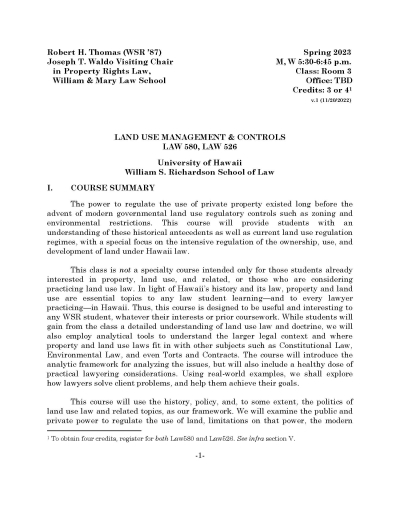
Starting in January, we’ll be teaching the venerated, and oh-so-important Land Use course (Law 580) at the University of Hawaii’s Law School.

We’re at least temporarily stepping into some mighty big slippers (this is Hawaii, so we don’t always wear shoes), as this is the course that our mentor Professor David Callies taught for decades. And is there a better venue in which to teach and study land use law and regulation, and its limits? After all, Hawaii may be the most heavily-regulated land on the planet, and is a focal point for every issue you can think of, from zoning to environmental restrictions to takings to public trust to subdivision to admin law to … well, you get the drift.

We’ll cover those topics, as well as the fundamentals. And we have a few surprises up our sleeve – some impressive guest lecturers, explorations of dirt law careers

Continue Reading Hawaii 5-80: Land Use Law At The University Of Hawaii

As we noted earlier this week, the Federal Quiet Title Act isn’t exactly on the public radar screens. Especially questions about whether the Act’s 12-year statute of limitations is “jurisdictional” or merely a claims processing rule.

Thus, you are not likely to see throngs of protesters on the Supreme Court steps today (Wednesday, Nov. 30, 2022 at 10:00 a.m). when the Court hears oral arguments in Wilkins v. United States, No. 21-1164.

Our law firm colleague Jeff McCoy is arguing, and you can watch him and the rest of our legal team explain what’s at stake in the above video. Or you can tune in and listen live to the audio here.

To hear what others think this case is about, read on:


Continue Reading Today’s Dirt Law SCOTUS Arguments: Whether The Federal Quiet Title Act’s Statute Of Limitations Is Jurisdictional Is A Property Rights Question

Here’s the latest in a case we’ve been following.

In this cert petition, business owners on the losing end of a Co-19 shutdown order assert that the Sixth Circuit got it wrong when it concluded that the “overriding public purpose” of the shutdown orders should be given what amounts to dispositive weight under the “character of the government action” Penn Central factor.

The Sixth Circuit correctly (in our view) rejected the district court’s rationale that the takings claim could be rejected simply because “the state acts pursuant to its police powers to protect public health.” Slip op. at 15. But the Sixth Circuit didn’t stop there, and affirmed the dismissal because the “character” of responding to the Co-19 emergency was so overwhelming that it outweighed the other two factors (which the court had already concluded “weigh in favor of the Plaintiffs”).

As we explained in an article on

Continue Reading New Cert Petition: There Must Be A Real Emergency Before Commandeerings Are Exempt From Compensation

Here’s a short one you might have overlooked because it’s an unpublished memorandum opinion.

In Kagan v. City of Los Angeles, No. 21-55233 (Nov. 10, 2022), a Ninth Circuit panel summarily affirmed the dismissal of property owners’ challenge to a city ordinance prohibiting eviction of “protected status” tenants from a duplex in order to regain the unit for family use. 

The takings claim was rejected for the now-familiar Yee rationale: there’s no physical invasion or a taking of the right to exclude, because the owner wasn’t forced to let the tenant on the premises in the first place. In other words, once you let someone in your property, you lose the right to exclude:

Here, as in Yee, the Owners “voluntarily rented their land,” and were not required to submit to physical occupation by another. Id. at 527. Moreover, the RSO allows at-fault evictions, such as evictions for creating

Continue Reading Ninth Circuit: Property Owners Don’t Have A Fundamental Right To Use And Occupy Their Own Property

Screenshot 2022-11-28 at 12-12-00 Wilkins v. United States Is the Quiet Title Act’s Statute of Limitations Jurisdictional and How Does the Answer Affect Property Rights

The Federal Quiet Title Act isn’t exactly on the public radar screens. Especially questions about whether the Act’s 12-year statute of limitations is “jurisdictional” or merely a claims processing rule.

Thus, you are not likely to see throngs of protesters on the Supreme Court steps this Wednesday, Nov. 30, 2022 at 10:00 a.m. when the Court hears oral arguments in Wilkins v. United States, No. 21-1164.

Our hands are somewhat tied here from making major comments, since our law firm represents the property owners. But thankfully, our friend and colleague Stephen Davis has written up a summary of the issues in the case, and more importantly, explains why the issues are important to property rights:

The federal government’s litigation strategy in Wilkins attempts to deny landowners their remedy under the Quiet Title Act. The Supreme Court should carefully consider the potential ramifications for private property rights in deciding whether

Continue Reading SCOTUS Argument Preview: Is The Federal Quiet Title Act’s Statute Of Limitations “Jurisdictional?”

CA

One from the U.S. Court of Appeals for the First Circuit.

In In re Financial Oversight & Management Board for Puerto Rico, No. 22-1048 (Nov. 22, 2022), the court affirmed the district court’s 12(b)(6) dismissal of a takings claim because the government didn’t actually force the plaintiff credit unions into buying what the complaint alleges are “worthless government-issued securities,” even where “the defendants knew – but did not disclose – that these would be losing investments given the precarious state and dire financial situation in which Puerto Rico found itself at the time.” Slip op. at 1.

Conned into purchasing junk bonds? That’s on you.

This is another Takings Clause claim arising out of the Puerto Rico governmental bankruptcy. [Disclosure: we represent some of the property owners/Respondents in that other matter, now at the cert stage in SCOTUS.] The complaint alleged that in a series of meetings over

Continue Reading Shame On You: Govt Exerting “Irresistible Pressure” On (But Not Forcing) You To Buy Worthless Bonds Isn’t A Taking

46508371_10155973930825208_4800191308415107072_o

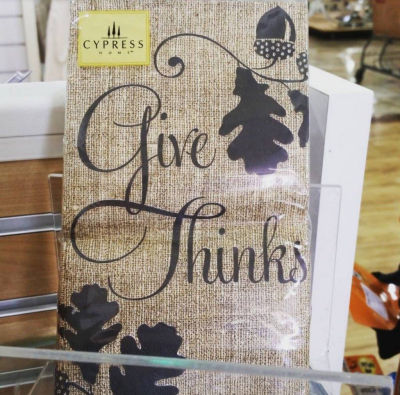
On this Thinks…uh Thanksgiving holiday, we’re grateful for all you property law and property rights mavens out there. Drive on, friends.

And no Thanksgiving gathering would be complete without the obligatory dramatic reading of John Stossel’s timeless holiday classic, “Private Property Rights Made the First Thanksgiving Possible.” We’re certain your relatives are eagerly awaiting your performance, including your interpretive dance. They’ll be very thinkful, we’re sure.Continue Reading We’re Thinkful For All You Dirt Law Lovers!