February 2023

20151208_064159

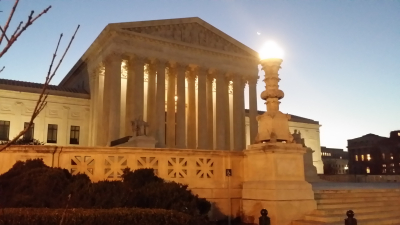
Here’s the merits brief, filed yesterday in the above-depicted Court by our law firm colleagues, headed by Counsel of Record Christina Martin in Tyler v. Hennepin County, No. 22-166, a case and an issue we’ve been following closely. This is the one, where, as recounted in the petition:

Hennepin County confiscated 93-year-old Geraldine Tyler’s former home as payment for approximately $15,000 in property taxes, penalties, interest, and costs. The County sold the home for $40,000, and, consistent with a Minnesota forfeiture statute, kept all proceeds, including the $25,000 that exceeded Tyler’s debt as a windfall for the public. In all states, municipalities may take real property and sell it to collect payment for property tax debts. Most states allow the government to keep only as much as it is owed; any surplus proceeds after collecting the debt belong to the former owner. But in Minnesota

Continue Reading Property Owner’s SCOTUS Merits Brief: “Under no circumstances can government have an unbounded ability to confiscate entire properties of any size for even the most minimal tax debts.”

IMG_20191203_083257
The Chief Justice Wants YOU to attend this webinar.

We try to remember anniversaries and birthdays. Some welcome, like the recent 100th of Pennsylvania Coal v. Mahon. Some maybe not so welcome, like this, the 200th anniversary of Johnson and Graham’s Lessee v. M’Intosh, 21 U.S. (7 Wheat.) 543 (Feb. 28, 1823).

That’s the decision in which the Supreme Court, in an opinion authored by Chief Justice John Marshall (noted above, giving us the finger), held:

Upon this principle the North American Indians could have acquired no proprietary interest in the vast tracts of territory which they wandered over; and their right to the lands on which they hunted, could not be considered as superior to that which is acquired to the sea by fishing in it. The use in the one case, as well as the other, is not exclusive. According to every theory of property, the

Continue Reading Happy (?) 200th Anniversary, M’Intosh

Would not have guessed that The Fenwicks, described as “America’s only Afro-Celtic Yiddish Ska band,” and compared to “Oingo Boingo on steroids” would have a song about eminent domain & property rights, “Preeminent Domain.”

But there it is. Check it out. Continue Reading The Fenwicks, “America’s only Afro-Centric Yiddish Ska Band,” With The Property Rights Anthem, “Preeminent Domain”

Screenshot 2023-02-23 at 11-13-54 Toward Principled Background Principles in Takings Law

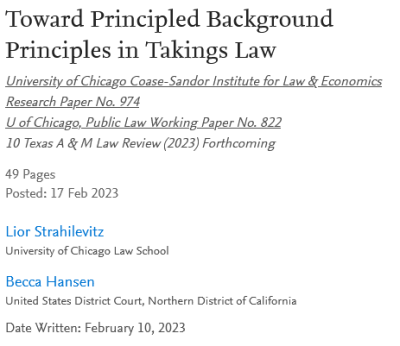
Check this out, a new article co-authored by a federal judge’s law clerk and lawprof Lior Strahilevitz (Chicago). With the title, “Toward Principled Background Principles in Takings Law” are we going to read it? You bet. (Unlike a lot of new scholarship that we post here, we read this one immediately.)

Here’s the Abstract:

Blunders made by lawyers, judges, and scholars have caused the Supreme Court’s recent opinion in Cedar Point Nursery v. Hassid to be deeply misunderstood. In Cedar Point, the Court re-wrote takings law by treating temporary and part-time entries onto private property as per se takings. Prior to Cedar Point these sorts of government-authorized physical entries would have been evaluated under a balancing framework that almost invariably enabled the government to prevail. As it happens, there were two well-established rules of black letter law that California’s lawyers and amici mistakenly failed to invoke in defending

Continue Reading New Article: “Toward Principled Background Principles in Takings Law” (Strahilevitz & Hansen)

ThomasMitchell

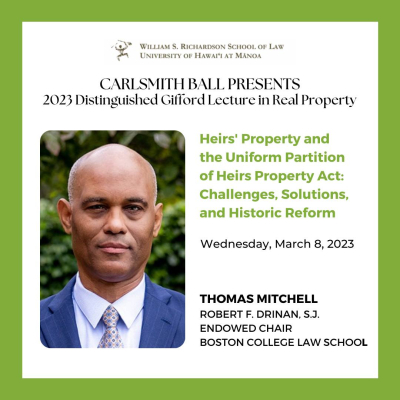
If you are in Honolulu, please join us on Wednesday, March 8, 2023, 4:30-5:30 p.m. at the University of Hawaii Law School for Professor Thomas Mitchell on “Heirs’ Property and the Uniform Partition of Heirs Property Act: Challenges, Solutions, and Historic Reform.”

Our U.H. Land Use class is attending to learn more about “heirs’ property” (described as “the biggest problem you’ve never heard of“), and so should you. Yes, Hawaii has adopted the Uniform Partition of Heirs’ Property Act and we have followed this issue for some time, but if you didn’t know about this, now is your chance to catch up.

Here are the details from the U.H. newsletter:

Carlsmith Ball presents the 2023 Distinguished Gifford Lecturer in Real Property, Thomas W. Mitchell. Mitchell is a professor at Boston College Law School, where he holds the Robert F. Drinan, S.J. Endowed Chair and serves as the Director of the Initiative on Land, Housing & Property Rights. He is a national expert on property issues facing disadvantaged families and communities and has published leading scholarly works addressing these matters.

In 2020, Professor Mitchell was named one of 21 recipients of the MacArthur Fellowship in recognition of the substantial impact his professional work has had in assisting disadvantaged farmers and property owners, people who are disproportionately but not exclusively African American and other people of color. He is the only lawyer in his MacArthur Fellowship class. Please join us for this Distinguished Gifford Lecture; a light reception is to follow from 5:30 – 6:30 p.m.

Come, join us for this compelling session.
Continue Reading Join Us On Wed March 8 at 4:30pm For 2023 Distinguished Gifford Lecture In Real Property – Prof Thomas Mitchell On “Heirs’ Property & the Uniform Partition of Heirs’ Property Act: Challenges, Solutions, & Historic Reform”

As part of the nationwide reaction to Kelo v. New London, Indiana adopted a statute that in some cases requires the condemnor to compensate property owners at not just fair market value, but at 150% of FMV.

As far as we can tell, the Indiana Court of Appeals’ opinion in Guzzo v. Town of St. John, No. 21A-PL-2213 (Jan. 19, 2023) is the first appellate case applying that statute, or any similar law. Read on.

The statute at issue, Ind. Code § 32-24-4.5-8, sets compensation for the taking of “residential property” at 1.5x the fair market value:

Sec. 8. (a) Notwithstanding IC 32-24-1, a condemnor that acquires a parcel of real property through the exercise of eminent domain under this chapter shall compensate the owner of the parcel as follows:

….

(2) Subject to subsection (b), for residential property:

(A) payment to the owner equal to one hundred fifty

Continue Reading Indiana App: This House Is “Residential Property” Qualifying It For The Statutory 150% FMV Enhancement

IRWA header

The International Right of Way Association‘s Real Estate Law Committee produces twice-a-year reports “which contain summaries of eminent domain decisions and legislation within the United States.”

And what is really nice is that they make the report available.

Here’s the latest.

We’re posting it here because we’re one of the co-authors. Hat tip to our co-authors Brad Kuhn, Jillian Friess Leivas, and Ajay Gajaria.

The report is short, and doesn’t contain a lot of fluff. Just what you wanted.Continue Reading IRWA’s Summary Of Major Eminent Domain Cases & Legislation (June-Dec 2022)

Screenshot 2023-02-21 at 09-24-48 Search - Supreme Court of the United States

Most of the time these days, we’re rooting for cert granted. That comes, naturally, from our work pushing cases and issues up to the Supreme Court, looking to correct lower court errors and in the process make some good law. And that usually entails being on the “petitioner” side of things. Cases like Sackett, Wilkins, and Tyler, for example.

But not always. In Financial Oversight & Management Board for Puerto Rico v. Cooperative de Ahorro y Credito Abraham Rosa, No. 22-367, we were on the “respondent” side of things, advocating for a “cert denied” because there, the First Circuit had reached what we think was the right result for the right reasons. As we noted in this post, the First Circuit correctly held that the “Fifth Amendment precludes the impairment or discharge of prepetition claims for just compensation in Title III bankruptcy.”

In short, just

Continue Reading Cert Denied In Self-Executing Just Compensation Case

There’s not a lot new to report in the U.S. Court of Appeals for the Seventh Circuit’s opinion in Kreuziger v Milwaukee County, No. 22-2489 (Feb. 13, 2023). But there’s a bit of old that make it worth posting.

The issue the court considered was whether riparian property owners have any protectable interest in the level of the water which their property abuts. After the County demolished a long-standing dam on the Milwaukee River resulting in a four-foot lowering of the water next to Kreuziger’s upriver property, he sued for a taking. Slip op. at 3 (“The lower surface level of the river exposed a ten-foot strip of marshy land between Kreuziger’s seawall and the water’s edge that had previously been submerged.”).

You probably already understand the general rule in these situations: riparian owners have no compensable property interest in any particular water level, as long as the waterway

Continue Reading CA7: Riparian Owner Has No Property Right In Water Level On Navigable River

Here’s the latest SCOTUS cert petition, filed by our law firm colleagues Dave Breemer and Deborah LaFetra. Because this is one of ours, we won’t be commenting, but leave it to you to digest it yourself.

Here’s the Question Presented:

Frank and Rachel Revere and David and Judith Kagan (Owners) own a duplex in Los Angeles, California, as tenants in common. The Reveres live in one unit. In 2019, the Reveres applied to the City to displace a month-to-month tenant in the other unit, so they could move in their own family members. The City denied the request, concluding the tenant was protected from eviction for a family move-in under Los Angeles’ Rent Stabilization Ordinance. The Owners sued, alleging the City’s decision forced them to suffer a physical taking of their property.

The question presented is:

Whether a law that bars termination of a tenancy, and compels the occupation

Continue Reading New Takings Cert Petition: Yee v. Escondido And Physical Occupations