May 2023

Screenshot 2023-05-08 at 22-48-29 Post Feed LinkedIn

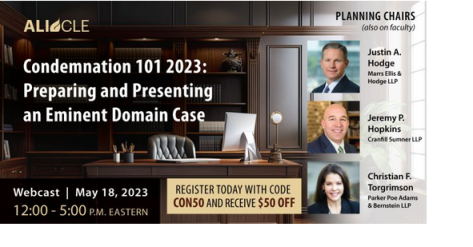
Missed out on the 2023 ALI-CLE Eminent Domain and Land Valuation Litigation Conference back in February in Austin, and the legendary “Condemnation 101” track?

Well, here’s your chance to get the knowledge. On May 18, 2023, ALI-CLE is going live with a rebroadcast of that program, including real-time Q & A with the program Planning Co-Chairs.

As we’ve noted before, the Condemnation 101 program is a great “basic training” program for lawyers new to the eminent domain and takings practice. But it is also a fantastic refresher course for those experienced dirt lawyers looking to brush up on the fundamentals.

CLE credits are available, of course. And unlike the in-person program back in February, there’s no danger of ice storm delays!

More about the program here, including registration information, fees, the agenda, and the faculty. And, just because you are a reader of this
Continue Reading Condemnation 101: Preparing & Presenting an Eminent Domain Case Webcast (May 18, 2023)

Sidewalk

A good opinion from the U.S. Court of Appeals for the Sixth Circuit in Knight v. Metro. Gov’t of Nashville, No. 21-6179 (May 10, 2023), holding that conditions imposed on every development — and not just ad hoc administratively-imposed conditions — must conform to the Nollan-Dolan-Koontz close nexus and rough proportionality standards.

You takings and land use mavens can stop right there, because you know what this means: the Sixth Circuit has added to the growing split in the lower courts about whether legislatively-imposed conditions on development which cover everyone are, as some courts characterize them, mere land use regulations subject only to Euclid‘s rational basis review, or are constrained by N-D-K ‘s requirements (see here, and here for examples). The Supreme Court has been presented with the lower court disagreement, but so far has not stepped in and resolved the issue.

The Sixth Circuit experienced

Continue Reading CA6: Legislative Conditions Are Subject To Nexus-And-Proportionality Requirements

Harding

Here’s a new cert petition, filed this week by Michael Berger that asks whether Knick‘s no-need-to-exhaust-or-chase-state-compensation rule applies retroactively.

The Second Circuit held that no, the owner’s claims were too late, and although Knick overruled the Williamson County rule that kept him from a timely filing in federal court, that’s just too bad:

We also agree with the district court that the remaining claims are largely time barred. Demarest filed this lawsuit in June 2021, yet much of the conduct targeted by his complaint dates from long before. Since a § 1983 claim adopts the limitations period for a state personal injury tort-which in Vermont is three years, see Morse v. Univ. of Vt., 973 F.2d 122, 125-27 (2d Cir. 1992)-claims accruing before June 2018, which comprise the majority of Demarest’s complaint, would be time barred. Although Demarest argues that his claims accrued only when a

Continue Reading New (Michael Berger) Cert Petition: Knick “Changed the world of takings litigation” And Applies Retroactively – And Statutes Of Limitations Are Affirmative Defenses

Here’s an article for your Monday reading, Bethany R. Berger, Property and the Right to Enter, 80 Wash. & Lee L. Rev. 71 (2023).

Here’s the abstract:

On June 23, 2021, the Supreme Court decided Cedar Point Nursery v. Hassid, holding that laws that authorize entry to land are takings without regard to duration, impact, or the public interest. The decision runs roughshod over precedent, but it does something more. It undermines the important place of rights to enter in preserving the virtues of property itself. This Article examines rights to enter as a matter of theory, tradition, and constitutional law, arguing that the law has always recognized their essential role. Throughout history, moreover, expansions of legal exclusion have often reflected unjust domination antithetical to property norms. The legal advocacy that led to Cedar Point continues this trend, both undermining protections for vulnerable immigrant workers in this case

Continue Reading New L Rev Article: “Property and the Right to Enter” (Bethany Berger)

1992 Aerial Photo Island2
Shands Key, with the City of Marathon in the background

This just in: in Shands v. City of Marathon, No. 3D21-1987 (May 3, 2023), Florida’s Third District Court of Appeals held that the city’s downzoning the property (Shands Key, shown above in an exhibit from the Key West trial we participated in in June 2021) from General Use (density: one home per acre) to Conservation Offshore Island (one home per 10 acres; Shands Key is just under 8 acres) effected a Lucas taking.

We’re not going to go into too much detail, because this case is one of ours. Our Pacific Legal Foundation colleague Jeremy Talcott was the lead trial and appellate counsel, backed by Kady Valois.

Shandstrialteam_after
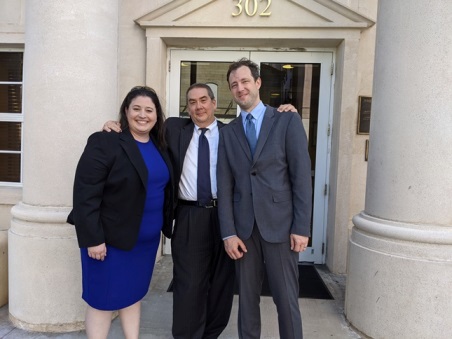
Trial (and appeal) team after closing arguments in Key West:
Valois, inversecondemnation.com, Talcott

But we’re not going to let you go without noting a few highlights from the Court of

Continue Reading This Just In – Florida Appeals Court: TDRs, Beekeeping, And Camping Are Not Economically-Beneficial Uses, So Downzoning Is A Lucas Taking

Check this out, a recently-published article in the Virginia Law Review, Aziz Z. Huq, “Property against Legality: Takings after Cedar Point,” 109 Va. L. Rev. 233 (Apr. 10, 2023).

Here’s the abstract:

In the American constitutional tradition, a zealous judicial defense of property is closely aligned with the idea of “the rule of law.” Conventional wisdom holds that the Takings Clause of the Fifth Amendment vindicates both property rights and the rule of law by foreclosing arbitrary, lawless state action. But the standard story linking property rights, legality, and a constraint on arbitrary governance is more commonly stipulated than analyzed. This Article uses an apparent sharp break in takings jurisprudence, the United States Supreme Court’s June 2021 decision in Cedar Point Nursery v. Hassid, to closely scrutinize the relationship between legality and property rights. To that end, it offers first a careful analysis of the sharp rupture

Continue Reading New L Rev Article: “Property against Legality: Takings after Cedar Point (Huq)

Keepoutyourownproperty

Here’s the cert petition in a case we’ve been following

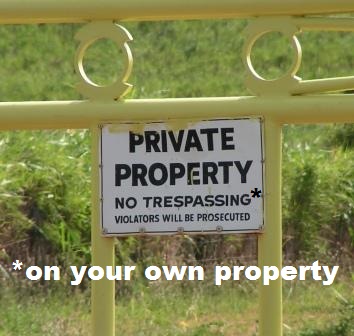
This is the one where a North Carolina county went bonkers in the early days of Co-19, and truly “locked down” by banning nonresident property owners from entering the county. This wasn’t done all at once, but in phases, with nonresident property owners being informed that if they didn’t get to their Dare County homes by March 20, they were going to be prohibited from even entering the county. As the Fourth Circuit put it, “In effect, Dare County told non-resident property owners:’“If you want to quarantine at your beach house, get there by March 20.’ This gave non-resident property owners four days to travel to the county.”

Blackburn was stopped from accessing his property for 45 days.

The Fourth Circuit upheld the district court’s rejection of his takings claim, concluding that this was not a physical invasion

Continue Reading New Cert Petition: Is Barring You From Accessing Your Own Property A Categorical Taking?

Bohon

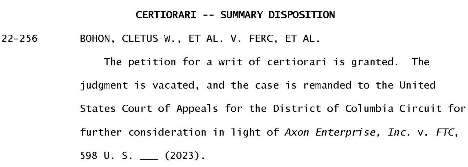
In this Order, the Supreme Court granted this cert petition which presents these questions:

Whether a facial challenge to Congress’s delegation of eminent domain power to private parties is properly filed in district court, as this Court held in PennEast Pipeline Co. v. New Jersey, 141 S. Ct. 2244 (2021), or with FERC, which has admitted it has no jurisdiction to adjudicate the constitutionality of this delegation.

Whether a facial challenge to Congress’s overly broad delegation of legislative power to FERC is properly filed in district court or with FERC, which has admitted it has no jurisdiction to adjudicate the constitutionality of this delegation.

Whether a facial challenge to Congress’s delegation of eminent domain power to FERC is properly filed in district court or with FERC, which has admitted it has no jurisdiction to adjudicate the constitutionality of this delegation.

As the Order notes:

Petition GRANTED. Judgment VACATED

Continue Reading SCOTUS GVR’s Pipeline Cert Petition On Delegation Of Eminent Domain To Private Parties

We’re not going to dwell too much on the U.S. Court of Appeals’ opinion in Fox v. Saginaw County, No. 22-1265 (Apr. 28, 2023), because even though it is a case involving the “home equity theft” takings issue argued at the Supreme Court last week, this one tells us more about civil procedure than takings. 

The Fox case is a class action, and several of the defendant counties may engage in the practice of seizing property and liquidating it to satisfy a tax debt (and then keep any excess), but they didn’t do it to the lead plaintiff Mr. Fox.

The district court held that the class action could proceed, but the Sixth Circuit said no: Fox may have standing to assert the one county that kept his equity has taken his property, but has no standing to assert claims against the other governmental defendants because those defendants

Continue Reading No Class: CA6 Rejects Class Certification For Home Equity Theft Takings Case

Screenshot 2023-04-30 at 11-07-31 Natural Property Rights

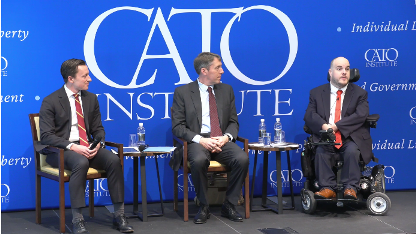
In case you missed it live last week, here’s the recording of Cato Institute’s Book Forum on lawprof Eric Claeys’ forthcoming book, “Natural Property Rights.” As Cato notes:

The book introduces and defends a theory of property relying on labor, natural rights, and traditional principles of natural law. Justified on those grounds, property rights protect individual freedom, but they also help government officials resolve the basic resource conflicts that arise in property law. Natural Property Rights illustrates this with examples from real estate, oil and gas, tangible personal property, water rights, government regulatory and taking powers (and constitutional limits on those).

With Professor Clayes (George Mason Law School), Matthew Cavedon (Visiting Legal Fellow, Cato Institute, and Robert Pool Fellow, Center for the Study of Law and Religion, Emory University), Chad Squitieri (Assistant Professor of Law, Catholic University), and Clark Neily (Sr. Vice President for Legal Studies, Cato Institute).Continue Reading Watch: Cato Institute Book Forum – “Natural Property Rights” (Eric Claeys)