


2023

Euclid_front

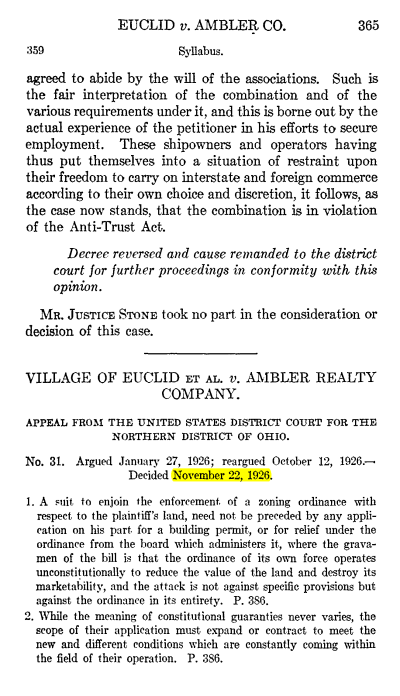
On this day in 1926, the United States Supreme Court issued its landmark opinion in Village of Euclid v. Ambler Realty Co., 272 U.S. 365 (Nov. 22, 1926).

You know this one (shame on you if you don’t!) – it is the case in which the Supreme Court first upheld — against a facial due process challenge — the validity of this thing we call “zoning.” While in the intervening century, zoning has become a catch-all term for regulatory restrictions on the uses of real property, land users know that “zoning” — ackshually — refers only to the regulation and separation of uses, and restrictions on density, and height regulation.

While “Euclid” and “Euclidean zoning” have become part of the land use lexicon and landscape, the decision might have been seen at the time as somewhat surprising. After all, the Supreme Court was in

Continue Reading (Un)Happy 97th Birthday, Euclid!

“No need to ask, he’s a smooth operator…”

Here’s the amicus brief we just filed in a case we’ve (obviously) been paying close attention to.

This is Devillier v. Texas, the case in which the Supreme Court is considering what does the it mean when it describes the Just Compensation Clause as “self-executing?” Do you need statutory authorization in order to bring a takings or just compensation claim, or can you sue directly under the Constitution? Does it matter that Congress has adopted a statute which authorizes damages suits against local governments (“persons”), but has not expressly done so against states qua states?

We say no and our brief explains why.

Note that there’s no Eleventh Amendment issue here, because Devillier filed his federal claims in a Texas court, and it was the State of Texas that removed it to federal court (thus forfeiting any 11A claim, because

Continue Reading “The courts don’t need Congress’s permission to enforce the self-executing constitutional right to just compensation.”

Check this out, our law firm colleague Joshua Thompson talks about regulatory takings, and his big Supreme Court victory in Cedar Point Nursery.

If you are reading this blog, you already know what that means. Regulatory takings. Bundle of sticks. Penn Central (bleh), and right to exclude. Here’s the description of the program:

In this thought-provoking episode, Bob Stetson and Joshua Thompson, Director of Equality and Opportunity Litigation at the Pacific Legal Foundation, discuss the landmark case of Cedar Point Nursery vs. Hassid and explore the intricate balance between private property rights and public interests. What constitutes a ‘taking’ and how far government regulations can go in the name of the public good?

Stream it above, or listen on Spotify here.

(Our own thoughts on the Cedar Point case here.)Continue Reading New Podcast: The Cedar Point Takings Case (From The Guy Who Argued Cedar Point)

Screenshot 2023-11-16 at 15-28-57 About SCOTUS Ladies

Although the Dissed! podcast is no more, our colleagues Elizabeth Slattery (PLF) and Anastasia Boden (Cato) have thankfully redirected their efforts to the written form, a new law blog (how retro!).

As the title (“SCOTUS Ladies“) hints, their blog focuses on the doings of a certain court in Washington, DC. Here’s how they describe the project:

The SCOTUS Ladies are Elizabeth Slattery and Anastasia Boden. You may know us from our legal commentary, social media exploits, public speaking, or our former podcast about Supreme Court dissents, Dissed.

We’re two liberty loving Supreme Court superfans with experience in the liberty legal movement, ranging from the Heritage Foundation to the Cato Institute—and a few places in between. We believe legal commentary doesn’t have to be dull on the one hand or polemical on the other. And it should never be dense. We started this website so any liberty-curious person

Continue Reading The Queen Is Dead, Long Live The Queen(s): Introducing The “SCOTUS Ladies” Blog

Here’s the merits brief in a case we’ve been following (naturally, because it is one of ours). This is Sheetz v. El Dorado County, the case which asks whether a condition on development (aka an “exaction”) is exempt from the close nexus and rough proportionality standards of Nollan/Dolan/Koontz simply because the exaction is imposed on every owner who asks for permission to use its property, and not via an ad hoc administrative permit procedure.

Because this is one of ours, we’re not going to go into in further, but leave to you to read our brief:

In this Court’s key exactions precedents—Nollan, Dolan, and Koontz—it held that when government exacts money or real property as a condition on the right to use or develop land, it must establish that the exaction bears an “essential nexus” and “rough proportionality” to an adverse public impact caused by the owner’s proposed

Continue Reading Legislative Exactions Merits Brief (Ours): “the text and history of the Takings Clause admit no exception for legislative takings”

Erasing the Black Spot from WHRO on Vimeo.

As we first noted here, Hampton University and WHRO recently produced a live program on “Erasing the Black Spot – How Virginia Universities Have Disrupted Black Neighborhoods.” We couldn’t make it in person, but watched the live-stream.

Now, as we hoped, the recorded program has been published. Stream it above, or watch here on Vimeo. Here’s the description:

Virginia’s public universities have a long history of expanding campuses in the name of progress and economic growth. But often, these expansions used eminent domain and property seizures to disrupt and diminish thriving Black communities across the state.

An investigative series by The Virginia Center for Investigative Journalism at WHRO and ProPublica uncovers the damaging social and economic impacts on Black communities of college expansions at Christopher Newport University, Old Dominion, and the flagship University of Virginia.

In the

Continue Reading Program Recording: “Erasing the Black Spot” – Virginia’s Use Of Eminent Domain To Take Minority Property

Here’s the latest in a case we’ve been following.

Not that long ago, the Ninth Circuit held that a challenge to Washington state’s Co-19 eviction moratorium was moot because the moratorium had ended, and the plaintiffs had only sought declaratory relief. Thus, the court concluded, the moratorium did not have a “brooding presence” affecting the plaintiffs.

The owners have now asked the Supreme Court to review the case, and in this cert petition have posed these Questions Presented:

1. Because the Takings Clause of the Fifth Amendment demands just compensation for governmental takings, including temporary ones, did the Ninth Circuit err in dismissing as moot a challenge to Washington State’s COVID-19 eviction moratoria by landowners who suffered great losses by bearing the social burden of providing public housing during the pandemic against their will because those moratoria had ended by the time the case reached the Ninth Circuit on

Continue Reading New Cert Petition: Is Preventing Owners From Recovering Rental Units From Nonpaying Tenants A Compensable Taking?

We don’t often post trial court orders — especially state trial court orders — but read on and you will understand why we made an exception here. Our thanks to an Oregon colleague for sending it our way.

Today’s case involves a pretty typical situation — a condemnor (or, “condemner” — for it is in Oregon that our scene lies) is contemplating taking property from someone, and wants and needs to figure out whether the property it is contemplating is suitable. It needs to get on site and check it out. Do things like surveys, examinations, tests, and sample-taking. Often, the owner of the property doesn’t mind: pay me a bit for my trouble, indemnify me in the event someone gets injured, and you can have limited access to do your business and then go on your way, condemner. 

But sometimes, an owner — as is her right — says

Continue Reading Some Precondemnation Entries Are Takings Requiring An Up-Front Condemnation And Compensation

Another must-listen episode of Clint’s Eminent Domain Podcast. He’s joined by Pepperdine Law School Professor Shelley Ross Saxer:

Professor Shelley Ross Saxer joins the show to discuss the role that the damaging clauses found in more than half of state constitutions across the United States play in inverse condemnation claims related to natural disasters such as the recent Hawaii wildfires.

Definitely worth a listen (as always with EDP). Stream above, or download here. Continue Reading Inverse Condemnation And Hawaii’s Wildfires: Lawprof Shelley Saxer Joins Clint Schumacher’s Eminent Domain Podcast

ALI-CLE brochure cover page

Here’s the brochure and the full agenda and registration information for the upcoming ALI-CLE Eminent Domain and Land Valuation Litigation Conference at the JW Marriott in New Orleans, February 1-3, 2024.

This is the long-running nationally-focused conference on all things eminent domain, takings, valuation, and related. We have three tracks, from which you can choose a la carte – Practice, Substantive, and Condemnation 101:

For over 40 years, we’ve been bringing eminent domain practitioners together to examine the latest issues, engage in healthy debate, and get the information they need to stay current in their practice. This year – our 41st – is THE perfect time to reunite with your eminent domain colleagues. There will be plentiful opportunities to meet and mingle with the faculty and other registrants – throughout the conference and at evening social events. Attendees come back year after year to make new friendships and renew

Continue Reading Here’s The Program For The 41st ALI-CLE Eminent Domain And Land Valuation Litigation Conference, Feb 1-3, 2024, New Orleans