2023

Here’s what we’re reading about the Supreme Court’s property rights docket — some good, some disappointing — this day.

  • Niina Farah, “Supreme Court flooding case could ripple across the energy sector (E & E News / Energywire) – About the Devillier case (which we summarized here), in which we were quoted: “The Supreme Court decision to hear the Devillier case comes after a concerted effort in recent years to convince the court to address procedural maneuvers that have made it challenging for property owners to bring their claims to court, said Robert Thomas, director of property rights litigation at the Pacific Legal Foundation. The nonprofit is among the groups that has asked the court to address takings cases and has lent its support for the property owners in Devillier in a ‘friend of the court‘ brief. ‘There’s a lot of gamesmanship going on
Continue Reading Supreme Court Property Rights Round-Up

Isnt_it

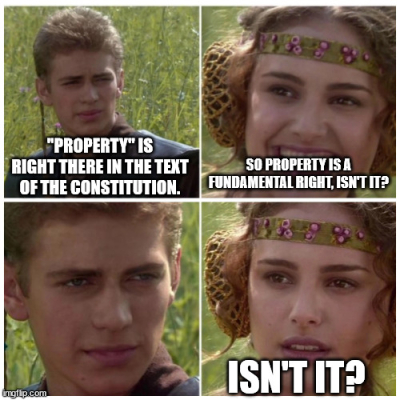
To us, one of the strangest things in constitutional law is the conclusion that although private property is a fundamental right for purposes of the Just Compensation Clause, it isn’t fundamental for purposes of the Due Process Clause. When your private property is taken you must be provided compensation. But when you are deprived of property, all you get is rational basis review. But both “property” and “private property” are right there in the text of the Constitution. How can courts conclude that a property right isn’t fundamental?

Doesn’t compute for you either?  The lower courts are indeed all over the place on this one. Check out cases like this one, and compare the reasoning to cases like this one.

Last week, our firm filed a cert petition asking the Supreme Court to take up the issue. The case involves property owners’ Due Process challenge to the City

Continue Reading New Takings Cert Petition: The Right To Exclude Is A Fundamental Right Isn’t It?

We’re not going to ask you to read the entire 24 pages of the Washington Supreme Court’s 5-4 opinion in Gonzales v. Inslee, No. 1000992-5 (Sep. 28, 2023), in which the court seriatim rejects every challenge to the Governor’s Co-19 emergency eviction moratorium for tenants, which allowed tenants who did not pay rent to remain in occupation for the up to 15 months the moratorium was in place.

Instead, we’re going to focus only on the takings challenge under the Washington Constitution. The plaintiffs asserted a physical takings claim, based on their right to exclude nonpaying tenants. Rejecting the argument (as several other courts have done), the Washington court concluded that the moratorium on evictions was merely regulation of the “voluntary relationship” between an owner and tenant.

Hang on, you say, what do you mean “voluntary relationship?” If I am an owner, yes, I voluntarily handed over the keys

Continue Reading PruneYard Revisited: Washington SCT Says No Physical Occupation Taking In State’s Eviction Ban – You Invited Tenants In, So Forcing Owners To House Them For Free Is Merely Regulating That Voluntary Relationship

092923zr_q8l1_Page_1
I’ll take ‘Words I Like to See’ for $800, Alex.

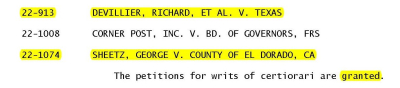
In this Order, the U.S. Supreme Court agreed to hear two important property rights cases (are there any other kind?). Both are cases we’ve been following — and indeed are now playing a part in.

The first is detailed in this post.

In the second, Sheetz v. El Dorado County, the Court is finally getting to the long-unresolved question of whether an exaction or permit condition is exempt from the usual requirements of “logical nexus” and “rough proportionality” simply because the condition is imposed uniformly by legislation, and not ad hoc via an administrative or other permit decision.

We commented on the Sheetz case in this post (“Whether $23K Traffic Fee Is Proportional To One Single-Family Home Is Beyond The Ken Of Judges“) and won’t repeat the facts or comments here.

But here’s

Continue Reading Cert Grant #2 – SCOTUS (Finally!) To Resolve Whether Legislative Exactions Are Subject To Nollan-Dolan-Koontz Nexus And Rough Proportionality

092923zr_q8l1_Page_1
I’ll take ‘Words I Like to See’ for $800, Alex.

In this Order, the U.S. Supreme Court agreed to hear two important property rights cases (are there any other kind?). Both are cases we’ve been following — and indeed are now playing a part in.

The first is Devillier v. Texas (the second is Sheetz v. El Dorado County which we’ve posted about here).

After what can only be described as a weird Fifth Circuit panel opinion, followed by an even more unusual post-cert petition en banc denial (complete with concurrals and dissentals), the Supreme Court granted the cert petition.

The Question Presented:

In First English Evangelical Lutheran Church v. County of Los Angeles, this Court recognized that the Fifth Amendment’s Takings Clause was “self-executing” and that “[s]tatutory recognition was not necessary” for claims for just compensation because they “are grounded in

Continue Reading Cert Granted #1 – You Don’t Need The Government’s Permission To Obtain Just Compensation, Do You?

Before you get too excited by the U.S. Court of Appeals for the Sixth Circuit’s opinion in Catholic Healthcare Int’l, Inc. v. Genoa Twp., No. 22-2139 (Sep. 11, 2023), a spoiler up front: this may be a good ripeness decision, but this isn’t a takings case.

But you takings mavens may still want to take a quick look over the opinion for how the court deals with a ripeness argument in a case where the plaintiffs assert the Township violated their rights by denying (twice) its requests for a land use special permit.

The story is about a walking path created by Catholic Healthcare that contains fourteen “Stations of the Cross” “depicting the “story of Christ’s last day.” Slip op. at 1. The Township insisted that Catholic Healthcare obtain a special use permit, because the Township believed that the trail use is the equivalent of a church.

So

Continue Reading CA6: “The distric court’s ripeness determination, in turn, was plainly mistaken”

Interested in the intriguing question of whether a court ruling can “take” property? If so, check out the latest cert petition on the issue.

Let’s start with the Questions Presented:

1. Is a state supreme court able to “side-step” the just compensation requirement of the Fifth and Fourteenth Amendments by simply removing preexisting property rights of owners to real property?

2. Is the North Carolina Supreme Court’s decision in holding that an established right of private property no longer exists a taking in violation of the Fifth and Fourteenth Amendments to the United States Constitution?

3. Is the North Carolina Supreme Court’s grant of title and ouster of property rights without payment of just compensation a violation of the due process clauses of the Fifth and Fourteenth Amendments to the United States Constitution?

You remember the last time that the Supreme Court ventured into this area, it wasn’t exactly a

Continue Reading New Cert Petition: “It is Time to Recognize the Judicial Takings Doctrine”

IRWA 6-2023 summary jpg

Thanks to our co-authors for the latest issue of this recurring update.

The International Right of Way Association’s Real Estate Law Committee produces twice-a-year reports “which contain summaries of eminent domain decisions and legislation within the United States.” (This is the “international” right of way association, so that last qualifier is important.)

And what is really nice is that they make the report available.

The laboring oars on this are really Brad Kuhn and Jullian Friess Leivas (both from the Nossaman firm), but they were kind enough to include us. Brad and Jillian wrote up more at the California Eminent Domain Report:

We recently had the pleasure of collaborating with Robert Thomas and Ajay Gajaria once again for the International Right of Way Association’s (IRWA) biannual report covering numerous eminent domain cases at local, state and federal levels from January through the end of June 2023. This


Continue Reading Just Published – IRWA’s “Summary of Major Eminent Domain Cases & Legislation: Jan 1, 2023 – June 30, 2023”

KS_aerial
According to the County, this is an “industrial” use,
incompatible with “agricultural” zoning

Note: sorry, this is one of those longer posts, but the topic is a serious one, so we felt it needed more than our usual cursory treatment.

How Can That Be?

We’ve been somewhat reluctant to post too much on the legal aspects of the Maui wildfires (other than to comment on the first lawsuit), just because it still seems “too soon.” The focus should be on aiding the victims and helping those who want to rebuild to do so, and not on premature blamestorming (see also this), legal theories, and  the “opportunities” this disaster presents (see also this, this.and this).

But we did want to clear one thing up. There are a lot of stories (see here, here, and here, for example), about the State of

Continue Reading Can One Government Official Really Hold Up Necessary Water Uses? The Hawaii Public Water Trust In Action

On the day we celebrate Constitution Day (or should we say Khaaaaan-stitution Day?) we have to admit that pretty much nothing beats One Named Kirk’s reading of the Preamble

KIRK: This was not written for chiefs!

Hear me! Hear this!

Among my people, we carry many such words as this from many lands, many worlds. Many are equally good and are as well respected, but wherever we have gone, no words have said this thing of importance in quite this way. Look at these three words written larger than the rest, with a special pride never written before or since.

Tall words proudly saying We the People. That which you call “Ee’d Plebnista” was not written for the chiefs or the kings or the warriors or the rich and powerful, but for all the people!

Down the centuries, you have slurred the meaning of the words: “We

Continue Reading This Was Not Written For Chiefs! Happy Constitution Day From One Named Kirk