January 2024

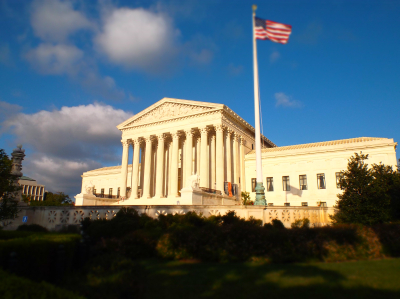
DSCF3357

If you were looking for deep clarity from the Justices about land use law and whether a legislature imposing monetary conditions on property development always gets the free judicial pass of rational basis review in this morning’s oral arguments in Sheetz v. County of El Dorado, you may not discover a lot of predictive insight when you listen to the argument recording or read the transcript.

But it is definitely worth your time to listen or read. Yes, there were some head-scratching moments as several of the Justices struggled with how to differentiate between monetary land use exactions that are subject to the nexus and rough proportionality standards, and other government requirements to pay money such as user fees, tolls, and property taxes that presumably are exempt. But there were also moments of clarity. Important moments.

In other words, there’s gold in them thar transcript hills if you

Continue Reading Today’s Arguments In Sheetz v. El Dorado County: “[R]adical [A]greement” On The Key Issue

Conf-2024-flyer
Bismarck in January is looking pretty good.

Here’s what we’re reading today:

  • Christian Britschgi, Court’s Wild Zoning Decision Blocks ‘Montana Miracle’, Reason (Jan. 2, 2024) (“In an eyebrow-raising decision, a Montana judge has halted the implementation of two laws legalizing duplexes and accessory dwelling units on residential land across the state, writing that they’d likely do ‘irreparable’ damage to residents of single-family neighborhoods.”).
  • Richard Frank, The U.S. Supreme Court & Environmental Law in 2024, LegalPlanet (Jan. 3, 2024) (“First up before the Court in 2024 is this “regulatory takings” case from California…. Over the past four decades, U.S. Supreme Court decisions have developed the so-called ‘unconstitutional conditions’ sub-doctrine of regulatory takings law, but to date have only applied it to individually-negotiated land use permit conditions and fees. California state courts–including in the Sheetz case–have consistently refused to extend the doctrine to broadly-applicable fees and conditions imposed on landowners


Continue Reading What We’re Reading Today, Property Rights Edition

What is a case about the U.S. Court of Appeals for the Fifth Circuit’s en banc opinion on the FDA’s approval procedures for e-cigarettes, Wages and White Lion Invs, L.L.C. v. Food & Drug Admin., No. 21-60766 (Jan. 3, 2023), doing here?

We consider it worthy of your time and post it here because of the way the majority addresses the FDA’s central argument: that even though the public took the FDA’s public instructions (including statements on its website) at face value, these procedures meant nothing. 

Government shouldn’t play such games, the court concluded. It can’t go back on what it holds out to the public, especially as a later litigation posture. See, e.g., slip op.at 20 (“In the MDO’s, however, FDA explicitly stated that its instructions were all for naught.”). Government “about-face[s]” are not appreciated. Slip op. at 28. We rightfully expect more from our

Continue Reading CA5: Government Should Not Send You On A Wild Goose Chase Though Its Own Procedures: “It was the regulatory equivalent of Romeo sending Mercutio on a wild goose chase—and then admitting there never was a goose while denying he even suggested the chase.”

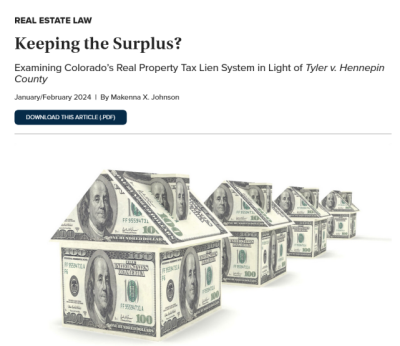
Screenshot 2024-01-04 at 09-57-31 Keeping the Surplus Colorado Lawyer

How thrilled are we that an alum of our William and Mary Law School courses, up-and-coming Colorado property lawyer Makenna X. Johnson, has published an article in the area of law we all love (dirt law)?

Let’s just say that we’re thrilled. Makenna writes:

Colorado’s real property tax system resembles Minnesota’s principally in that it provides no mechanism for a property owner to recover any surplus or equity in excess of the taxes and fees owed. Although in Colorado a surplus may be retained by either a private party or a municipality, the result is the same: the owner’s property interest in the surplus is forfeited. Applying the logic of Tyler, a court might deem unconstitutional any system that requires property owners to forfeit the surplus without allowing them an opportunity to request a refund.

Check it out in the Colorado Lawyer (Jan-Feb 2024): Keeping the Surplus?

Continue Reading New Article: “Keeping the Surplus? Examining Colorado’s Real Property Tax Lien System in Light of Tyler v. Hennepin County” (Makenna Johnson)

Sheetz

Get ready for Sheetz v. El Dorado County, No. 22-1074, the “legislative exactions” case at the Supreme Court. [Disclosure: this is one of our firm’s cases, so we won’t be doing an analysis here. Besides, you already know where we stand on the issue.]

With the final merits brief filed last week (Petitioner’s Reply), the case is now teed up for argument next week. Wow, that seemed to come at us very quickly.

Screenshot 2024-01-01 at 15-41-45 Search - Supreme Court of the United States

Here’s the Question Presented:

George Sheetz applied, to the County of El Dorado, California, for a permit to build a modest manufactured house on his property. Pursuant to legislation enacted by the County, and as the condition of obtaining the permit, Mr. Sheetz was required to pay a monetary exaction of $23,420 to help finance unrelated road improvements. The County demanded payment in spite of the fact that it made no individualized determination

Continue Reading Sheetz v. El Dorado County Argument Preview: Do Blanket Exactions Present The Same Risk As Ad Hoc Exactions?

As you may remember, from time to time we’ve visited the sites of well-known dirt law cases. Kaiser Aetna, Loretto, Mahon, PruneYard, Chicago Burlington, the High Line, Dolan, Nollan, Seneca Village, and Hadacheck are the ones that readily come to mind.

Yes, we have a lot of tech available that makes it pretty easy and inexpensive to “see” a location and get a sense of it without having to actually go there, but very often Google Maps or GIS just isn’t enough. As you property lawyers know, nothing helps in your understanding of a case or issues more than being on the ground at the site, feeling the earth beneath your feet, looking around at the environs, hearing the birds, smelling the air, taking a few of your own photos, talking to neighbors and others, just seeing what is nearby. There’s

Continue Reading Takings Pilgrimage: Boomer v. Atlantic Cement Today

HAWSCT

We’re not going to go into very much detail or provide commentary on the Hawaii Supreme Court’s unanimous 88-page opinion in an eminent domain case we’ve been following, City and County of Honolulu v. Victoria Ward, Ltd., No. SCAP-22-0000335 (Dec. 29, 2023), because before we departed private practice for public interest law a couple of years ago, this was our client and our case (so we still have a bias).

Update: more on the decision from Jesse Souki, “Hawai’i Court Holds that Consideration of Severance Damages in Honolulu Rail Case Should be Left to the Jury” (“The HSCT was critical of the circuit court’s granting of summary judgment motions where there were genuine issues of material fact that should be decided by the jury[.]”).

Short story: the Honolulu rail agency (we’re still calling it “HART” and not the weird “Skyline” although the latter is

Continue Reading Hawaii SCT: Most Of Those Eminent Domain Issues (Esp. Severance Damages) Are For Juries

Screenshot 2023-12-31 at 10-57-26 Walt Disney Animation Studios' Steamboat Willie - YouTube

As of today, the copyright protection for the “Steamboat Willie” version of Mickey Mouse has lapsed, meaning it is in the public domain.

What can and can’t you do with this, as of January 1, 2024? As Duke lawprof Jennifer Jenkins writes as “Mickey, Disney, and the Public Domain: a 95-year Love Triangle,” you have to be a bit careful:

Steamboat Willie and the characters it depicts – which include both Mickey and Minnie Mouse – will be in the public domain. As indicated in the green circle, this means that anyone can share, adapt, or remix that material. You can start your creative engines too—full steam ahead! You could take a page out of the Winnie-the-Pooh: the Deforested Edition playbook and create “Steamboat Willie: the Climate Change Edition,” in which Mickey’s boat is grounded in a dry riverbed. You could

Continue Reading Happy New Year: Say Goodbye To The Right To Exclude, Steamboat Willie