June 2024

Screenshot 2024-06-12 at 13-31-02 Property Rights and Regulatory Takings at the Supreme Court ALI CLE

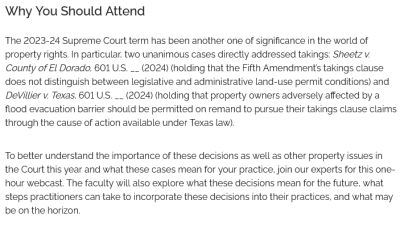
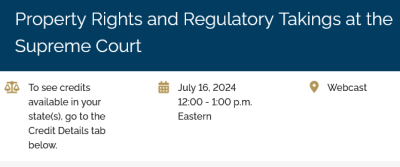
Mark your calendars and register now for the upcoming American Law Institute-CLE webinar “Property Rights and Regulatory Takings at the Supreme Court.” The focus of this program is a summary and analysis (including “what’s next?”) of the two big property and eminent domain cases decided by the U.S. Supreme Court, Sheetz (exactions), and Devillier (just compensation remedy).

We’ve brought together counsel for the property owners in the cases, as well as a legal scholar to provide an academic view of the cases and issues.

The faculty:

Screenshot 2024-06-12 at 13-31-26 Property Rights and Regulatory Takings at the Supreme Court ALI CLEDetails:

  • Date: July 16, 2024
  • Time: 12n – 1pm Eastern Time
  • Format: webinar, with audience questions
  • CLE credits: ALI-CLE programs are approved for CLE credits in most jurisdictions

Come Continue Reading Register Now! ALI-CLE Webinar “Property Rights and Regulatory Takings at the Supreme Court” (With Counsel For Sheetz & Devillier) – July 16, 2024

Screenshot 2024-06-12 at 16-43-41 California Courts - Appellate Court Case Information Screenshot 2024-06-12 at 16-43-31 California Courts - Appellate Court Case Information

Disclosure: this one is one of ours, so we’re not going to do a deep dive or do much commentary (must resist!).

Yesterday, the California Supreme Court granted a Los Osos property owner’s petition, and agreed to review an (unpublished) Court of Appeal opinion which held that the California Coastal Commission has the authority to appeal (to itself!) the County of San Luis Obispo’s decision to grant Shear a Coastal Development Permit to build a handful of homes in the coastal zone.

The County has adopted a Local Coastal Program ordinance regulating development in the coastal zone in the County. Under the California Coastal Act, a municipal government adopting a LCP delegates to the municipality to authority to make these type of land-use permitting decisions, with a very limited window for the Commission to inject itself. The point of the Coastal Act is to maintain

Continue Reading California SCT To Review Major Challenge To Coastal Commission’s Claimed Power To Overrule Local Govt’s Housing Approvals

Here’s the latest in a case we’ve been following.

Our friends at the Institute for Justice have filed this cert petition asking the Supreme Court to take up the case where a New York town eminent domained the Brinkmann property for a public park.

What’s wrong with that, you ask…isn’t a public park a “classic” public use? Yes. But the twist here is there was also a showing that what actually motivated the taking wasn’t some need for another public park in the town, but rather the public’s dislike of the use the Brinkmanns intended for their land.

These are what we call “spite takings,” where the main purpose behind a condemnation isn’t really to do something public with the land, but to stop a disfavored use. Are these ok under the Public Use requirement because — as the Second Circuit panel majority held — that who

Continue Reading New “Spite Taking” Cert Petition: Can Govt Take Property To Stop Owner From Making An Allowed – But Disfavored – Use?

This one is about Robert Moses. Yeah, that guy. You may think you know the story, but even if you do, it will be worth your time to listen to this episode of Dave and Kristen’s Infrastructure Junkies podcast. You will probably learn something new like me.

Here’s the pod’s description of the episode:

The best way to understand why we have our standard eminent domain laws and procedures may be to learn through a good story.

Houston attorney Bobby Debelak of the law firm McDowell Hetherington joins Infrastructure Junkies to tell the story of Robert Moses, who amassed incredible power despite never being elected to a public office. Morris utilized eminent domain to accomplish some of the most amazing infrastructure projects in New York. During his amazing reign, virtually all of the City, State and Federal infrastructure spending in New York flowed through Moses. Hear more about his

Continue Reading (Another) Must-Listen Podcast: Infrastructure Junkies’ “The Greatest Eminent Domain Story That You’ve Never Heard!”

Games people play
Night or day they’re just not matchin’
What they should do
Keeps me feelin’ blue
Been down too long
Right, wrong, I just can’t stop it

This one isn’t about takings, but is nonetheless a must-read.

In Health Freedom Defense Fund, Inc. v. Carvalho, No. 22-55908 (June 7, 2024), a panel of the U.S. Court of Appeals for the Ninth Circuit (yes, the Ninth Circuit!) held that the litigation was not moot even though the government had revised the challenged regulation. The Ninth Circuit also vacated and remanded the District Court’s dismissal of the challenge to the Los Angeles Unified School District’s requirement that its employees be vaccinated 

The sequence of facts is important. Check out the shell game shenanigans that LAUSD went through, after which it told the courts with a straight face that this was just routine and not it playing litigation games:

  • LAUSD


Continue Reading Games Government Play: Ninth Circuit Doesn’t Buy Attempt To Moot Constitutional Challenge To Co-19 Vaccination Policy By Sandbagging And Withdrawing

This is a must-listen, the latest episode of John Ross’s Bound by Oath podcast. This season is covering property rights, and this episode details Berman v. Parker, which may be the first case in what we’ll call the “modern era” where the Supreme Court set the judicial hands-off tone for public use challenges.

The guest this episode is our friend and colleague Amy Lavine, who wrote what we think is the seminal article deconstructing Berman (we include it as required reading in our William and Mary Eminent Domain course).

This episode is a great companion piece to BBO’s episodes on Euclid (zoning), and Pennsylvania Coal (reg takings).

On this episode: Berman v. Parker, the Supreme Court’s decision in 1954 to abandon previous constitutional limits on the government’s power to take property from Person A to give it to Person B. The decision greenlit the era of urban

Continue Reading New Bound by Oath Episode: Berman, Public Use, And Urban Renewal

Here’s the latest in a case we’ve been following.

Check out this cert petition which asks about what actions trigger the statute of limitations on a takings claim. This is an issue that seems to be cropping up more and more these days. For example, see here, here, here, here, and here.

Here are the Questions Presented:

Whether the statute of limitations for a Section 1983 takings claim for the unconstitutional deprivation of private property (specifically real estate) can begin to run before the municipal action that caused the property owner to sacrifice all economically beneficial uses has transpired?

And further, whether the Tenth Circuit Court of Appeals used the proper unit of property to measure if Mr. Bruce was forced to sacrifice all economically beneficial uses of his property?

And finally, whether the 14th Amendment’s due process provisions permit the mayor of a

Continue Reading New Cert Petition: When Does The Statute Of Limitations Start To Run On A Reg Takings Claim?

Here are three federal circuit opinions, all unpublished. None of them worthy of a stand-alone post, but also not to be overlooked entirely.

  • GHP Management Corp. v. City of Los Angeles, No. 23-55013 (9th Cir. May 31, 2024): Lessors “failed to state a claim for a Fifth Amendment per se physical taking[,]” in their challenge to LA’s eviction moratorium. You know why: you waived your right to exclude by renting your properties, so the government prohibiting you from getting breaching tenants out is merely a regulation of the landlord/tenant relationship. Yee.
  • Innova Investment Group, LLC v. Village of Key Biscayne, No. 21-11877 (11th Cir. May 29, 2024): After the Village tagged Innova with a NOV and $4k fine for not obtaining an interior demolition permit and Innova failed to correct the violations within the 60-day deadline, the Village imposed $4k per day fines and “aggregate penalties of


Continue Reading Unpublished Wednesday: Eviction Moratorium Taking, Excessive Fines Taking, And 1983 Zoning Statutes Of Limitations

GPElXhCWkAA3bWK

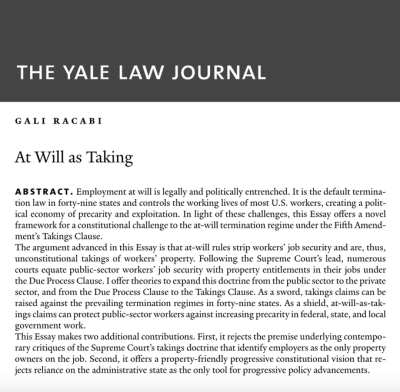
Here’s the abstract:

Employment at will is legally and politically entrenched. It is the default termination law in forty-nine states and controls the working lives of most U.S. workers, creating a political economy of precarity and exploitation. In light of these challenges, this Essay offers a novel framework for a constitutional challenge to the at-will termination regime under the Fifth Amendment’s Takings Clause.

The argument advanced in this Essay is that at-will rules strip workers’ job security and are, thus, unconstitutional takings of workers’ property. Following the Supreme Court’s lead, numerous courts equate public-sector workers’ job security with property entitlements in their jobs under the Due Process Clause. I offer theories to expand this doctrine from the public sector to the private sector, and from the Due Process Clause to the Takings Clause. As a sword, takings claims can be raised against the prevailing termination regimes in forty-nine states. As

Continue Reading New Article: “At Will [Employment] as Taking,” 133 Yale L.J. 2165 (2024)