September 2024

PXL_20240909_225028495.MP~4

The 21st Brigham-Kanner Property Rights Conference is underway at the William and Mary Law School. We have a series of student-oriented programs (co-sponsored by the Office of Careers Service),

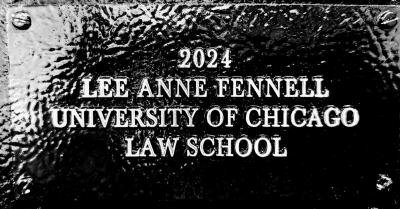
Tomorrow, lawprof Lee Anne Fennell of the University of Chicago Law School will be presented the Brigham-Kanner Property Rights Prize for her work on “how property rights are structured and imagined, and the implications that different possibilities hold for the allocation of resources and the way societies are organized. She has cast these issues in terms like ‘slices’ versus ‘lumps,’ ‘unbounded’ homes, ‘half-torts,’ and ‘streaming property.'”

On Friday, there’s a series of presentations on the impact of Professor’s Fennell’s work and other hot topics in dirt law. Full agenda here or below.

We are fortunate enough to be the referee — uh, “moderator” — for the group discussing what we see as the hottest issue in the field: housing. The

Continue Reading 21st Brigham-Kanner Property Rights Conference Now Underway
Screenshot 2024-09-06 at 09-20-48 The Benefits of the Fourth Amendment's Property-Rights Baseline by Nicholas Alden Kahn-Fogel SSRN

Regular readers know that in addition to our focus on Fifth Amendment property rights, we’re also looking at the Fourth Amendment as a vehicle that protects and promotes property rights.

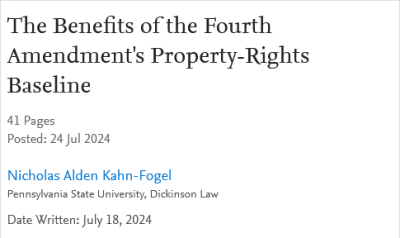
In that vein, here’s a forthcoming article that is worth reading,”The Benefits of the Fourth Amendment’s Property-Rights Baseline,” by lawprof Nicholas Alden Kahn-Fogel.

Here’s the Abstract:

Since 2012, Fourth Amendment claimants have had two alternative doctrinal tests available to establish that government investigative activity constitutes a Fourth Amendment search implicating their rights. First, if the government physically intrudes onto a person, house, paper, or effect to gather information, its conduct is a search, even if the claimant had no reasonable expectation of privacy against the government intrusion. The Court has referred to this directive as the “property-rights baseline.” Second, even in the absence of a physical intrusion onto a constitutionally protected area, if government surveillance infringes a person’s

Continue Reading New Article: “The Benefits of the Fourth Amendment’s Property-Rights Baseline”

A frequent vibe in cases where a member of the public asks a court to compel a local government to do something about an undesired land use (i.e., “the city should stop my neighbor from illegally renting their property,” or “the police should remove the pop-up unlicensed food stand on the sidewalk in front of my restaurant”) is that zoning enforcement is often viewed by courts as a discretionary municipal function or a question about allocation of enforcement resources — and therefore the judiciary takes a hands-off approach.

That vibe, however, did not carry the day when the Arizona Court of Appeals tackled Brown v. City of Phoenix, No. CV23-0273 (Aug. 27, 2024). In that case, the court upheld a trial court’s preliminary injunction ordering Phoenix to do something about the notorious “zone” that the trial court determined was a public nuisance “created or maintained” by the

Continue Reading Court To Phoenix: Clean Up Your Act!

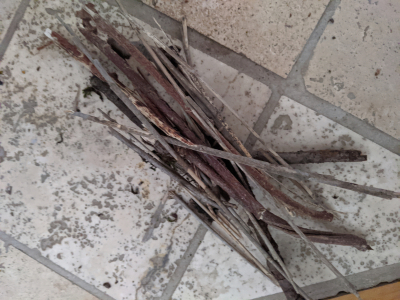
Sticks bundle
We don’t see any free public education here.

Some old-school property “sticks” analysis from the U.S. Court of Appeals for the Ninth Circuit in Zeven v. Jones, No. 23-35438 (Aug. 23, 2024), worth checking out.

The Idaho Constitution has a “free common schools” clause:

The stability of a republican form of government depending mainly upon the intelligence of the people, it shall be the duty of the legislature of Idaho to establish and maintain a general, uniform and thorough system of public, free common schools.

Idaho Const. art. IX, § 1.

According to some parents, the term “free” means that school districts cannot charge fees for “certain educational and extracurricular opportunities.” In one case, the fees ranged from $4 for locker use, to a $32 optional fee to cover the cost of purchased items for a “health occupations” store. In another, the fees ranged from $15 to $300.

Continue Reading CA9: No Taking For Charging School Fees, Because Idaho’s “Free Common Schools” Clause Does Not Create Private Property Interest

Excerpt

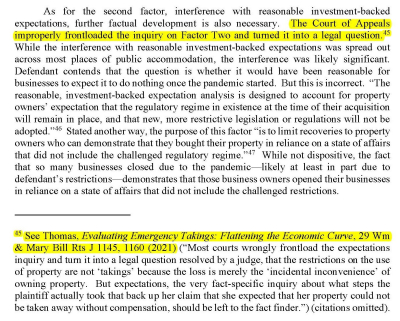
In this Order, the Michigan Supreme Court declined to consider a case which challenges the Michigan governor’s Co-19 shutdown executive orders, which, in the words of the dissenting Justices, reached “nearly every aspect of life in our state.”

There have been a lot of cases asserting that Co-19 shutdowns are takings, with most (but not all) of them crashing and burning, including this one. Here, the plaintiffs — a class of owners whose businesses suffered devastating losses as a result of the shutdown orders — sought just compensation for the regulatory taking. They alleged both types of takings, categorical and ad hoc (Penn Central). They also asserted claims under the Michigan Constitution (a trend we approve!).

We recommend you take a dive into the Statement of the two Justices who dissented. They would have taken up the case because “the majority leaves unresolved

Continue Reading Michigan, Over Dissent, Declines To Hear Co-19 Shutdown Takings Case

As we hinted at a couple of weeks ago, we have some good — nay, great — news: the Eminent Domain Podcast, retired earlier this year by its originator Clint Schumacher, is back with a new host and a slightly new title: “Come and Take It: The Eminent Domain Podcast.”

Bobby Debelak has stepped into the host’s chair. As you might be able to tell from the new title, Bobby is also a Texas lawyer.

Here’s the first episode, where Client figuratively hands the baton to Bobby. If you haven’t already subscribed to the feed, now’s the time so you don’t miss an episode. Available on all pod feeds, so be sure to get subscribed.

Are you as excited about this as we are?Continue Reading The Eminent Domain Podcast Is Back!