Skip to content

October 2024

You understand that there are just some cases where a certain analysis and outcome  appeal to your intellect, but your gut goes “ick,” and you’d bet that a judge’s (or judges’) reaction would be similar. Thus, intellectual analysis takes a backseat to the gut. (What one of our mentors referred to as “the widow plaintiff” scenario.)

The Kentucky Court of Appeals’ opinion in Doe v. Dean, No. 2023-CA-0844-MR (Sep. 20, 2024) is just one of those.

Kentucky law prohibits registered sex offenders from residing, working, loitering, or otherwise being within 1,000 feet of certain child-related operations such as daycare facilities, schools, or playgrounds. The plaintiff Doe is a registered sex offender, having “pled guilty to one felony count of possession of matter portraying a sexual performance by a minor[.]” Slip op. at 2.

Apparently, he’s been toeing the line since then, and “Doe has not been subject to active

Continue Reading Ky App: No Taking To Force Sex Offender To Move When Daycare Opens Near His Home
The California Coastal Commission has now reached the parody stage.

In the “Star TrekTV shows and movies, Starfleet Headquarters is depicted as being across the Golden Gate from San Francisco, in the Marin Headlands. It’s a longstanding joke among those who know about the regulatory overreach of the California Coastal Commission that — ha, haTrek really is science fiction because the Commission would never allow a development like this in the coastal zone (especially in Marin County). Even in the 23d century. And even for an enterprise as noble as the exploration of space.

Now life is imitating humor: as the Los Angeles Times reports in “California officials reject more SpaceX rocket launches, with some citing Musk’s X posts.” We know that Space X isn’t quite Starfleet, but it is getting pretty close (and this is reality, not some fanciful

Continue Reading You Thought We Were Joking When We Said The California Coastal Commission Would Never Allow Starfleet Headquarters To Be Built

PXL_20241004_152452877.MP
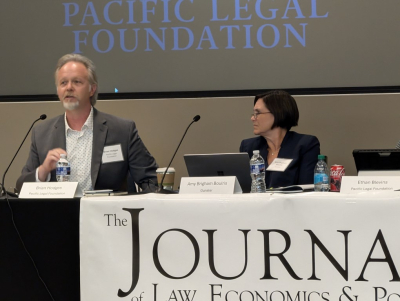
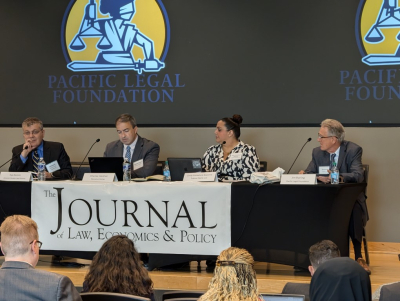
Lawprof Ilya Somin (GMU Law), Mercatus Center’s Charles Gardner,
and lawyer Emily Cruikshank Bayonne (Tubman Realty, LLC)
speaking on “
How Policy Changes Can Address Incursions on
Property Rights Where Courts Have Failed to do So.”
Jim Burling (PLF) moderating.

Recently, we attended a wonderful symposium co-sponsored by George Mason Law School’s Journal of Law, Economics & Policy (congratulations to the student editors who ran the show that day), and our outfit Pacific Legal Foundation. Of course, with the subject being “Imagining the Future of Regulatory Takings,” how could we resist attending?

If you missed it, it was not recorded unfortunately. But stay tuned for the full published symposium issue which shall include all of the articles and other pieces the speakers presented that day.

PXL_20241004_130701595.MP
PLF’s Ethan Blevins kicked off the day by
urging the speakers and the audience to
“make property rights cool again.”

PXL_20241004_182439511.MP
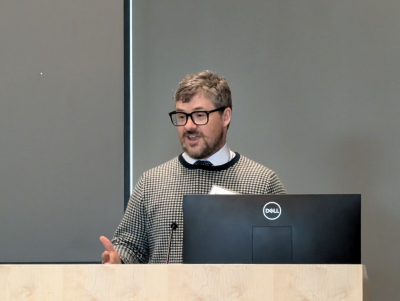
Brian Hodges

Continue Reading Imagining The Future Of Regulatory Takings: “Making Property Rights Cool Again”

This one from the Tenth Circuit didn’t even merit a published opinion, but is still worth reading, just because the situation seems so absurd.

In this Order and Judgment, the court affirmed the dismissal of property owners’ claim that the County wouldn’t issue a septic permit until after the owners actually constructed the septic system. Colorado law, they argued, requires them to get a permit before building a septic system. That’s nice, replied the County: here, we do it different; first you build, and only then do we decide whether you get a permit.

The owners alleged that without a septic permit, they could not obtain a construction permit. Which means that they couldn’t build their home as planned. Next stop, federal lawsuit alleging due process violations (both kinds) and a taking. 

The district court dismissed and the Tenth Circuit summarily affirmed:

  • Procedural due process: yes, the conflict between


Continue Reading CA10: A Municipality Is Forcing Owners To Violate State Law … No Problem!

Here’s the latest in our series of cases which in effect say “when you settle, you’re done.”

In State ex rel. Gideon v. Page, No. 2024-0573 (Oct. 10, 2024), the Ohio Supreme Court made short work of an argument that the trial judge in an eminent domain case lacked jurisdiction to enforce a settlement agreement after she vacated an earlier entry of dismissal. The objecting party asserted that the court’s earlier dismissal deprived it of jurisdiction to vacate the dismissal itself, and enforce the settlement agreement.

Although the party which asked the court to vacate the dismissal did not cite Rule 60(b), the court held that was a mere technical defect, and “a trial court may, upon motion, vacate a final judgment, order, or proceeding for multiple reasons …” Slip op. at 5. In short, the Supreme Court wasn’t too bothered by the details. See slip op. at 7

Continue Reading Ohio: Settlement Means You’re Done

Screenshot 2024-10-11 at 08-06-50 RPFSS

Hawaii lawyers (and those barred in the 808), take note: On October 21, 2024, the Hawaii State Bar Association will hold its annual Convention, and as always there’s a full lineup of CLE programs so you can meet your MCLE requirements.

Thanks to the Real Property & Financial Services Section, there’s a significant dirt law component. First, there’s “Property Rights and Regulatory Takings” the program on which we are presenting along with Dwight Merriam and lawprof Shelley Saxer. Here’s the official description:

This course will provide a survey of property rights and regulatory takings with an emphasis on recent decisions from the United States Supreme Court. Panelists include distinguished faculty and practitioners that will address impact fees, development rights, taking claims, rent controls, and other current issues.

Following us will be a program on “Land Use Conditions” with Cal Chipchase, Brad Saito, and a lawyer

Continue Reading Hawaii Dirt Lawyers: Don’t Miss “Property Rights & Regulatory Takings” CLE At The HSBA Convention (In-Person & Webcast)

CRE prize

Congratulations to our Pacific Legal Foundation colleague Brian Hodges for his article “Build-to-Rent Homes: A Promising Solution to Chronic Housing Shortages” being awarded the 2024 Jared Shales Prize by the Counselors of Real Estate (CRE).

From the Introduction:

When homeownership is increasingly out of reach for many, build-to-rent (BTR) housing offers a desirable alternative to traditional homeownership. First, BTRs provide flexibility that traditional homeownership cannot match. By renting rather than owning, tenants are free to move around the city or the country as their jobs, family situations or lifestyle decisions dictate. They can enjoy the benefits of urban or suburban living without being tied down to a particular location or property. Second, BTRs are often built to higher standards than traditional rental properties, with modern amenities and communal spaces that foster a community and belonging. These properties are often professionally managed, meaning that tenants can enjoy the

Continue Reading “Build-to-Rent Homes: A Promising Solution to Chronic Housing Shortages” – CRE 2024 Jared Shales Prize

Today we have a guest post by New York colleague Jennifer Polovetsky, who writes about the intersection of administrative law (Chevron deference) and public use in eminent domain.Thanks to Jennifer (and to the New York Law Journal) for allowing us to republish her intriguing piece.

_____________________________

Is Judicial Deference to Government Agency Decisions in Eminent Domain Cases at Risk?

by Jennifer Polovetsky

Since 1984, when the U.S. Supreme Court decided the Chevron U.S.A., v. Natural Resources Defense Council case, it has been well-settled law that the judiciary must defer to agency determinations in connection with the interpretation of a statute when the law was ambiguous or unclear (so long as the agency’s interpretation was reasonable and not arbitrary or capricious). See Chevron, 468 U.S. 837 (1984). The Chevron standard has been applied across the board in many legal cases since then.

On June 28, 2024, however, SCOTUS overruled Chevron


Continue Reading Guest Post (Jennifer Polovetsky): “Is Judicial Deference to Government Agency Decisions in Eminent Domain Cases at Risk?”

If there’s a silver lining in the U.S. Court of Appeals for the Sixth Circuit’s opinion in Slaybaugh v. Rutherford County, No. 23-5765 (Sep. 3, 2024), a case about what we call “SWAT takings” (police destroy someone’s property in order to dislodge a criminal suspect), it’s that the court did not adopt the usual “this was a really, really good exercise of the municipality’s police power so there’s no taking” approach.

But even though it applied a different analysis, the result was the same: no taking. Instead of the “police power” rationale, the court dug into the substance a bit more and determined that the police were “privileged” to physically invade and destroy the Slaybaugh property.

The court first acknowledged that owners generally have the right to exclude:

In arguing their prima facie takings claim, the Slaybaughs contend that police infringed on their property rights by invading

Continue Reading No SWAT Takings In CA6: Police’s Power To Arrest Includes Privilege To Damage Property