November 2024

PXL_20241111_181016079.MP

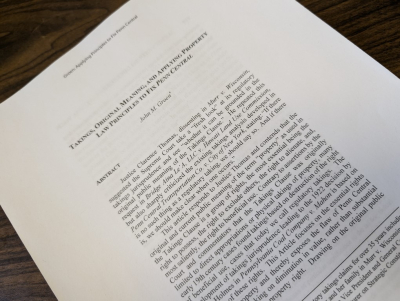
Today’s must-read, a (very) recent article by our Pacific Legal Foundation colleague John Groen, published in the Touro Law Review, “Takings, Original Meaning, and Applying Property Law Principles to Fix Penn Central.”

Get the pdf here.

With a title like that, who could resist? Here’s the Abstract:

Justice Clarence Thomas, dissenting in Murr v. Wisconsin, suggested the Supreme Court take a “fresh look” at its regulatory takings jurisprudence and see “whether it can be grounded in the original public meaning of the Takings Clause.” He repeated this request in Bridge Aina Le’A, LLC v. Hawaii Land Use Commission, but also sharply criticized the existing takings analysis developed in Penn Central Transportation Co. v. City of New York, stating: “If there is no such thing as a regulatory taking, we should say so. And if there is, we should make clear when one occurs.”
Continue Reading New Law Review Article: John Groen, “Takings, Original Meaning, and Applying Property Law Principles to Fix Penn Central,” 39 Touro L. Rev. 973 (2024)

As we express our thanks today to all those who have served, here are some of our previous posts which feature military-related topics:


Continue Reading Veterans Day 2024: Our Posts

Screenshot 2024-11-08 at 07-19-21 Track Appeals NJ Courts

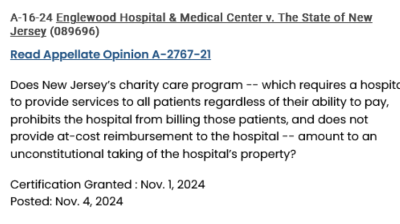
Here’s the latest in a case we’ve been following. The New Jersey Supreme Court has agreed to review the Appellate Division’s decision in Englewood Hospital & Medical Center v. New Jersey

That’s the case where several hospitals challenged a New Jersey statute which requires hospitals to take all patients regardless of their ability to pay, but does not fully reimburse under Medicaid the hospitals for the costs of treating these patients even where it results in the hospitals losing money.

The Appellate Division held this was not a categorical (Cedar Point/Loretto) or an ad hoc (Penn Central) taking.

The hospitals asserted that the statute required them to suffer a physical invasion, because the statute prohibited hospitals from excluding nonpaying patients. The court rejected the argument, in what reminded us of the Yee rent control and PruneYard commercial benefit approach, where the essential reasoning

Continue Reading NJ Supreme Court Grants Review: Is Forcing Hospitals To Operate At A Loss A Taking?

Sutherland_5
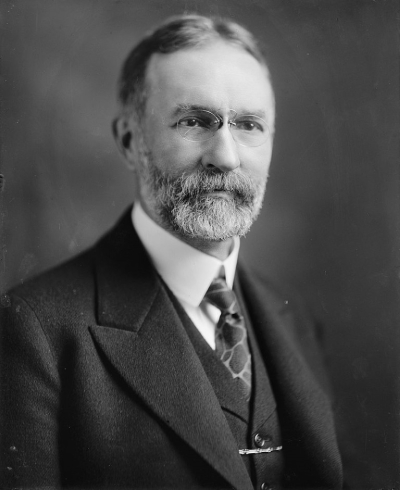
Justice Sutherland asks:
whadda mean, you don’t like apartments?

Check out this uncharacteristically-lengthy opinion from New York’s Appellate Division (and entire 6 pages!).

In Bennett v. Troy City Council, No. CV023-0709 (Oct. 24, 2024), the court invalidated a municipal upzoning (from single-family residential to Planned Development — which would permit apartments) because the city’s conclusion that the zone change would have no significant environmental impact under New York’s study-and-disclose statute.

Not content with apartments coming to the neighborhood, an adjoining owner, the “coufounder of The Friends of the Mahicantuck,” sued to challenge the negative environmental declaration. Under New York’s environmental study-and-disclose statute, the “environment” may include such things like historic or archaeological resources, and similar. 

Zoning and rezoning is generally subject to deferential judicial review under Euclid, with the courts applying rational basis review and generally taking a hands-off approach. But this was not a Euclid-like challenge

Continue Reading The Old “Neighborhood Character” Trope Dressed In Environmental Clothing

20180719_101400_Film8
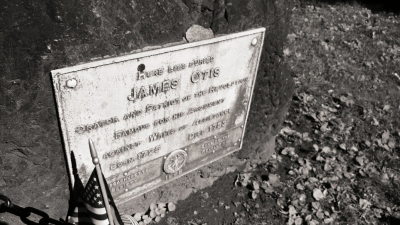
Mr. Otis would be a P’Nut fan.

Our Pacific Legal Foundation colleague and search-and-seizure expert Daniel Woislaw quickly responded to the cultural zeitgeist and looked into l‘affaire P’nut le Squirrel with his keen legal eye.

That’s the case in which an internet narc dropped dime on the owner of a pet squirrel, resulting in New York state game officials obtaining a warrant, searching his home, confiscating said squirrel and his little buddy Fred the Raccoon, and then through a series of unfortunate events, putting both P’Nut and Fred down. Sad!

Here’s Daniel’s thoughts.

+++++++++++++++++++++++++++++++++++++++++++++++

Government kills pet squirrel P’Nut in Fourth Amendment horror story

Daniel Woislaw

In a small corner of New York State, a family’s quiet, peaceful home was shattered by an unthinkable intrusion. Environmental police stormed in, seized a rescued orphan squirrel named P’Nut, took him away, and put him down. All because his owner allegedly

Continue Reading Guest Post: P’Nut, The Fourth Amendment, And Property Rights

Screenshot 2024-11-04 at 12-34-18 Texas Supreme Court
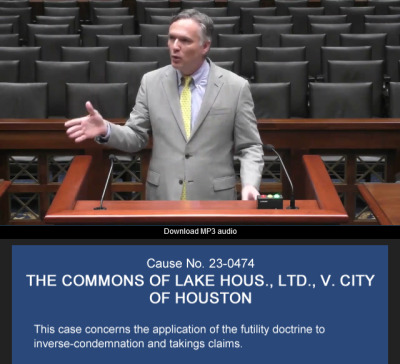
Charles McFarland, arguing.

Here’s the latest in a case we’ve been following closely (and disclosure: our firm filed an amicus brief in the Texas Supreme Court).

In The Commons of Lake Houston, Ltd. v. City of Houston, the Texas Court of Appeals held that the city could not be liable for a taking for an ordinance that limited development and use within the city’s 100-and-500-year floodplains because the ordinance was a valid exercise of police power and otherwise survived the rational basis test.

As we wrote here, that seems like utter nonsense to say that a valid police power reason categorically insulates a government action from a takings challenge. After all, the entire regulatory takings doctrine is built on the notion that an otherwise-valid exercise of government power (here, the police power, delegated from the State to the city) can so impact an owner’s property rights that

Continue Reading Oral Arguments In Texas Takings Case: If The Govt Limits Use For Healthsafetywelfaremorals, Is It Exempt From Takings?

Here’s the latest takings cert petition, in a case involving a California county’s refusal to rezone property back to its former zoning to allow residential development. The only uses permitted on the property presently are “scientific research facilities uses” and hiking trails. Or, at the petition puts it, “only public, park-like uses.” Pet. at 5. 

The District Court and the Ninth Circuit both held no taking.

Here are the Questions Presented:

Does a taking analyzed under Lucas v. S.C. Coastal Council require that the affected property be left with no value even if the regulation in question deprives the property of all economically beneficial uses?

Does Palazzolo v. Rhode Island leave any room for consideration of the landowners’ expectations in a Penn Central takings analysis?

Do the decisions in Loper Bright Enters. v. Raimondo, Cedar Point Nursery v. Hassid, Sheetz v. Cnty. of El Dorado and Lingle

Continue Reading New Cert Petition: Use vs Value, And Applying Penn Central

Access
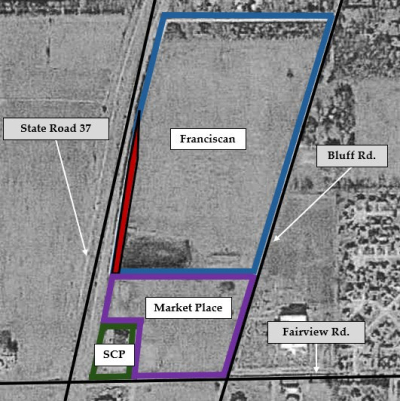
We like it when courts include photos and maps.

The Indiana Supreme Court’s ruling in State of Indiana v. Franciscan Alliance, Inc., No. 245-PL-118 (Oct. 31, 2024) isn’t all that surprising. After all, the State’s eminent domain action did not take access to the undeveloped property, and the owner was not entitled to compensation for the change in traffic flow brought about by the closure of an intersection. This increased the “circuitry of travel,” but did not cut off the parcel.

Here’s how the court framed the issue:

Here, there is no question that the State’s condemnation of Franciscan’s 0.632-acre strip of land is a taking requiring just compensation. Likewise, it is indisputable that this condemnation amounted to a taking of SCP’s easement rights over that strip of land. But the record confirms that the State has already paid compensation for those easement rights. Thus, the only question

Continue Reading Indiana: No Compensable Property Right In Traffic Flow; No Compensation For Impairment Of Access

Screenshot 2024-11-04 at 07-50-41 Guns and the Right to Exclude Saving Guns-at-Work Laws from Cedar Point's Per Se Takings Rule The University of Chicago Law Review

The latest issue of the University of Chicago Law Review has this student-authored piece that is worth your time reading. “Guns and the Right to Exclude: Saving Guns-at-Work Laws from Cedar Point‘s Per Se Takings Rule,” 91 U. Chi. L. Rev. 2047 (2024). 

Here’s the Abstract:

The Supreme Court’s decision in Cedar Point Nursery v. Hassid has left considerable uncertainty in the realm of takings law. In Cedar Point, the Court announced a new rule that government-authorized physical occupations of property, even temporary ones, constitute per se takings. But the Cedar Point decision left significant questions unresolved regarding the scope of its per se takings rule and its various exceptions.

To resolve these questions, this Comment looks to the example of guns-at-work laws. Enacted by about half of the states, guns-at-work laws protect the right of a business’s employees, customers, and invitees to store firearms in

Continue Reading New U Chi L Rev Article (Comment): “Guns and the Right to Exclude: Saving Guns-at-Work Laws from Cedar Point‘s Per Se Takings Rule”