2024

One week ago today, the U.S. Supreme Court heard oral arguments in Devillier v. Texas.

We wrote up our thoughts in this post, “Rogue States: Today’s Argument In Devillier v. Texas – ‘Aren’t the Courts supposed to do something’ About Violations Of The Constitution?,” and now bring you other reports:

  • Niina H. Farah, “Supreme Court leans toward landowners in Texas flooding case” (Politico E&E News) (we were quoted in this piece: “Robert Thomas, director of property rights litigation at the Pacific Legal Foundation, said critiques of Texas appeared to cut across the ideological spectrum on the court. ‘Even those justices who you might not usually think of as viewing property rights favorably, they didn’t seem to appreciate what I would call the gamesmanship [from Texas],’ said Thomas, who wrote a friend of the court brief to the Supreme Court in support of landowners.).
  • Lydia Wheeler,


Continue Reading Devillier Oral Argument Round-Up

Don’t miss out!

We promise: this is the last time we’re going to try to entice you to the upcoming ALI-CLE Eminent Domain & Land Valuation Litigation Conference in New Orleans. We are getting close to capacity, but there is still room. In recent years, we have standing room only in the Conference halls, and have sold out the hotel block. After all, this is a pretty niche area of law. So what gives?

When we were in Austin last year, we thought it might be nice to try and answer that question. We asked Conference participants why they come, year-after-year (and in Austin, despite massive travel disruptions). Yes, it is the various venues (Nashville, Austin, Scottsdale, Palm Springs, to name a few recent locations), and yes, it is the excellent and useful programming.

But as we suspected it is more than that.

Continue Reading No FOMO: There’s Still Room For You To Join Us In New Orleans Feb 1-3, 2024 For The 41st ALI-CLE Eminent Domain & Land Valuation Litigation Conference

This season of the Institute for Justice‘s podcast series “Bound by Oath” is devoted to property rights. It’s a fascinating series — produced by John Ross, it is more like an audio documentary than a typical podcast — focusing on constitutional issues. And we say this not just because we’ve been a guest a couple of times — see “Groping in a Fog“, this season’s immediate prior episode about regulatory takings, and Season 1, where we guested on the episode about the origins of the “incorporation” doctrine).

In the latest episode, “A Lost World,” John covers the world before zoning and the use (and abuse) of the plain-old police power to regulate the use of land and property.

Here’s the description:

On Episode 3, we journey back to a lost world: the world before zoning. And we take a look at a

Continue Reading “The Lost World – Land Use Before Zoning” – Bound by Oath Podcast, S3 E3: Hadacheck, Buchanan

We’d guess that most people, if asked whether the courts can “do something” when the government acts beyond the authority delegated to it in the Constitution, would respond that “doing something” is exactly what courts are for. 

Bottom Line Up Front

And that is what drives our BLUF on today’s Supreme Court oral arguments in Devillier v. Texas: we’re predicting that the property owner’s arguments in will convince a majority of the Justices, and that the Court will answer the Question Presented with a “yes” –

May a person whose property is taken without compensation seek redress under the self-executing Takings Clause even if the legislature has not affirmatively provided them with a cause of action?

Courts Exist to “Do Something” When Government Violates Rights, Right?

Justice Kagan, as if often the case, drove right to the heart of the matter. For the “money quote” in the transcript or

Continue Reading Rogue States: Today’s Argument In Devillier v. Texas – “Aren’t the Courts supposed to do something” About Violations Of The Constitution?

“No need to ask, he’s a smooth operator…”

On Tuesday, January 16, 2024, the Supreme Court will hear arguments in a case we’ve  been following closely because it involves the fundamental limitation on the sovereign power to take private property. In our system, the sovereign indeed has the power to take private property against the will of the owner, but only if the taking is accompanied by just compensation.

Before we go on, a disclosure: we filed an amicus brief supporting Devillier’s arguments, so we’ve have an obvious bias. Special kudos to our law firm colleagues — and self-executing Just Compensation mavens — Deb La Fetra and Kady Valois for this brief.

Texas Flooded Devillier’s Property

Here are the facts in Devillier v. Texas. As part of a road project, the Texas Department of Transportation caused Devillier’s property to flood. The state flooding someone’s property is one of those

Continue Reading Devillier v. Texas Argument Preview: Do Courts Need Congress’ Permission To Enforce The Right To Just Compensation?

Here is a collection of commentary on the oral arguments in Sheetz v. El Dorado County, heard by the Supreme Court earlier this week. (Our own thoughts here.)


Continue Reading Sheetz Argument Round-Up

We’ve noted this before, but we shall say it again: if you ever have the opportunity to teach in a law school — either as a full-time legal scholar or part-time as an expert adjunct practitioner — do it if you are at all able. You might think you know a lot about a particular subject, but there’s nothing like spending time at the lectern in a law classroom in front of sharp and eager lawyers-in-training to sharpen your thoughts, and get you to truly understand a subject. And it can be oh-so-rewarding as you see law students develop into colleagues at the Bar.

(And everyone insisting on calling you “professor” can evoke a smile.)

Sensei

But if there’s a downside to the law school experience from the teacher’s side of the lectern, it’s grading. Especially at a law school like William and Mary that has a pretty strict mandatory curve

Continue Reading The Future Looks Bright: A Sampling Of Final Paper Topics From William and Mary Law’s Eminent Domain & Property Rights, And Land Use Courses

DSCF3357

If you were looking for deep clarity from the Justices about land use law and whether a legislature imposing monetary conditions on property development always gets the free judicial pass of rational basis review in this morning’s oral arguments in Sheetz v. County of El Dorado, you may not discover a lot of predictive insight when you listen to the argument recording or read the transcript.

But it is definitely worth your time to listen or read. Yes, there were some head-scratching moments as several of the Justices struggled with how to differentiate between monetary land use exactions that are subject to the nexus and rough proportionality standards, and other government requirements to pay money such as user fees, tolls, and property taxes that presumably are exempt. But there were also moments of clarity. Important moments.

In other words, there’s gold in them thar transcript hills if you

Continue Reading Today’s Arguments In Sheetz v. El Dorado County: “[R]adical [A]greement” On The Key Issue

Conf-2024-flyer
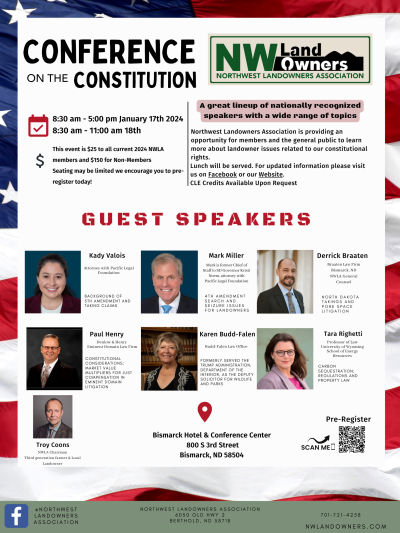
Bismarck in January is looking pretty good.

Here’s what we’re reading today:

  • Christian Britschgi, Court’s Wild Zoning Decision Blocks ‘Montana Miracle’, Reason (Jan. 2, 2024) (“In an eyebrow-raising decision, a Montana judge has halted the implementation of two laws legalizing duplexes and accessory dwelling units on residential land across the state, writing that they’d likely do ‘irreparable’ damage to residents of single-family neighborhoods.”).
  • Richard Frank, The U.S. Supreme Court & Environmental Law in 2024, LegalPlanet (Jan. 3, 2024) (“First up before the Court in 2024 is this “regulatory takings” case from California…. Over the past four decades, U.S. Supreme Court decisions have developed the so-called ‘unconstitutional conditions’ sub-doctrine of regulatory takings law, but to date have only applied it to individually-negotiated land use permit conditions and fees. California state courts–including in the Sheetz case–have consistently refused to extend the doctrine to broadly-applicable fees and conditions imposed on landowners


Continue Reading What We’re Reading Today, Property Rights Edition

What is a case about the U.S. Court of Appeals for the Fifth Circuit’s en banc opinion on the FDA’s approval procedures for e-cigarettes, Wages and White Lion Invs, L.L.C. v. Food & Drug Admin., No. 21-60766 (Jan. 3, 2023), doing here?

We consider it worthy of your time and post it here because of the way the majority addresses the FDA’s central argument: that even though the public took the FDA’s public instructions (including statements on its website) at face value, these procedures meant nothing. 

Government shouldn’t play such games, the court concluded. It can’t go back on what it holds out to the public, especially as a later litigation posture. See, e.g., slip op.at 20 (“In the MDO’s, however, FDA explicitly stated that its instructions were all for naught.”). Government “about-face[s]” are not appreciated. Slip op. at 28. We rightfully expect more from our

Continue Reading CA5: Government Should Not Send You On A Wild Goose Chase Though Its Own Procedures: “It was the regulatory equivalent of Romeo sending Mercutio on a wild goose chase—and then admitting there never was a goose while denying he even suggested the chase.”