Skip to content

2024

PXL_20241004_152452877.MP
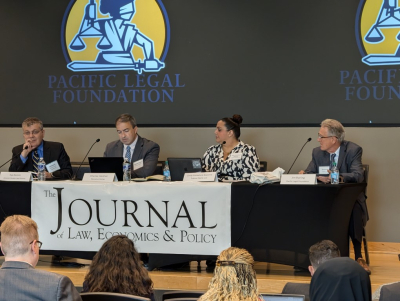
Lawprof Ilya Somin (GMU Law), Mercatus Center’s Charles Gardner,
and lawyer Emily Cruikshank Bayonne (Tubman Realty, LLC)
speaking on “
How Policy Changes Can Address Incursions on
Property Rights Where Courts Have Failed to do So.”
Jim Burling (PLF) moderating.

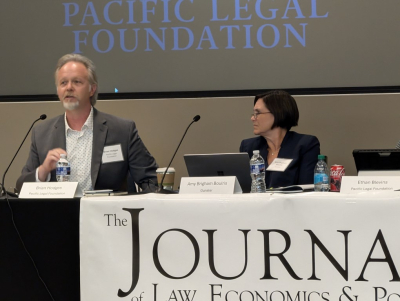
Recently, we attended a wonderful symposium co-sponsored by George Mason Law School’s Journal of Law, Economics & Policy (congratulations to the student editors who ran the show that day), and our outfit Pacific Legal Foundation. Of course, with the subject being “Imagining the Future of Regulatory Takings,” how could we resist attending?

If you missed it, it was not recorded unfortunately. But stay tuned for the full published symposium issue which shall include all of the articles and other pieces the speakers presented that day.
PXL_20241004_130701595.MP
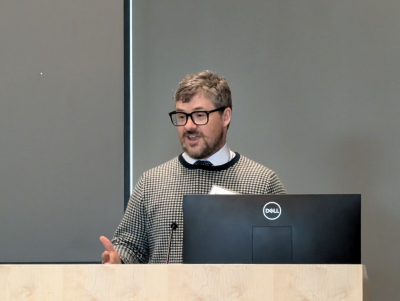
PLF’s Ethan Blevins kicked off the day by
urging the speakers and the audience to
“make property rights cool again.”
PXL_20241004_182439511.MP
Brian Hodges

Continue Reading Imagining The Future Of Regulatory Takings: “Making Property Rights Cool Again”
This one from the Tenth Circuit didn’t even merit a published opinion, but is still worth reading, just because the situation seems so absurd.

In this Order and Judgment, the court affirmed the dismissal of property owners’ claim that the County wouldn’t issue a septic permit until after the owners actually constructed the septic system. Colorado law, they argued, requires them to get a permit before building a septic system. That’s nice, replied the County: here, we do it different; first you build, and only then do we decide whether you get a permit.

The owners alleged that without a septic permit, they could not obtain a construction permit. Which means that they couldn’t build their home as planned. Next stop, federal lawsuit alleging due process violations (both kinds) and a taking. 

The district court dismissed and the Tenth Circuit summarily affirmed:

  • Procedural due process: yes, the conflict between


Continue Reading CA10: A Municipality Is Forcing Owners To Violate State Law … No Problem!

Here’s the latest in our series of cases which in effect say “when you settle, you’re done.”

In State ex rel. Gideon v. Page, No. 2024-0573 (Oct. 10, 2024), the Ohio Supreme Court made short work of an argument that the trial judge in an eminent domain case lacked jurisdiction to enforce a settlement agreement after she vacated an earlier entry of dismissal. The objecting party asserted that the court’s earlier dismissal deprived it of jurisdiction to vacate the dismissal itself, and enforce the settlement agreement.

Although the party which asked the court to vacate the dismissal did not cite Rule 60(b), the court held that was a mere technical defect, and “a trial court may, upon motion, vacate a final judgment, order, or proceeding for multiple reasons …” Slip op. at 5. In short, the Supreme Court wasn’t too bothered by the details. See slip op. at 7

Continue Reading Ohio: Settlement Means You’re Done

Screenshot 2024-10-11 at 08-06-50 RPFSS

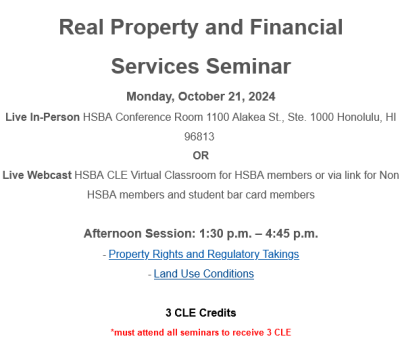
Hawaii lawyers (and those barred in the 808), take note: On October 21, 2024, the Hawaii State Bar Association will hold its annual Convention, and as always there’s a full lineup of CLE programs so you can meet your MCLE requirements.

Thanks to the Real Property & Financial Services Section, there’s a significant dirt law component. First, there’s “Property Rights and Regulatory Takings” the program on which we are presenting along with Dwight Merriam and lawprof Shelley Saxer. Here’s the official description:

This course will provide a survey of property rights and regulatory takings with an emphasis on recent decisions from the United States Supreme Court. Panelists include distinguished faculty and practitioners that will address impact fees, development rights, taking claims, rent controls, and other current issues.

Following us will be a program on “Land Use Conditions” with Cal Chipchase, Brad Saito, and a lawyer

Continue Reading Hawaii Dirt Lawyers: Don’t Miss “Property Rights & Regulatory Takings” CLE At The HSBA Convention (In-Person & Webcast)

CRE prize

Congratulations to our Pacific Legal Foundation colleague Brian Hodges for his article “Build-to-Rent Homes: A Promising Solution to Chronic Housing Shortages” being awarded the 2024 Jared Shales Prize by the Counselors of Real Estate (CRE).

From the Introduction:

When homeownership is increasingly out of reach for many, build-to-rent (BTR) housing offers a desirable alternative to traditional homeownership. First, BTRs provide flexibility that traditional homeownership cannot match. By renting rather than owning, tenants are free to move around the city or the country as their jobs, family situations or lifestyle decisions dictate. They can enjoy the benefits of urban or suburban living without being tied down to a particular location or property. Second, BTRs are often built to higher standards than traditional rental properties, with modern amenities and communal spaces that foster a community and belonging. These properties are often professionally managed, meaning that tenants can enjoy the

Continue Reading “Build-to-Rent Homes: A Promising Solution to Chronic Housing Shortages” – CRE 2024 Jared Shales Prize

Today we have a guest post by New York colleague Jennifer Polovetsky, who writes about the intersection of administrative law (Chevron deference) and public use in eminent domain.Thanks to Jennifer (and to the New York Law Journal) for allowing us to republish her intriguing piece.

_____________________________

Is Judicial Deference to Government Agency Decisions in Eminent Domain Cases at Risk?

by Jennifer Polovetsky

Since 1984, when the U.S. Supreme Court decided the Chevron U.S.A., v. Natural Resources Defense Council case, it has been well-settled law that the judiciary must defer to agency determinations in connection with the interpretation of a statute when the law was ambiguous or unclear (so long as the agency’s interpretation was reasonable and not arbitrary or capricious). See Chevron, 468 U.S. 837 (1984). The Chevron standard has been applied across the board in many legal cases since then.

On June 28, 2024, however, SCOTUS overruled Chevron


Continue Reading Guest Post (Jennifer Polovetsky): “Is Judicial Deference to Government Agency Decisions in Eminent Domain Cases at Risk?”

If there’s a silver lining in the U.S. Court of Appeals for the Sixth Circuit’s opinion in Slaybaugh v. Rutherford County, No. 23-5765 (Sep. 3, 2024), a case about what we call “SWAT takings” (police destroy someone’s property in order to dislodge a criminal suspect), it’s that the court did not adopt the usual “this was a really, really good exercise of the municipality’s police power so there’s no taking” approach.

But even though it applied a different analysis, the result was the same: no taking. Instead of the “police power” rationale, the court dug into the substance a bit more and determined that the police were “privileged” to physically invade and destroy the Slaybaugh property.

The court first acknowledged that owners generally have the right to exclude:

In arguing their prima facie takings claim, the Slaybaughs contend that police infringed on their property rights by invading

Continue Reading No SWAT Takings In CA6: Police’s Power To Arrest Includes Privilege To Damage Property

BK banner

Here’s the full report from David Morrill about the 21st Brigham-Kanner Property Rights Conference earlier this month. Pictured above: Professor James Stern (responsible for the overall planning of the B-K Conference), this year’s Prizewinner Professor Lee Fennell (U. Chicago Law School), and Andrew Brigham, St. Augustine, Florida – property rights lawyer extraordinaire).

Here are what Prof. Fennell had to say:

Upon accepting the Property Rights Prize, Fennell said that spending time in myriad places through the years piqued her interest in how property can work better for complex systems like large and interconnected cities and ecosystems. In the process, she tried to learn more about what sorts of interconnectedness matter most for humans and other animals, and what forms of adaptability and property forms can best serve needs going forward.

“We can’t make any headway on property as an institutional response to interdependent systems without practicing interdependence ourselves, getting together

Continue Reading 21st Brigham-Kanner Property Rights Conference Report

Here’s a recently-filed cert petition which raises two questions about the constitutional calculation of just compensation.

Here are the Questions Presented:

A county unquestionably used real property that denied access to private property and allowed the private property owner to restore the denied access at the owner’s own expense, without county reimburse- ment. Although at trial a jury awarded substantial damages, the appellate court would eventually reduce damage to zero. The questions presented are:

1. When the government undisputedly takes a real property right, does a court have an independent duty to ensure that just compensation is more than $0?

2. Where there is a temporary taking of property rights, is it required under the Fifth Amendment to measure just compensation using the rental value of the property for the time it is taken?

Follow along on the Court’s docket here.

Petition for a Writ of Certiorari, CBS MN

Continue Reading New Just Comp Cert Petition: Is $0 Just Compensation Constitutional?

Screenshot 2024-09-26 at 09-41-29 Too Far Imagining the Future of Regulatory Takings

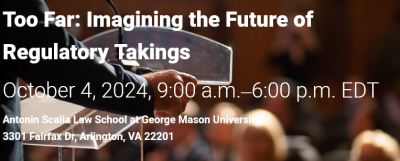
There’s still time to join us next Friday, October 4, 2024, at the Antonin Scalia Law School (George Mason University) for the symposium “Too Far: Imagining the Future of Regulatory Takings.”

Co-produced by our outfit (Pacific Legal Foundation) and the Journal of Law, Economics & Policy, the symposium will feature the most cutting-edge legal academics and courtroom practitioners discussing what is on the horizon in regulatory takings. Here’s the description of the program (full agenda and presenter list below):

A century ago, Supreme Court Justice Oliver Wendell Holmes cautioned government that if property regulations went “too far,” they would be “recognized as a taking.” Flash forward to today, where governments are constantly trying to push the limits while the courts struggle to define what exactly “too far” means.   

Join Pacific Legal Foundation and George Mason University’s Journal of Law, Economics, and Policy for a day-long symposium

Continue Reading Too Far: Imagining the Future of Regulatory Takings (Friday, Oct. 4, 2024)