2024

Be sure to read the entirety of Lawprof Ilya Somin’s recent post on Volokh,Federal Appellate Court Rules in Favor of Takings Lawsuit Against the CDC’s Covid-Era Eviction Moratorium.”

There, he analyzes the Federal Circuit’s recent 2-1 opinion in Darby Dev. Co., Inc. v. United States, No. 22-1929 (Aug. 7, 2024) (we wrote up the case here: “Deepening A Lower Court Split, Fed Cir (2-1) Reinstates CDC Co-19 Eviction Moratorium Temporary Takings Claim“).

Professor Somin does a better job that we did offering his thoughts on the “authorized” issue, concluding:

To me, the decisive factor should be that the Takings Clause nowhere says that compensation is only required for legal government actions or for those specifically authorized by statute. Rather, the Clause imposes a general rule that compensation must be paid whenever the government takes private property for “public use.” That, of course, can happen

Continue Reading Lawprof Somin: “Federal Appellate Court Rules in Favor of Takings Lawsuit Against the CDC’s Covid-Era Eviction Moratorium”

Here’s the latest in the solved-but-not-quite-solved issue of whether the government can keep the surplus which remains after a tax-foreclosure sale (see Tyler v. Hennepin County), the Michigan Supreme Court’s opinion in Schafer v. Kent County, No. 164975 (July 29, 2024), where the court concluded that its earlier decision in Rafaeli v. Oakland County is applicable not merely going forward (prospectively) but applies to those cases which are not final and closed out.

There’s a lot there — especially on the nuances of whether judicial decisions on constitutional rights apply only prospectively, or govern cases instituted in the past — but we are focused on the opinion’s analysis of property rights and takings as matters of history and tradition. We’re not going to comment here because this case is one of ours, argued by Christina Martin and Pacific Legal Foundation’s Home Equity Theft team. That said, here’s

Continue Reading Michigan: “few rights and legal principles have greater legal, historical, and constitutional pedigrees than the protection against uncompensated takings”

You remember that old adage (or maybe its a cliché?) that “a conservative is a liberal who has been mugged?” Well, here’s your environmentalist analog.

In Echeverria v. Town of Tubridge, No. 23-AP-291 (Aug. 2, 2024), the Vermont Supreme Court held that property owners’ lawsuit asserting their right to prohibit the town from allowing bicycling on hiking trails on their land, and to prohibit it from allowing members of the public onto the property to maintain the trails, is ripe. The owners asserted that as the owners, they alone have the authority “whether and how to maintain the legal trails that cross their property.” Slip op. at 2. Here are the details: the owners assert

sole and exclusive authority to decide whether and how to maintain the legal trails that cross their property. They alleged that the expected entry onto their property by volunteers seeking to exercise

Continue Reading A Property Rights Advocate Is An Environmentalist Who Has Been Overregulated: Anti-Takings Advocate Argues For The Right To Exclude

Screenshot 2024-08-09 at 09-59-51 Brigham-Kanner Property Rights Conference 2024 Tickets Williamsburg Eventbrite

Come join us in Williamsburg, Virginia at the William and Mary Law School for the 21st edition of the Brigham-Kanner Property Rights Conference. The Conference is unique, because its express purpose is to bring property legal scholars and property law practitioners together to discuss, what else, property and property rights law.

Yes, there’s a healthy dose of theory and academics, but also the real-world perspectives of practicing lawyers who bring the cases that put theory into practice. (New to this event and want a preview? Here’s our write-up of the 2024 Conference.)

More details here. Register here.

The days prior to the Conference launch on Thursday All that week, we’re putting on student-oriented programming.in conjunction with the WM Law Career Services Office. Sessions on “Careers in Dirt Law,” “Land Use and Real Estate Law in Practice,” and “Comparative Property Rights,” for example, presented by experienced practitioners

Continue Reading Register Now: 21st Brigham-Kanner Property Rights Conference, William & Mary Law School, Sep. 12-13, 2024

20151205_145921

This one is a must-read.

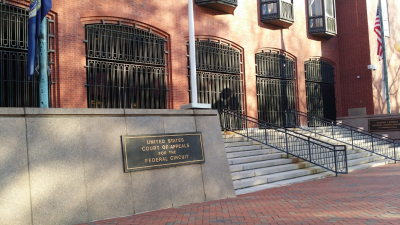
In Darby Dev. Co., Inc. v. United States, No. 22-1929 (Aug. 7, 2024), the U.S. Court of Appeals for the Federal Circuit held that the Court of Federal Claims should not have dismissed Darby’s complaint for failure to state a physical invasion takings claim.

The short takeaways:

  • Takings claims do not require the government action be legally authorized (here, the courts invalidated the government action, after which the plaintiff sued for a taking), only that the government action was “authorized” and thus can be “chargeable to the government.”
  • Prohibiting evictions is not merely a regulation of the landlord-tenant relationship. Yee v. City of Escondido is distinguishable, and does not categorically exempt all actions that implicate the landlord-tenant relationship from physical takings challenge.

We think the longer story is worth your time. Here it is.

As you may recall, the Center for Disease Control purported

Continue Reading Deepening A Lower Court Split, Fed Cir (2-1) Reinstates CDC Co-19 Eviction Moratorium Temporary Takings Claim

Check this out, the latest takings cert petition from the Pacific Legal Foundation shop.

Since this is one of ours (our colleague Chris Kieser is in the lead), we’re not going into too much detail, but will say that this involves ripeness in a regulatory takings claims, a topic we’ve been focused on a lot lately.

The question here is once the government says “no” to a development plan, must the owner keep on asking? What’s that old adage? If at first you don’t succeed, try and try again? We know that in land use, that means as long as the government says it is willing to “clarify” or “change” its decision (something it almost always asserts it is able and willing to do), most courts will very likely never hold it to task. Planning authorities know this, and as a consequence are hardwired to almost never say no

Continue Reading New Cert Petition: After Permit Denial, To Ripen A Takings Claim Do You Have To Keep On Trying?

81XRFQ5ONQL._SL1500_

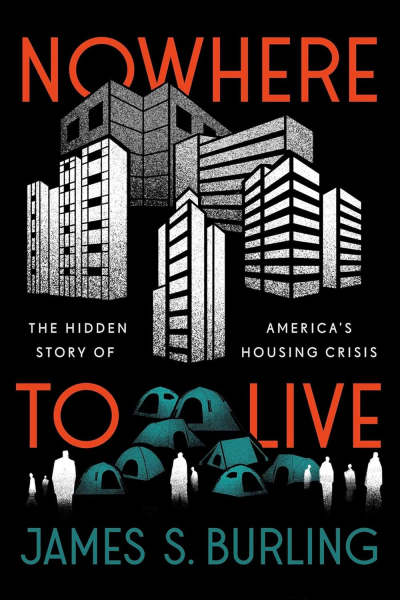
If you are in the California Southland (or plan to be in the next week), please be sure to reserve on your calendar Tuesday, August 13, 2024, to join us in-person for the launch of our colleague Jim Burling‘s forthcoming book, “Nowhere to Live: The Hidden Story of America’s Housing Crisis.”

Here’s a blurb about the book, which is available for preorder on Amazon:

A century of policy mistakes ruined America’s cities and created an unprecedented housing crisis.   
 
For many families, homelessness is no longer someone else’s problem. It is right around the corner, a real threat in their own immediate future. Our housing crisis is the result of a long history of government policies, court cases, and political manipulation. While these disparate causes make up a tangled web, they have one surprising root: the attack on private property rights. For more than

Continue Reading Book Launch Event, Aug 13, 2024: Jim Burling, “Nowhere to Live: The Hidden Story of America’s Housing Crisis”

Screenshot 2024-07-31 at 17-33-40 The End of Means-End Scrutiny by Francesca Procaccini SSRN

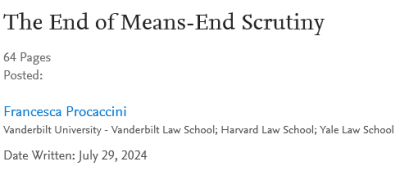
Here’s an article worth reading, just posted to SSRN, Procaccini, The End of Means-End Scrutiny (July 29, 2024).

For your takings and individual liberty nerds, please focus on pages 36-38 (showing how takings analysis is not accomplished by the usual means-ends scrutiny), pages 40-42 (social and economic liberties), and pages 43-44 (searches and seizure).

Why move from means-ends scrutiny to more robust judicial review? Zero in on pages 50-52 (“Transforming Rights from Mediated Interests to Uncompromising Trumps”). We’re thinking the author concludes this move is a bad thing, but we’re not so sure it is.

Here’s the Abstract:

It is black letter law that courts apply means-end scrutiny to evaluate laws that burden constitutional rights. Not anymore. Discreetly and pervasively, this Supreme Court has ousted means-end scrutiny from constitutional law. It has done so through a series of smaller and seemingly unconnected doctrinal incursions, including the introduction of history and

Continue Reading New Article: “The Ends of Means-Ends Scrutiny”

Just compensation

Just a few posts ago, we put up the Louisiana Supreme Court’s opinion in a case where property owners obtained a final inverse condemnation judgment ordering the New Orleans Sewer Board to pay just compensation.

Then…crickets. The sewer board did not satisfy the judgment. It relied on a provision in the Louisiana Constitution that says that the state and local governments don’t need to pay civil judgments except when they want to.

The Louisiana Supreme Court didn’t see it that way, and held that just compensation is “self executing” and that paying it is a ministerial duty, meaning that no statutory authorization is needed, and mandamus to compel payment is an available remedy for non-payment.

Now, the sewer board has asked the court for a do-over. In its motion for rehearing, it asserts that that earlier federal litigation is res judicata and already resolved the issue (although that

Continue Reading Govt: We Were Really Really Really About To Pay…Until You Forced Us To Pay! Sewer Board Seeks Rehearing In Self-Executing Just Comp Case

Check out City of Kemah v. Crow, No. 01-23-00417-CV (July 25, 2024), from the Texas Court of Appeal (First District).

This is yet another takings ripeness case — here, the so-called “final decision” requirement — the second recent opinion on this issue from the Texas court. SeeFinal Decision Takings Ripeness Is Based On All Circumstances, Not Hard-And-Fast Requirements (Read That Again: A Factual Question)” for our write-up of the other case.

In this one, the owner asserted that the city issued her a building permit for her “barndominium” and and two other structures to be used as short-term rentals, but later issued a stop work order. This resulted in a Penn Central taking, she asserted.   

The city sought ripeness dismissal, asserting the owner didn’t actually have a permit issued by the city council as its ordinances require. The owner didn’t have the actual

Continue Reading Relying On Complaint’s Allegation That City Issued A Permit As Confirmed By Chief Building Officer Email, Texas App Holds Takings Claim Ripe Even Though City Said Council Must Issue Permits