December 2025

In an earlier post, we covered the highlights of 2025.

There are quite a lot to choose from, but here’s our curated list of the year’s lowlights. As in our highlight list, we’re affirmatively omitting cases in which we had a hand.

Here we go:

Cert Denial of the Year: GHP Management Corp. v. City of Los Angles, No. 24-435 (U.S. June 30, 2025). We include this one because there’s a clear circuit split, and the lower courts’ misapplication of the Yee theory (forbidding or delaying a lessor from recovering possession should not be analyzed as a physical invasion taking, but is treated as a mere regulation on use because the lessor voluntarily opened the property to the offender) continues, mostly because the Supreme Court hasn’t acted.

Worst Regulatory Takings Case of the Year: Green Room LLC v. State of Wyoming, No. 24-853 (10th

Continue Reading Adieu To The Highs And Lows Of 2025 (Part II: The Lows)
It is time to bid farewell to the Year 2025, and our mind wanders back over the last 364 days in an attempt to ascribe meaning, a theme — a vibe — to the year that was.

Scientists tell us that this is just another trip around the Sun, but we humans like to assign meaning to a measure of time, so here’s our thoughts on what will stick with us about 2025.

Barista’s note: in the interest of objectivity, we shall exclude our shop’s cases such as this one: “Fla Ct App (en banc) In Takings Case: ”failing to vindicate a right expressly stated in the Constitution is not judicial restraint but judicial abnegation. That we must not do.'”

That said, here we go with what we think were the highlights of 2025 (lowlights are posted here in Part II).

Regulatory Takings Case of the Year:

Continue Reading Adieu To The Highs And Lows Of 2025 (Part I: The Highs)

This one is worth your time to review.

In HRT Enterprises v. City of Detroit, No. 23-1847 (Dec. 22, 2025), the U.S. Court of Appeals for the Sixth Circuit affirmed the district court’s entry of summary judgment in favor of the plaintiff/owner and a jury verdict on just compensation.

The case is notable not only for the fact it’s a property owner win, but that the usual procedural hurdles an owner is forced to jump through were successfully navigated. For example, the city’s assertion that the takings claim was both not ripe, and res judicata. Yes, in the city’s view, the claim was simultaneously too early and too late.

The first sentence of the opinion tells you that the focus of the analysis is going to be the res judicata question:

After losing in state court, HRT Enterprises sued the City of Detroit in federal court under a

Continue Reading CA6 Affirms Detroit Land Bank Taking: New Facts Defeat Res Judicata

Sometimes when you read a court opinion you imagine there’s a big gap between the objective, sterile words on the page and the reality of the situation.

The U.S. Court of Appeals for the Seventh Circuit’s opinion in O’Donnell v. City of Chicago, No. 24-2946 (Dec. 22, 2025) is one of those.

The words on the page reveal the court held that a Chicago ordinance which authorizes the city to seize vehicles for traffic violations — even other cars the violator owns — is not a taking because its “an exercise of the City’s police power to enforce its traffic code, and thus isn’t a taking.” Slip op. at 5. (We have problems with that conclusion, but more on that below.)

But reading the opinion gives a hint of the off-page reality on the ground.

Dig this. Get a traffic ticket in Chicago, and you can either challenge it

Continue Reading CA7: No Taking When City Forfeited Cars For Traffic Violations – Even Cars Not Involved In The Violation

Here’s one you don’t want to miss. Lawprof Shelley Ross Saxer has published “Forfeiture Takings, Police Power, and Necessity Destruction,” 80 U. Miami L. Rev. 147 (2025).

Here’s the Abstract:

Civil forfeiture laws allow law enforcement to seize property when there is probable cause it has been used or possessed in violation of legal rules, often before an owner has a chance to contest the government’s seizure in court. In the criminal context, forfeiture is typically an in personam action that requires a criminal conviction and is part of a defendant’s sentence. In the civil context, however, forfeiture is an in rem proceeding brought against the property derived from or used to commit an offense––not against the person who committed the offense. As such, a civil forfeiture may not require a criminal conviction or predeprivation hearing, and, under the “guilty property” theory, developed in England before eventually being

Continue Reading New Article: Shelley Ross Saxer, “Forfeiture Takings, Police Power, and Necessity Destruction,” 80 U. Miami L. Rev. 147 (2025)

In Gould v. Interface, Inc., No. 23-12883 (Oct. 2, 2025), the U.S. Court of Appeals for the Eleventh Circuit was dealing with a claim for wrongful termination of a tech CEO.

So what’s the case doing here? Skip forward to page 12 of the slip opinion, where the court deals with an oft-occurring argument: the appellant “waived” (forfeited, actually) a claim by failing to pursue it below. The general rule is that a litigant can waive a claim, but not an argument.

Okay, got it. But again, why is this opinion posted here? Well, the example the court uses to illustrate the difference between a “claim” and an “argument” is the (in)famous takings case, Yee v. City of Escondido, 503 U.S. 519 (1992). Takings mavens know that Yee is often cited in support of the argument that things like rent control do not force property owners to allow

Continue Reading A Reminder From CA11: There’s Only A Single Claim For A Regulatory Taking (Although There May Be Several Arguments)
PXL_20221218_214724672.MP

Too busy writing those briefs and petitioning for those writs, so haven’t found the time to hit your local store or the interwebs and fulfill your seasonal duties? Or maybe you just have gifter’s block this holiday season about an appropriate present for the dirt lawyer in your life?

You want to be known as a a good gifter, not a grifter.

Fear not, friend. Here’s our annual Holiday Dirt Lawyer Gift Guide, with our suggestions for things that could make the DL in your life happy. Some serious, some cheeky. You figure out which applies.

Let’s go!

* * * *

Bespoke Property Rights Rickroll Mug.

We’ll start with a new entry, one that is sure to become a favorite. We’re not quite sure what to call it, so we’ve settled on “Property Rights Rickroll Mug.”

For those of you who remember, fondly or otherwise, the

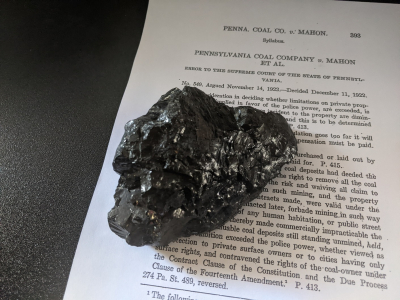
Continue Reading SCOTUS Origami Boulders, Bundles Of Sticks, Lumps Of (Pennsylvania) Coal, And Bags O’ Dirt: Presenting Your 2025 Dirt Lawyer Holiday Gift Guide (Including Last-Minute Entries)

The U.S. Court of Appeals for the Ninth Circuit’s opinion in Epic Games, Inc. v. Apple, Inc., No. 25-2935 (Dec. 11, 2025), isn’t one the typical readers of this outlet might notice.

After all, it’s mostly about a tech company beef, as the caption might indicate. And the opinion is about one aspect of that beef, where the district court ordered Apple to do something, and then … it didn’t. As the opinion summary details:

After a bench trial, the district court enjoined Apple from certain anticompetitive business practices related to its App Store, and this court affirmed the injunction. Apple claimed to comply with the injunction, but it instead prohibited App Store developers from using buttons, links, and other calls to action without paying a prohibitive commission to Apple, and it restricted the design of the developers’ links to make it difficult for customers to use them.

Slip

Continue Reading CA9: District Court’s Contempt Order Isn’t A Judicial Taking