



2025

Screenshot 2025-05-04 at 11-03-11 1033 Exchanges Advanced Strategies for Optimal Tax Deferral ALI CLE

Want to learn of some of the options available to property owners whose land is taken by eminent domain (or, even more sadly, destroyed by a disaster)?

Then you should sign up for next week’s ALI-CLE webinar, “1033 Exchanges: Advanced Strategies for Optimal Tax Deferral.”

Here’s a description of the program:

When property is lost due to an involuntary conversion such as a taking by eminent domain, destruction by natural disaster, or theft, many clients assume they must immediately face a significant tax burden from compensation received. However, IRS §1033 provides a powerful alternative—tax-deferral through strategic reinvestment. Understanding the nuances of 1033 exchanges allows attorneys to guide clients through the process, ensuring they maximize tax benefits and rebuild wealth effectively.

Join us for this comprehensive CLE course designed to equip legal professionals with the knowledge and tools needed to navigate 1033 transactions with confidence.

With our colleagues Alan Continue Reading ALI-CLE Webinar: Tax Consequences Of Eminent Domain (May 13, 2025)
We had to read the facts of the Tennessee Court of Appeals’ opinion in City of Pigeon Forge v. RLR Investments, LLC, No. E2023-01802-COA-R3-DV (Apr. 20, 2025) a couple of times over, just to make sure we were understanding what was going on. But the effort was worth it, just because of the unusual arguments presented. Check it out.

RLR owned two adjacent properties, the first used for a hotel, the second for a duplex, parking area, and open green space. So far so good. The city took portions of each for a greenway. It also took temporary construction easements on each parcel. Check. The city sought immediate possession. Got it. The owner objected to public use and the quick take, but the trial court agreed with the city, and entered an order of possession. Understood.

Here’s where it gets squirrelly. RLR, the property owner, sought to enforce the order

Continue Reading It’s The Vibe: Taking Of Condemnee’s Property To Replace Property Taken From Condemnee Is A Public Use

Partial taking for highway project. You know what that means: severance damages. And you also know that often means a “general or special” benefits fight over how the remainder parcel may have been improved by the project, and whether these benefits can reduce the severance owed.

Before-the-project condition: undeveloped land on a frontage road with no nearby connection to the freeway. After-the-project condition: remainder property has direct freeway access, an increase in traffic to the site and easier ability to enter/exit, and curb and sidewalk improvements. The trial court concluded these specially benefited the remainder property, and could be offset against compensation.

In Utah Dep’t of Transportation v. Boggess-Draper Co., LLC, No. 20220875 (May 1, 2025), the Utah Court of Appeals disagreed. In accordance with a Utah Supreme Court decision, benefits that may be used to offset compensation must be those which “affect the land itself,” and increase “the

Continue Reading Friends Without Special Benefits: Direct Access To Interstate Is General Benefit

Here’s the latest in a case we’ve been following.

This is Fane Lozman. You know his name. Yes, the guy who has taken on the City of Riviera Beach, Florida twice at the Supreme Court, and is now coming back for a third shot on goal. Houseboat guy. Public hearing gadfly guy. And now, maybe the ripeness guy.

Lozman has filed a cert petition asking the Court to review the Eleventh Circuit’s opinion which dismissed his regulatory takings claim as unripe.

Here’s the Questions Presented:

Fane Lozman has a contentious relationship with the City of Riviera Beach, Florida. The City’s mistreatment of Mr. Lozman has twice required this Court’s intervention. See Lozman v. City of Riviera Beach, 568 U.S. 115 (2013); Lozman v. City of Riviera Beach, 585 U.S. 87 (2018).

In this third chapter, Mr. Lozman was forced to sue the City

Continue Reading SCOTUS Hat Trick? Houseboat Guy Returns For Shot At Lucas Ripeness

Here’s more on an issue we recently covered involving Texas’s “depopulation” of captive white-tailed deer in order to curb Chronic Wasting Disease. In the earlier opinion, the court held that the owner of a deer-breeding facility did not have a property interest in the deer, and thus could not assert a due process or takings claim.

The court in Young v. Texas Parks & Wildlife Dep’t, No. 15-24-00052-CV (Apr. 24, 2025) reached the same conclusion. We’re posting the latest opinion because it elaborates on the “ferae naturae” issue, and every law student and lawyer’s old (very old) friend, the rule of capture

The court rejected the owner’s arguments:

Comparing the facts in Tyler to those here, Young argues that the common law doctrines of ferae naturae and the rule of capture existed long before the Texas Legislature stepped in and began regulating white-tailed deer. In

Continue Reading More On That White-Tailed Deer Takings Case: Law Of Capture Subject To Public Trust

There’s a lot of detailed legal analysis in the Pennsylvania Supreme Court (Eastern District)’s opinion in Pignetti v. Pennsylvania, No. J-11A-2024 (Apr. 25, 2025). But in the end it boiled down to a simple concept.

The case was about what property constituted the larger parcel. As the court put it, where “the condemnation of one parcel may affect the use and the value of another to such an extent that the two parcels should be valued as one.” Slip op. at 1-2 (footnote omitted). In Pennsylvania, they apparently call this “plottage,” but the analysis is familiar. (Think “three unities” — or some combination thereof.)

The Pennsylvania Legislature codified what in a lot of other jurisdictions is a common law doctrine. The statute provides:

Where all or a part of several contiguous tracts in substantially identical ownership is condemned or a part of several noncontiguous tracts in substantially identical ownership

Continue Reading Pennsylvania: “Used Together” In Larger Parcel Statute Means “One Purpose”

The California Supreme Court has agreed to review and resolve a lower (California) court split regarding the standard of review a court should apply in challenges to a government taking of a privately-owned public utility.

In Town of Apple Valley v. Apple Valley Ranchos Water, No. E078348M (Feb. 13, 2025), the California Court of Appeal held that when a privately-owner public utility objects under the California Eminent Domain Code to the public use of a governmental takeover of the utility, the court must review the Resolution of Necessity with extreme deference (gross abuse of discretion). This means the reviewing court starts off with the presumption that the resolution is valid and its conclusions are true, and that no additional evidence may be considered to counter that conclusion.

One other Court of Appeal held otherwise, and the California Supreme Court agreed to resolve the divergence of analysis. Here’s

Continue Reading Cal Supreme Court Reviewing Necessity Challenge To Public Utility Takeover

Chart

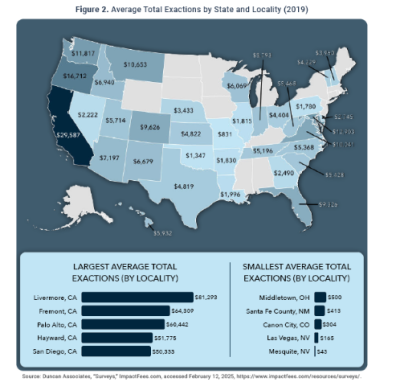
Check out the new report by our Pacific Legal Foundation colleagues Kyle Sweetland and Brian Hodges, “How to Protect Property Rights from Improperly Assessed Exactions” (Apr. 2025).

This research in brief shows how exactions grew and increased home construction costs over a 16-year period. It provides a history of exactions, showing how they have frequently moved away from their original impact-mitigation purpose and how that shift in purpose risks violating the Constitution. It illustrates an improperly assessed exaction and provides examples of how exactions have hampered construction during the present housing crisis. It concludes by examining how state legislatures can help set boundaries on local exactions and protect property rights.

It’s short, its sweet, it’s straightforward and understandable. What more could you want? Oh yeah, unlike exactions … it’s free. No strings attached. Check it out.

Sweetland & Hodges, How to Protect Property Rights from Improperly Assessed Continue Reading New Report: “How to Protect Property Rights from Improperly Assessed Exactions” (Sweetland & Hodges)

We’ve had this one in our queue for a bit, but it seems now is a good time to lay out the U.S. Court of Appeals for the Sixth Circuit’s opinion in McIntosh v. Madisonville, No. 24-5383 (Jan. 21, 2025). After all, the Due Process Clause seems to be in the news a lot lately, and this case explains what process is due property owners before they are deprived of that property.

Here’s the story. The city, after a code enforcement officer’s inspection (responding to a tenant complaint) declared that one of McIntosh’s mobile homes had mold and deemed it unsafe and unsalvageable. Letter followed notifying the owner of the city’s condemnation of the property, advising him that he had 30 days to submit plans for getting things in order, or else the city was going to tear it down. The city also put notice on the property itself.

Continue Reading CA6: The Predeprivation Hearing Required By Due Process Can’t Just Exist On Paper (And An Informal, And Possibly Made-Up Chance To Negotiate Isn’t Enough)

The key quote from the Illinois Appellate Court’s recent opinion in Robinson v. City of Chicago, No. 1-23-2174 (Mar. 24, 2025), in which a property owner challenged the inclusion of his property in a new Chicago historic preservation district? This seemingly innocuous sentence setting out the standard of review:

The plaintiff acknowledges that his substantive due process and equal protection challenges to the ordinance designating the District as a Chicago landmark are subject to rational basis review.

Slip op. at 13.

Those of you for whom this ain’t your first rodeo know that rational basis review (aka aliens might have done it) being invoked isn’t a good sign for a challenger. It nearly always tells the challenger “you lose, no matter what.” And here, that prediction plays out: the court rejected the property owner’s arguments that the city’s designation of his small neighborhood — a neighborhood that

Continue Reading Who Cares Your “Evidence” Shows This Is Just An Old Part Of Chicago – All That Matters Is The City Says It’s Historic