2025

A short one from the U.S. Court of Appeals for the Third Circuit, which asks: when the government is holding your abandoned property for you, do you have to ask for it to return it to you before you can bring a takings claim?

In Dillow v. Treasurer of the Commonwealth of Pennsylvania, No. 24-2004 (Oct. 3, 2025), the court held yes: the owner’s takings claim was not ripe because he had not asked the Treasurer to give the property back.

This is a non-precedential opinion so it is short. But there are two interesting parts that you should focus on.

First, the description of Pennsylvania’s system of unclaimed property. Pennsylvania deemed Dillow’s property — an uncashed claims payment check and a bank draft — to be “unclaimed,” and the Treasurer took custody and converted them to cash. Dillow did not file a claim for the cash. He acknowledged

Continue Reading CA3: No Taking Until You Ask For Your Property Back
An interesting dirt law decision from north of the border in a case we’ve been following.

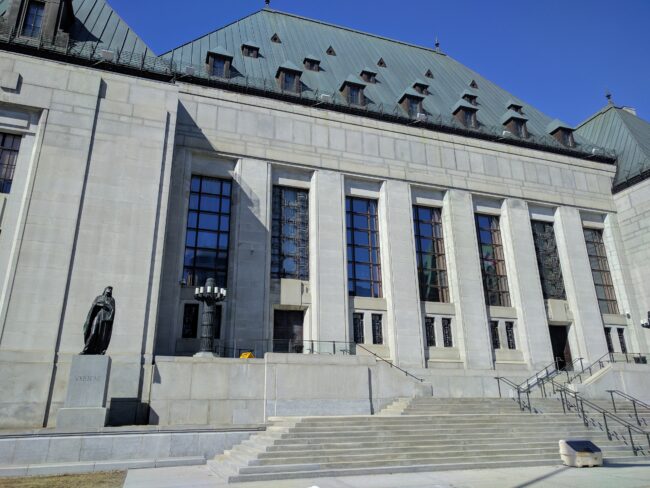
In Kosicki v. City of Toronto, No. 40908 (Sep. 19, 2025), the Supreme Court of Canada held that the usual common law rule of “no adverse possession against the government” didn’t govern, and permitted a private owner to do just that.

We can’t say we understand fully the decision as we have not been “called to the Bar” in Canada, but since our legal systems have a common legal ancestor, we can understand enough to get the story.

Here’s how the majority framed the issue:

[1] The issue in this appeal is whether the appellants, Pawel Kosicki and Megan Munro, can succeed in their claim for possessory title under the Real Property Limitations Act, R.S.O. 1990, c. L.15 (“RPLA”). Since 2017, the appellants have jointly owned a residential property

Continue Reading Cour suprême du Canada: Private Owner May Adversely Possess Public Land

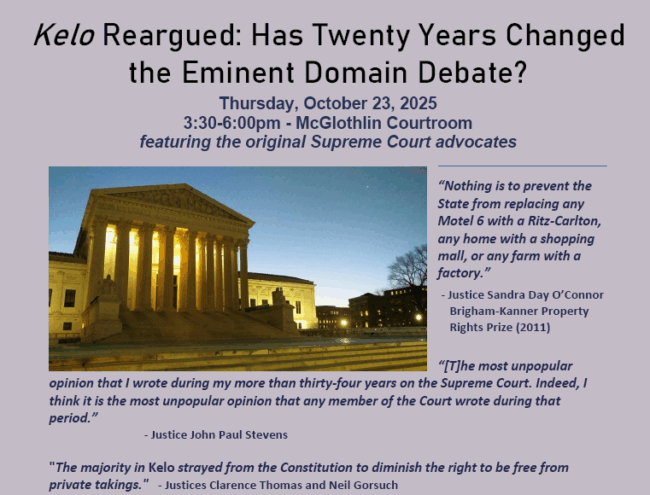
As part of the Brigham-Kanner Property Rights Conference being held next week at the William and Mary Law School, the student-run Real Estate Law Society is producing a very interesting program that offers a look back on Kelo v. City of New London, in this that case’s twentieth year.

We’re going to be rearguing the case in a Supreme Court moot, which will feature the lawyers for Susette Kelo — the Institute for Justice — rearguing her case to see if two decades of experience produces different arguments, or even a different outcome. Any guess who will be arguing the cause for the City of New London? That’s right, none other than Yours Truly (we promise not to “take a dive” and confess error on the City’s part — this is a moot court, after all!).

Serving as Moot Justices are academics, practitioners, and law students, including

Continue Reading Kelo Reargued: Has 20 Years of Controversy Changed the Eminent Domain Debate?

The U.S. Court of Appeals for the Seventh Circuit is the latest court to wade in (or more accurately, re-wade in) to what we call the SWAT Takings issue.

The logic is sound: under a governmental power (police power), the government (SWAT) has physically invaded (deprived the owner of an essential stick of private property, the right to exclude) a home (private property), for public use (police apprehending suspects is a good thing), triggering the obligation to spread the burden of this public good to the entire public (Armstrong).

 
Continue Reading CA7: No Taking For SWAT Destroying Property While Executing Valid Warrant

In Witherspoon v. Ince, No. 24-6194 (Oct. 9, 2025), the U.S. Court of Appeals for the Tenth Circuit held that a property owner who alleged that Oklahoma’s system of private takings — where the state authorizes private parties to use eminent domain to take what looks like an easement by necessity over a neighbor’s land for access — is unconstitutional, cannot sue the State under 42 U.S.C. § 1983 to raise that claim.

The private taking is not “under color of state law,” according to the court.

If that seems counterintuitive (after all, the neighbors are literally using a State-authorized process to seize property for their own private uses), the court found a way noodle through it:

Section 1983 creates civil liability for “[e]very person who, under color of any statute, ordinance, regulation, custom, or usage, of any State . . ., subjects, or causes to be subjected, any

Continue Reading CA10: Color Of What? Private Takings Are Not Government Action

The latest cert petition from Michael Berger, this time involving procedural due process and takings.

Here are the Questions Presented:

The City of Dana Point “red tagged” Petitioner’s motel and then had a receiver appointed to oversee its rehabilitation without ever providing notice of the hearing. Thereafter, it set the property for a foreclosure sale. It did all of this by means of “ex parte” proceedings that provided no formal notice or hearing. That raises serious due process issues, both procedural and substantive, as well as a taking of property without just compensation.

Question 1: When government acts without notice in a way that seriously impacts the rights of citizens, does the lack of constitutionally required notice deprive the victim of property without due process of law?

Question 2: Is it finally time to rein in California’s practice of ignoring this Court’s line of regulatory takings decisions, based

Continue Reading New Cert Petition: You Can’t Go Your Own Way On Takings, California

A short one (unpublished) from the U.S. Court of Appeals for the Sixth Circuit in a Tyler taking case (an issue that seems like it is on a lot of courts’ minds right now).

In Wayside Church v. Van Buren County, No. 24-1598 (Oct. 6, 2025), the court affirmed the district court’s certification of class certification and the subsequent class settlement. This issue is only of mild interest to us, and it isn’t reason we’re posting this case.

What really grabs our attention is Judge Kethledge’s concurring opinion (scroll down to page 23 of the pdf). It is not only a good overview of the home equity theft takings issue, but also points out how the just compensation rules actually work to keep property owners from receiving full compensation for what they have lost, especially in a class action settlement situation compared to a non-class section 1983 claim:

To

Continue Reading “Local governments should serve their people, not prey upon them” – CA6 Approves Takings Class Action Settlement (But Not Enthusiastically)

This just in: in this Order, the U.S. Supreme Court has granted certiorari and agreed to review two cases which involve property and property rights.

First, in Pung v. Isabella County, No. 25-95, the Court will be considering these Questions Presented:

1. Whether taking and selling a home to satisfy a debt to the government, and keeping the surplus value as a windfall, violates the Takings Clause of the Fifth Amendment when the compensation is based on the artificially depressed auction sale price rather than the property’s fair market value?

2. Whether the forfeiture of real property worth far more than needed to satisfy a tax debt but sold for fraction of its real value constitutes an excessive fine under the Eighth Amendment, particularly when the debt was never actually owed?

Here’s the cert petition in Pung. Note that the Court agreed to review the Excessive Fine

Continue Reading SCOTUS Grants Two Property Rights Petitions