2025

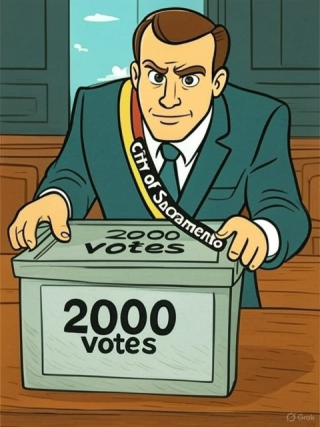
Sacto_votes

The above is the image Skynet returned when we
asked for a graphic for this post

The California Court of Appeal’s recent opinion in Dessins LLC v. City of Sacramento, No. C100644 (July 9, 2025) doesn’t deal with eminent domain or takings, but is about municipal fees and the way California requires these things get adopted. But we’re going to cover it, if only briefly. 

Why? Because it turns out that this decision tells us a lot about how California courts seem to look for any way to uphold exercises of government power. And when that power comes directly into conflict with the voters as it does here, one guess who wins.  

A bit of background for you non-Californians.

If you were to not have an understanding of the history of local fee collection and property taxation in California, you might be under the impression that it is pretty tough
Continue Reading One City, Many Votes: Cal App OK’s Municipal Sleight-of-Law To Permit City To Impose Fees… On Itself (And Others)

JLEPcover

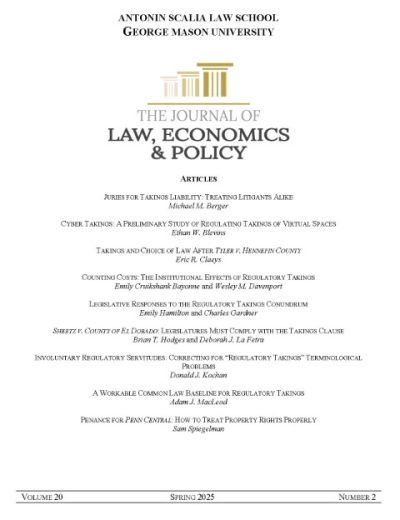
Last year, we attended a conference devoted to the future of regulatory takings, hosted by the Antonin Scalia School of Law (George Mason U), and Pacific Legal Foundation.

The publisher, the Journal of Law, Economics, and Policy has released the articles and essays from that conference, and made them available here

Here’s the list of articles:

  • Michael M. Berger, Juries for Takings Liability: Treating Litigants Alike
  • Ethan W. Blevins, Cyber Takings: A Preliminary Study of Regulating Takings of Virtual Spaces
  • Eric R. Claeys, Takings and Choice of Law After Tyler v. Hennepin County
  • Emily Cruikshank Bayonne and Wesley M. Davenport, Counting Costs: the Institutional Effects of Regulatory Takings
  • Emily Hamilton and Charles Gardner, Legislative Responses to the Regulatory Takings Conundrum
  • Brian T. Hodges and Deborah J. La Fetra, Sheetz v. County of El Dorado: Legislatures Must Comply With the Takings Clause
  • Donald J. Kochan, Involuntary Regulatory Servitudes:


Continue Reading New Property Rights Symposium Published – “Too Far: Imagining the Future of Regulatory Takings”

Here’s the latest in a case we’ve been following.

In Idaho Power Co. v. Bean, No. 23CV12213 (July 9, 2025), the Oregon Court of Appeals reversed a trial court ruling which held that Oregon’s precondemnation entry statute, which requires “reasonable compensation” for physical damage or substantial interference with the owner’s possession or use, sets the bar too high and the U.S. and Oregon Constitutions require “just compensation” for any appropriation of a right to physically invade, not just for physical damage or substantial interferences.

The court of appeals held that “temporary precondemnation entries–at least insofar as they do not cause any ‘substantial interference with the property’s possession or use’ or ‘any physical damage’–are consistent with ‘longstanding background restrictions on property rights’ and ‘traditional common law privileges to access private property.'” Slip op. at 699. In short, the court concluded that the U.S. and Oregon constitutions permit exactly

Continue Reading Oregon App: Not All Precondemnation Entries Are Takings – It’s Gotta Be “Substantial”

“The Irrigation District will disavow any knowledge of your actions…”

In Hamann v. Heart Mountain Irrigation District, No. S-24-0234 (July 11, 2025), the Wyoming Supreme Court unanimously held that a state agency cannot avoid its obligation to provide just compensation when its employee causes a taking or damaging of private property, merely because the employee was not acting under an express instruction to take or damage property. 

In short, an agency can’t simply disavow actions of its employees that take take or damage property (or in this case, physically injure the owner). 

This is one of ours, so we are not going into great detail, but here is the short story.

A county road runs along the northern boundary of Hamann’s ranch. The Irrigation District operates and maintains a canal adjacent to the road and has used the northern road for access for decades. But the District also

Continue Reading Wyoming: Inverse Condemnation Claim Is How Owners Protect Property Rights Even Where Government Hasn’t Instituted Formal Action

What’s going on in the Sixth Circuit? First, there was this opinion in Howard v. Macomb County, which in our view really missed the Knick vibe and resurrected the overruled Williamson County “state procedures” requirement.

Now there’s a doubling down, OPV  Partners, LLC v. City of Lansing, No. 24-2035 (July 9, 2025). Unpublished, most likely because it doesn’t add anything new to an existing existing circuit split, and relies on Howard. Neither OPV nor Howard uses the word “exhaustion” or even mentions Williamson County or worse yet, Knick. Nor do they mention administrative remedies. But that’s sure what it looks like to us.

The issue in OPV was whether the city is liable for, inter alia, taking OPV’s private property by denying a certificate of occupancy for residential units that OPV rented. The city had flagged these units for maintenance problems and hit them with “pink”

Continue Reading CA6 Adds To Williamson County Resurrection: You “Forfeit” Your Takings Claim When You Don’t Exhaust Administrative Procedures To Ask For Compensation

The latest episode of the Is That Even Legal?” podcast features a familiar voice, that of former Eminent Domain Podcast host, Clint Schumacher who joins host Bob Sewell as a guest to discuss takings by eminent domain, and by overregulation. 

Clint joins the ITEL Podcast to discuss a situation that has been in the news lately, the possible taking of American-born Pope Leo XIV’s childhood home in Illinois to preserve it. What was just an old house yesterday is today history worth preserving, apparently!

Here’s a description of the episode:

What happens when the government decides it needs your land? Does the Constitution really allow officials to seize your family home, farm, or business property against your will? The answer might disturb you.

Attorney Clint Schumacher, a leading eminent domain expert, joins us to unravel the complex world where constitutional rights, property ownership, and government power collide. Schumacher

Continue Reading New “Is That Even Legal” Pocast Ep: “This Land Is Your Land…Till It’s Not” (Clint Schumacher)

A fascinating dirt … err water law (?) decision from the Texas Supreme Court.

We were all set to write up the recent decision in Cactus Water Services, LLC v. COG Operating, LLC, No. 23-0676 (June 27, 2025), when the Texas Agriculture Law Blog beat us to the punch and published a great summary and analysis of the case that we could never beat. Check out Tiffany Lashmet, “Texas Supreme Court: Produced Water Conveys to Mineral Lessee” (June 30, 2025) for details and analysis. 

The fight was between the surface owner and the owner of the mineral estate about who owns “produced water,” a fancy way of saying the byproduct of fracking for oil and gas. As the court described it, it is “a mixture of fracking fluid, hypersaline brine, residual hydrocarbons, and other substances of varying concentrations.” Slip op. at 6-7. Perhaps not surprisingly, until fairly recently

Continue Reading Texas: Liquid Oil And Gas Waste Belongs To Mineral Owner

Bradyfrontpage

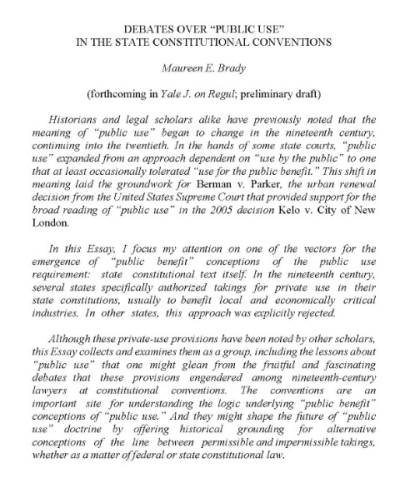
Be sure to check out the latest scholarship from lawprof Molly Brady, which sheds new light on the public use question in eminent domain, “Debates Over ‘Public Use’ in the State Constitutional Conventions,” forthcoming from the Yale Journal of Regulation. 

Here’s the Abstract:

Historians and legal scholars alike have previously noted that the meaning of “public use” began to change in the nineteenth century, continuing into the twentieth. In the hands of some state courts, “public use” expanded from an approach dependent on “use by the public” to one that at least occasionally tolerated “use for the public benefit.” This shift in meaning laid the groundwork for Berman v. Parker, the urban renewal decision from the United States Supreme Court that provided support for the broad reading of “public use” in the 2005 decision Kelo v. City of New London.

In this Essay, I focus my

Continue Reading Forthcoming Article: Maureen Brady, “Debates Over ‘Public Use’ in the State Constitutional Conventions,” Yale J. Regulation

001q

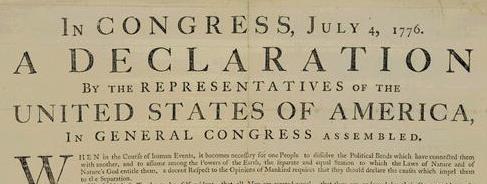
It’s not quite “Yes Virginia…” but here is our annual Independence Day missive on the legal angle on the Declaration. This may have special significance as the nation is in the process of reexamining many of our assumptions and history. But though the Founders may have been flawed individuals — as we all are — there’s really no question about the ideas they captured, and, thankfully, put down on for posterity.

—————————————————————————————

We know lawyers are easy targets (we enjoy lawyer jokes as much as the next person, i.e., What’s the difference between a good lawyer and a great lawyer? A good lawyer knows the law; a great lawyer knows the judge.).

Nonetheless, as we celebrate our independence, we note that author Thomas Jefferson and 23 other of the 56 signers of the Declaration of Independence were lawyers, and that the document was crafted and understood fundamentally


Continue Reading The Verified Complaint In Equity: The Declaration Of Independence, v.249

Here’s the latest in a case we’ve been following.

In Hudson Valley Property Owners Ass’n v. City of Kingston, No. 59 (June 18, 2025), the New York Court of Appeals held that after a municipality declares a housing emergency allowing it to regulate the amount of rent, it has the power to order lessors to refund to tenants rent which exceeded the maximum allowed amount, even if those rents had been collected prior to the declaration of the emergency. 

At least that is how we read the opinion. Due to its somewhat unusual procedural posture, the court did not actually allow the city to nail property owners for retroactive “overcharges,” it merely rejected the owners’ claims that because the statute may allow it in particular cases, it isn’t facially unconstitutional.

This was a facial challenge by property owners to Kingston, New York’s declaration of a housing emergency during

Continue Reading NY: In A Housing “Emergency,” City Can Retroactively Lower The Rent, Even Rent Collected Before The Emergency