January 2026

Need an excuse to be in Honolulu mid-winter?

If you are still looking for a reason to head to the 808 next month, here it is. The 2026 Future of Property Law Conference, February 13, 2026 at the University of Hawaii School of Law.

Chaired by Professor David Callies, the agenda features dirt law luminaries (and others, us included) speaking about topics like housing, the ALI Restatement, Coastal Protection/Public Trust, and IP/AI Property. (We are speaking on “Physical and Regulatory Takings” at 9:15am.)

Speakers include Thomas Mitchell, Jim Burling, John Infranca, Henry Smith, and Thomas Merrill.

See the complete agenda and speaker list (and registration) here.

Here’s the official program description:

This 1-day conference is a must attend for any attorney or professional whose practice involves land use and development. Distinguished land-use practitioners, scholars, planners, and regulators from Hawaii and the Mainland will discuss timely and relevant issues

Continue Reading 2026 Future of Property Law Conference, University of Hawaii Law School, Feb 13, 2026 (Live & Webcast)
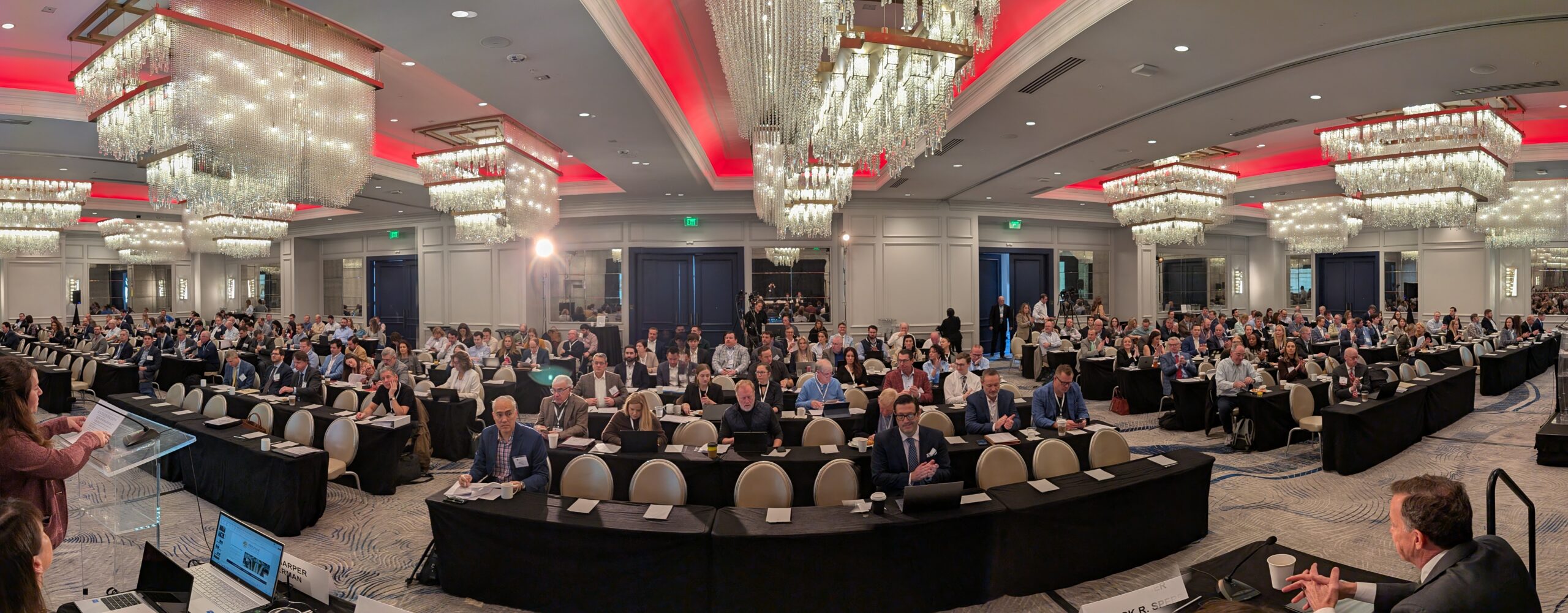
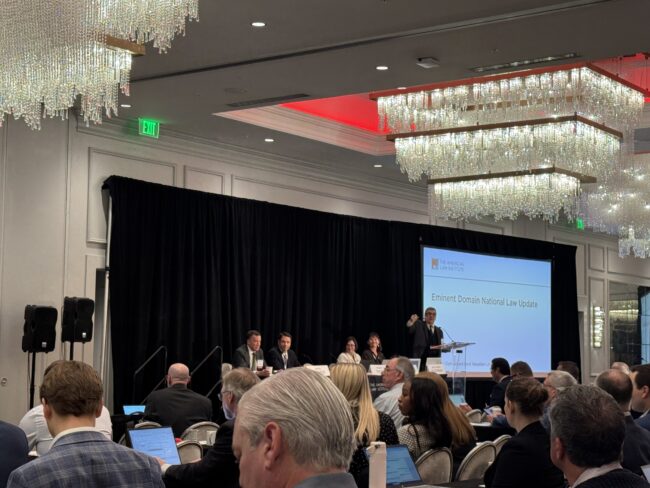

The view from the podium

That’s right. More than 300 of the nation’s best eminent domain lawyers, judges, appraisers, right-of-way agents, scholars, and other industry professionals are in Savannah for the next two and a half days for what is now known as the American Law Institute (“ALI” alone, no longer with the “-CLE” addition) Eminent Domain & Land Valuation Litigation Conference.

We’re now in our 43d edition and have a record attendance as the above photo, taken from the podium as we got underway, shows.

The view from the audience

If you are not here, you really should consider joining us. We’ll announce the location for the 2027 Conference tomorrow (hint: it will be in the west).

We’ll have more as the Conference progresses.

Continue Reading We’re Underway At The 43d American Law Institute Eminent Domain & Land Valuation Conference, Savannah

We’re deep in the throes of winter, and spring training won’t start for another month, but for those of you who are fans of the National Pastime — particularly if you are like us and a child of 1970’s baseball — then be sure to check out the U.S. Court of Appeals for the First Circuit’s recent opinion in Clemente Properties, Inc. v. Pierluisi-Urrutia, No. 23-1922 (Jan. 16, 2026).

The court had before it case where the owner of the trademark of the great Roberto Clemente (his family) sued officials of the Commonwealth of Puerto Rico, after the Commonwealth used a likeness of Clemente on commemorative license plates, among other things. The claims included not only Lanham Act, but also a claim for a taking without compensation. The district court tossed both claims.

Most of the opinion is dedicated to the trademark stuff. We’re just country takings

Continue Reading CA1: Government’s Use Of Roberto Clemente Trademark Isn’t A Categorical Physical Invasion Taking

Each year, the Texas A & M Journal of Property Law publishes a symposium on some aspect of dirt law.

This year, the subject is “Day Zero: How Cities Run Out of Water.”

Here’s the program description:

This symposium is centered around Professor Rhett Larson’s (Arizona State University) forthcoming book, Day Zero: How Cities Run Out of Water (Cambridge University Press).

For many people around the world today, “Day Zero” refers to the day a city runs out of water. Cities across the globe have faced a Day Zero Crisis: Cape Town, South Africa; Chennai, India; and Mexico City, Mexico. The experience of potentially confronting Day Zero has given rise to prophets of doom, heroic reformers, complacency and overreaction, propaganda to frighten and mollify, false starts, and stagnant failures.

In this symposium, legal experts from across the country will explore how these and other cities experience Day

Continue Reading TAMU Law’s Journal Of Property Law 2026 Symposium: “Day Zero: How Cities Run Out of Water” (Feb 6, 2026)

We were all set to offer our deep thoughts about the recently-published opinion of the California Court of Appeal in Mendocino Railway v. Meyer, No. A168497 (Jam. 7, 2026), which held that the Skunk Train (a “train to nowhere” that carries tourists up in California’s redwood country) is a “common carrier” with the power of eminent domain when Professor Shaun Martin’s California Appellate Report beat us to the punch.

In this post, Professor Martin writes:

Here’s the lingo that my teenage children would likely employ after reading this opinion:

Sus.

It’s not that the Mendocino Railway isn’t an actual railway. It is. It’s got train tracks and a locomotive, after all.

But it want to seize some private property via eminent domain. Property belonging to someone else.

Now, apparently, you can do that if you’re a common carrier. That itself seems super dubious to me, honestly. I

Continue Reading Cal App: Skunk Train Is A Common Carrier With Power Of Eminent Domain

Here’s the latest in a case we’ve been following closely. (We won’t be commenting much, because it is one of ours.)

In The Coalition for Fairness in Soho and Noho, Inc. v. City of New York, No. 112 (Jan. 13, 2026), the New York Court of Appeals (dun-dun) held that

New York City wants to save space so artists can live there. If an owner wants to covert a SoHo or NoHo artist live/work space into plain old residential (because artists ain’t living in SoHo or NoHo), she better get ready to pay to the City’s Arts Fund a non-refundable fee of $100 per square foot as a precondition of even filing a building permit. When owners challenged this fee as unconstitutional under Nollan/Dolan/Koontz/Sheetz, the trial division said no.

But the Appellate Division held otherwise, concluding that the imposition of the

Continue Reading NY Court Of Appeals Tees Up A Certworthy Exactions Case

In an earlier post (“CAFED: Like We Said Before, “Inevitably Recurring” Flooding Is A Taking“), we covered the U.S. Court of Appeals for the Federal Circuit’s recent opinion in Alban v. United States, No. 23-1363 (Dec. 22, 2025), which held that the failure of the Corps of Engineers to properly operate two dams which resulted in upstream flooding when Hurricane Harvey struck was a “permanent” taking.

In this post, we’ll cover the latter part of the opinion, which dealt with the just compensation aspects of the case (each party appealed a portion of the Court of Federal Claims’s damage award).

The first claim was that the CFC’s award of compensation for damage to structures and personal property was not compensable. The Federal Circuit clarified that had the government merely taken a flowage easement, its claim to not be liable for such damage might have had some merit.

Continue Reading CAFED: Where The Government Chooses To Not Condemn But Allows It To Happen, It “Bears The Risk” That The Property Taken Is More Than The Government Wants To Pay For

A reminder: there’s still time to join us for the upcoming American Law Institute-CLE Eminent Domain & Land Valuation Litigation Conference in Savannah.

Now in its 43rd year, this flagship gathering remains the undisputed national hub for practitioners, academics, appraisers, and anyone else who lives and breathes property and eminent domain law. We will be at the JW Marriott Plant Riverside District in Savannah, where historic charm meets Southern hospitality, moss-draped oaks, riverfront vibes. If you can’t make it in person, live webcast option is available.

What makes this conference indispensable? It’s the place to reconnect and talk shop with the sharpest minds in eminent domain and property law. Whether you’re on the owner’s side, or serve as agency-side counsel, or an appraiser, the programming is customizable and multi-track: 30+ programs tackling everything from relocation benefits to regulatory takings, valuation, and courtroom techniques. With 40+ speakers from across the

Continue Reading There’s Still Time To Join Us In Savannah (Jan. 21 – 24, 2026) For ALI-CLE’s 43d Eminent Domain & Land Valuation Litigation Conference

You know the deal: property owner is sued by government to condemn her land. The owner believes that action doesn’t cover all of the property or interests that the government is actually taking. What to do next? Counterclaim in the eminent domain action, or separate inverse case?

There’s no one answer, and different jurisdictions have different requirements.

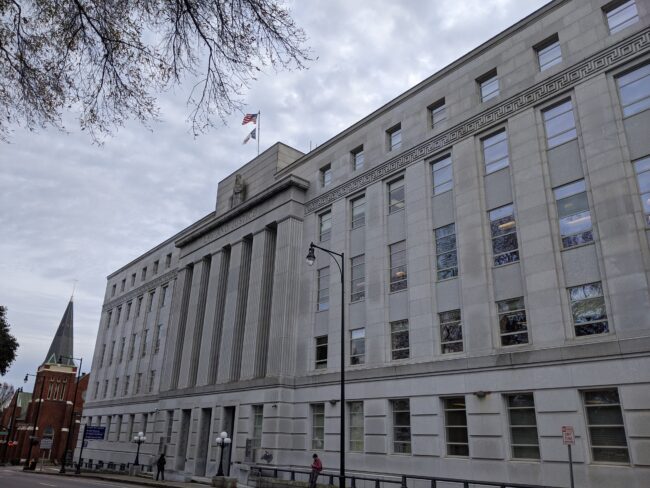
In Sanders v. N.C. Dep’t of Transportation, No. 87PA24-1 (Dec. 12, 2025), the North Carolina Supreme Court came down on the side of counterclaim in the condemnation action.

This is another one of those “Map Act” takings cases, so the facts are convoluted as in many of those cases. In Kirby v. NCDOT, the North Carolina Supreme Court held that NCDOT designating properties for possible future acquisition — which had the effect of “limiting the ability of property owners to improve their parcels and alerting potential buyers to the

Continue Reading NC: Raise Your Inverse Claim In The Eminent Domain Case…Or Else

No better way to start 2026 than to check out the Yale Journal of Regulation‘s (the self-labeled “Nation’s Top-Ranked Administrative and Corporate Law Journal”), for its symposium on the twentieth anniversary of the Kelo case.

Featuring authors who readers of this blog will recognize (all the big names), the symposium features articles you will want to dive into, including:

Arguing Kelo Then and Now” (Bullock and Berliner)

Debates Over ‘Public Use’ in the State Constitutional Conventions” (Brady)

Taking Homes” (Dickinson)

Kelo at the Crossroads of Constitutional and Administrative Law” (Epstein)

Eminent Domain, Corruption, and the Constitution” (Mahoney)

… and much more.

And while we’re on the subject, a reminder: back in October as part of the Brigham-Kanner Property Rights Conference, the William and Mary Law School Real Estate Law Society staged a “re-moot” of Kelo to see

Continue Reading Yale J. Reg. Symposium On Kelo’s Twentieth