A lot is being written about Friday’s Supreme Court opinions in Knick v. Township of Scott, No. 17-647 (U.S. June 21, 2019) (including us). Here’s a sampling. 


Continue Reading Knick Round-Up

Kungfu

We’ll be doing a longer post with our thoughts on the U.S. Supreme Court’s landmark ruling in Knick v. Township of Scott, No. 17-647 (June 21, 2019). But here’s the big picture.

It appears that at least five Justices finally seem to understand what we in the property bar have been saying for decades – that the essence of a federal “takings” claim against a local or municipal government is that “by regulation, you have deprived my property of ‘productive use’ [as Chief Justice Roberts noted on page 14 of the slip opinion], and you have not compensated me.” So it is enough that the government hasn’t paid me, and I have no obligation to “ripen” my federal claim by chasing down the local government for compensation in state court.

So nearly 100 years after Justice Holmes famously opined for the Court in Pennsylvania Coal Co. v. Mahon,

Continue Reading Williamson County Overruled: After Nearly A Century, Supreme Court Finally Has Figured Out What A Regulatory Takings Claim Looks Like

One does knick meme

Property lawyers, dust off your Federal Rules of Civil Procedure, and federal judges your long vacay from dealing with regulatory takings and inverse condemnation cases is over, because this just in: by a 5-4 margin (Chief Justice Roberts authored the majority opinion, with Justice Kagan writing the dissent), the U.S. Supreme Court today finally (finally!) overruled the state-litigation prong of the Williamson County ripeness doctrine. Knick v. Township of Scott, No. 17-647 (June 21, 2019).

Yes, overruled. Not trimmed around the edges. Overruled. 

Here’s what our quick skim turns up as a critical passage:

The Court in Williamson County relied on statements in our prior opinions that the Clause “does not provide or require that compensation shall be actually paid in advance of the occupancy of the land to be taken. But the owner is entitled to reasonable, certain and adequate provision for obtaining compensation” after a taking.

Continue Reading “The state-litigation requirement of Williamson County is overruled.”

A must-read for takings mavens. Property rights gurus Professor Gideon Kanner and Michael Berger have published a new article, The Nasty, Brutish, and Short Life of Agins v. Tiburon, 50 Urb. Lawyer 1 (2019). It’s the lead article in the latest volume of The Urban Lawyer, the law journal of our Section of the ABA, the Section of State and Local Government Law.

Barista’s note: since TUL ended its long-time editorial relationship with UMKC Law School last year, the journal has been published in-house, and we’ve taken on the role of Editor-in-Chief, in-between our lawyering and teaching day jobs. We recognize the efforts of our ABA editor, as well as our team of volunteer Associate Editors (our fellow lawyers who took on the responsibility of tech editing the pieces) in producing the journal. 

Kanner and Berger have written an informative (and entertaining) tour-de-force of modern regulatory takings law.

Continue Reading New Must-Read Article: Kanner & Berger, “The Nasty, Brutish, and Short Life of Agins v. City of Tiburon”

Our friend and colleague Dwight Merriam recently published this piece about the looming Knick v. Township of Scott decision. Yes, ripeness, and how SCOTUS will treat regulatory takings. We posted our own prognostications here (“Shaka, When The Walls Fell: Yes, Knick Will Be About Takings, But It Will Be More About Federalism“).

Awaiting ‘Knick” … Will SCOTUS Fix the Ripeness Mess?

by Dwight Merraim

The decision in an important takings case, Knick v. Township of Scott, Pennsylvania, reargued Jan. 16, is soon to be released. Be watching for it, because it could have a major impact on how governments regulate land use, and on the willingness of private property owners to challenge government regulation that overreaches. As an added bonus, we will get to see where Justice Brett Kavanaugh may position himself on property rights issues.

The issue is one of “ripeness;” specifically, whether the court should

Continue Reading Merriam: “Awaiting ‘Knick’…Will SCOTUS Fix the Ripeness Mess?”

With the opinion in the Knick v. Township of Scott case to drop as soon as Tuesday (we’re guessing the opinion will be by Chief Justice Roberts, by the way), hold on: we’re about to get super nerdy here. Impossibly nerdy. Yes, we’re revisiting the Star Trek analogies. We’ve been down this road before, even going so far as to have a colleague (who is perhaps even further down the rabbit hole than we are) present a takings CLE in his Starfleet uniform

The bottom line is this (and if you are not into Trek, you can stop right here): to us the key question which the Court is grappling with is whether a state’s judiciary is part of the state’s compensation system. If the majority of the justices conclude that it is, then don’t expect an out-and-out overruling of Williamson County, only a modest trim

Continue Reading Shaka, When The Walls Fell: Yes, Knick Will Be About Takings, But It Will Be More About Federalism

The title of this post may have you wondering, especially the part about how a regulation that invites others to physically enter private property, is determined by a court to not be a physical taking. (The court also hints at looking at a physical taking under Penn Central, and not by applying per se rules.) 

At issue in the Ninth Circuit’s 2-1 opinion in Cedar Point Nursery v. Shiroma, No. 16-16321 (May 8, 2019) was a regulation adopted by California’s Agricultural Labor Relations Board which requires agricultural employees to open their land to labor union organizers. The regulation is framed as protecting the rights of ag employees to “access by union organizers to the premises of an agricultural employer for the purpose of meeting and talking with employees and soliciting their support.”

The regulation, as the Ninth Circuit majority pointed out, “is not unlimited,” and regulates the “time

Continue Reading PruneYard Undone: California’s Union Easement – Which Invites Labor Organizers To Enter Private Property – Isn’t A Physical Taking

Photoskidrow

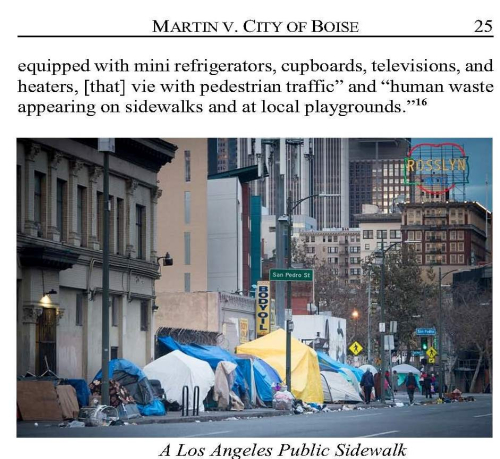
As we’ve noted before, the growing homeless and “urban camping” situation seems to be getting worse, and in our perception is reaching the point of being intractable. A trip down the sidewalk of any major city  — if you dare, particularly in the west — will confirm. And there are no easy answers, except maybe “get used to living with it.” Nor is there a consensus whether the law can do anything to remedy the problem.  

The Ninth Circuit’s latest foray into this area, this order denying rehearing and rehearing en banc of a panel opinion in a case out of Idaho, confirms. The case is a challenge to Boise’s ordinance under the Eighth Amendment’s prohibition on cruel and unusual punishments. The panel concluded that the city could not prosecute people for sleeping outside on public property because they have nowhere else to go. Until the

Continue Reading Ninth Circuit: Local Governments Cannot Enforce 24/7 Ban On Sleeping Or Camping On The Sidewalk If Nowhere Else To Go

We’ve been meaning to post the U.S. Court of Appeals for the Eleventh Circuit’s opinion in Hillcrest Property, LLP v. Pasco County, No. 16-14789 (Feb. 13, 2019), mostly because of the provocative way it starts off: 

The question before us is whether a litigant in this Circuit has a substantive-due-process claim under the Due Process Clause of the Fourteenth Amendment when the alleged conduct is the unlawful application of a land-use ordinance. The answer to that question is a resounding “no”—an answer that this Court delivered in McKinney v. Pate, 20 F.3d 1550 (11th Cir. 1994) (en banc), 24 years ago and has reaffirmed ever since. We held in McKinney that executive action never gives rise to a substantive-due-process claim unless it infringes on a fundamental right. A land-use decision is classic executive, rather than legislative, action—action that, at least here, does not implicate a fundamental right under

Continue Reading 11th Cir: The Use Of Land Isn’t A Fundamental Right, Even If “What happened to [the owner] here was pretty doggone s[tink]y.”

IMG_20180720_151841

Rather than sum up the issue and the Massachusetts Appeals Court’s** conclusion in Smyth v. Conservation Comm’n of Falmouth, No. 17-P-1189 (Feb. 19, 2019), here’s the first part of the opinion:

GREEN, C.J. A land owner brought this action in the Superior Court, claiming that local land use regulation effected a taking of her property, requiring just compensation under the Fifth Amendment to the United States Constitution and art. 10 of the Massachusetts Declaration of Rights. This appeal presents a question of first impression in Massachusetts: whether the land owner is entitled to have her regulatory taking claim decided by a jury. We conclude that the jury right does not attach to such a claim, and that the judge erred in denying the defendants’ motion to submit only the question of damages to a jury. We further conclude that the evidence presented at the trial did not, as matter

Continue Reading Mass App: Regulatory Takings Claims Don’t Get A Jury Trial