


EM Hauulaeminent_domain_abuse

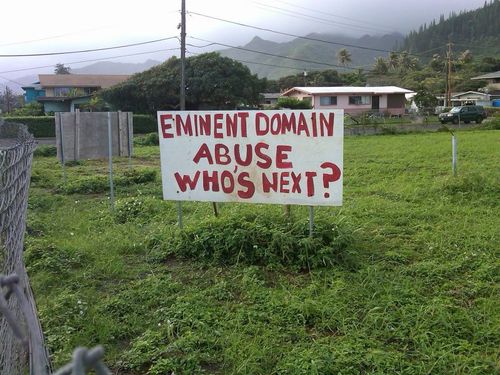
Here’s the Complaint, filed yesterday in U.S. District Court in Honolulu in which a windward Oahu property owner challenges the City and County of Honolulu’s removal of her protest signs on her property. 

The rub? She’s protesting the City’s condemnation of her property back in 2010. Her complaint alleges that the city “neither owns, manages nor maintains” the property, and that the owner continues to pay both property taxes and for the maintenance of the land. It also alleges there are other signs on nearby property with other messages that have not been touched. This seems similar to other cases in which property owners claim that the government is retaliating against them for their anti-eminent domain messages.

The complaint alleges that a few months ago, the City went on the property and posted a “removal notice” under the City’s newly-adopted “Bill 54,” an ordinance allowing the City to seize

Continue Reading New Federal Court Complaint Challenges Honolulu Grabbing Anti-Eminent Domain Signs Under “Stored Property” Ordinance

Here is a deeper look at the two lawsuits filed lastweek in U.S. District Court in San Francisco against the City ofRichmond, California, for the city’s Mortgage Resolution Partners-backed plan to condemn underwater mortgages, specifically those held by out-of-state securitizedbonds, residential mortgage-backed securitization (RMBS) trusts. The first Complaint was brought by Wells Fargo and a number of mortgage holders onbehalf of their trusts (“Wells Fargo” suit). The other, filed concurrently, was brought Wednesday bythe Bank of New York Mellon for its trusts(“Bank of NYM suit”).

My Damon Key colleague Bethany C.K. Ace has digested the complaints and provides us with her thoughts on the cases below. She joined me and Mark M. Murakami as the co-author of Recent Developments in Eminent Domain: Public Use, which is forthcoming in the next edition of the Urban Lawyer.

++++++++++++++++++++++++++++++++++

More On The Two Federal Lawsuits Challenging The Underwater Mortgage Taking Scheme

Continue Reading Guest Post: More On The Two Federal Lawsuits Challenging The Underwater Mortgage Taking Scheme

What’s this, a federal court actually allowing a federal Fifth Amendment claim to be litigated in federal court? Why that’s as rare as hen’s teeth, although it shouldn’t be

That’s the ruling of the Fourth Circuit in Sansotta v. Town of Nags Head, No. 12-1538 (July 25, 2013), which reversed the district court’s dismissal of a takings claim under Williamson County. The court of appeals held that the Town’s removal of the case to federal court waived the state litigation Williamson County defense. Other courts have rejected the same tactic (property owner does what Williamson County requires and files its takings claim in state court, only to have the government remove the case to federal court under College of Surgeons, and then argue that the federal court should dismiss the case under Williamson County), but it’s nice to see a U.S. Court of Appeals

Continue Reading 4th Cir: Town Waived Williamson County State Court Defense By Removing Case To Federal Court

It’s easy to report when you win a case, not so easy when you … don’t (at least not yet).

That’s the result in this stage of the Hawaii reapportionment case, as yesterday, a three-judge U.S. District Court denied the plaintiffs’ motion for summary judgment and entered summary judgment for the state defendants. We represent the plaintiffs by the way. Here’s the court’s Opinion and Order Denying Plaintiffs’ Motion for Summary Judgment and Granting Defendants’ Motion for Summary Judgment.

We won’t comment on the case, but we can repeat what we told the papers:

We always believed that the issues in this case merited resolution by the U.S. Supreme Court. We were hoping that a favorable decision from the Hawaii District Court would save us from taking it further, but alas no. While we have not finished reviewing the Hawaii District Court’s rationale in detail, everything we’ve

Continue Reading Three-Judge District Court: No Equal Protection Violations In Excluding Military From Reapportionment Population, Or in 44% Deviation

image from www.osborneink.com

A slight detour into our other favorite area of law, election law and voting rights. Yesterday, the Democratic Party of Hawaii (finally, after years of hemming and hawing) pulled the trigger on a federal court lawsuit seeking to invalidate Hawaii’s “open primary” laws (Haw. Const. art II, § 4, Haw. Rev. Stat. ch. 12), asserting they violate the Party’s First Amendment freedom of association.

Here are the Complaint and the Motion for Partial Summary Judgment and Preliminary Injunction, filed yesterday.

Here’s more on the story from the Honolulu Star-Advertiser (subscription may be necessary for full content). Or, try this story from Civil Beat (although it’s just a republishing of the Party’s press release). 

Complaint, Democratic Party of Hawaii v Nago, No. CV13-00301 JMS KSC (D. Haw. 6-17-2013)

Plaintiff’s Motion for Partial Summary Judgment and Preliminary Injunction, Democratic Party of Hawaii v N…


Continue Reading Members Only: Hawaii Democratic Party Seeks Closed Primary

Here’s the Brief in Opposition filed recently in City of Los Angeles v. Lavan, No 12-1073 (cert. petition filed Feb. 28, 2013), the case in which the Ninth Circuit in a 2-1 panel decision held that the city could not presume that property owned by homeless people in the Skid Row area was abandoned, and enjoined the city from seizing and destroying it when the owner was “momentarily away” from it.

Hawaii connection: The petiton pointed out a federal lawsuit filed in December 2012 alleging that the City and County of Honolulu violated the due process rights of “De-Occupy Honolulu” members (those folks who are still camping on the sidewalk next to Thomas Square across Beretania from the Honolulu Museum of Art). As noted here, we didn’t think that Lavan would have a direct impact on Honolulu’s “stored property” ordinance, or the more recently-adopted ordinance to deal with

Continue Reading Brief In Opposition In SCOTUS Homeless Property Case

The Washington Post reports that “Bob Fletcher, who saved farms of interned Japanese Americans, dies at 101,” and tells one small and little-known part of America’s internent of Japanese Americans during the Second World War. 

Once the evacuation was ordered and the internments began, Fletcher “quit his job [as a state agricultural inspector] and went to work saving farms” owned by three Sacramento-area families. He worked the land, and paid the mortgages and taxes. Unlike many of their neighbors, these families’ farms were there when they were released. Many Japanese American families (including ours, on mom’s side of the family, who lost their Sacramento-area farm) lost everything when they were transported to the camps, because unlike the farms that Fletcher saved, theirs were gone when they returned, lost to squatters, the banks, or the tax man.

For more on the legal aspects of the internment, see “Unfinished

Continue Reading Losing One Of The Good Guys

If you haven’t figured out by now, we like takings claims. We really do. But here’s one where we think the Third Circuit reached the right result when it concluded that there was no compensable taking. National Amusements, Inc. v. Borough of Palmyra, No. 12-1630 (May 9, 2013).

Why? Because when there may be an unexploded artillery shell on the property, and as a result the government seals off the property and temporarily closes the business conducted thereon, we don’t think the Takings Clause requires compensation, that’s why. The property owner thought otherwise, and in response to the Borough’s order to shut down after someone discovered that a flea market site was also former WWII-era muntions magazine and testing area, and that there was still some of that stuff left over, it objected:

The gist of the Complaint is that Palmyra overstated the danger posed by the unexploded munitions

Continue Reading Third Circuit: Closing A Business To Remove Unexploded Munitions Is Not A Taking

Here’s the opinion of the California Court of Appeal (1st District) in an appeal we’ve been following, Lockaway Storage v. County of Alameda, No. A30874 (May 9, 2013), affirming that the County of Alameda is liable for a temporary regulatory taking under Penn Central, and awarding the property owners nearly three-quarters of a million in attorney fees.

The entire opinion is worth reviewing, but here’s the short story. Lockaway purchased agriculturally-zoned land in the East Bay area for use as a boat and RV storage facility, an alternate conditional use in ag-zoned land. For over a decade, the property had been used as such pursuant to a series of Conditional Use Permits. In 2000, however, the voters of the county approved an initiative which prohibited the development of storage facilties, unless approved by public vote. The ordinance contained a provision allowing “minimum development” if the prohibition would deprive

Continue Reading Cal App Affirms Penn Central Temporary Regulatory Taking