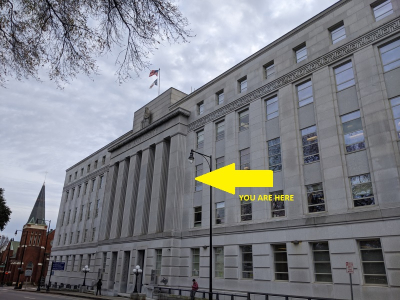
The DC Court of Appeals’ (note: not the U.S. Court of Appeals for the D.C. Circuit) opinion in Gordon v. District of Columbia, No. 20-CV-0568 (Feb. 15, 2024), presents a good cross-section of property rights issues. Not a good outcome on property rights issues, mind you.

If nothing else, be sure to check out the outrageous facts in the case. They will make your toes curl. 

The Gordon brothers own a home in the District, in the Forest Hills area. They didn’t want to be owners of this home, and instead wanted to sell it. Consequently, they took some of the usual steps one takes when one wants to sell a home – they retained a real estate agent, authorized certain entries for looky-looks (but did not ok free access or open house showings), and the like.

This aroused the ire of some of the area’s residents, who were
Continue Reading DC App: $350k Loss In Value Due To Home’s Historic Designation Not A Penn Central Taking

PXL_20230509_183011703

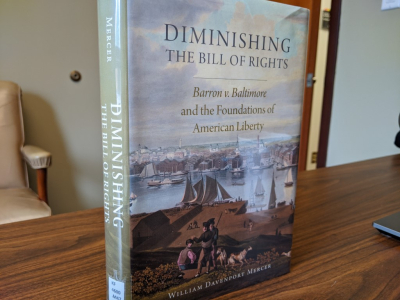
Today’s the day, 191 years ago, when — a mere 5 days after oral arguments — the U.S. Supreme Court issued its (in)famous opinion in Barron ex rel. Tiernan v. Mayor and City Council of Baltimore, 32 U.S. 243 (1833).

Generations of law students study this one in their Con Law classes, and it is mostly known as the case which held that the Bill of Rights limits only the federal government and does not limit the power of states. For the latter, one must look to state constitutions. Barron, of course, was overruled or otherwise neutralized by the Fourteenth Amendment (privileges or immunities clause or the due process clause, take your pick).

But the reason we’re posting our sad birthday wishes today isn’t for that reason, but more because in our estimation, Barron was the first “takings” case considered by the U.S. Supreme Court.

The case was instituted

Continue Reading Sad 191st Birthday To You, Barron v. Baltimore (Feb. 16, 1833) – The First SCOTUS Takings Case?

NCSCT
The historic Supreme Court of North Carolina.

Here’s the latest in a somewhat strange case we’ve been following about what happens after a court determines that a taking lacks a public use — but the condemnor goes ahead and just seizes the property anyway.

The Town of Apex, North Carolina, sought to take an easement across Rubin’s land. She objected, asserting the taking was not for a public use or purpose, but rather to benefit a private party: a developer who needed the easement to connect two of his non-contiguous parcels to the municipal sewer system, a precondition of the Town’s development approvals for his proposed residential subdivisions.

While Rubin’s public use objection was pending, the Town went ahead at installed the sewer line, purportedly under its quick-take power. That was not the best of moves, however, because the courts eventually agreed with Rubin that the taking violated the public

Continue Reading The Public Use Requirement Is Self-Executing: “In a free society, we should not expect that when a court tells the government that a taking is illegal and unconstitutional, that it would just go ahead and seize the property anyway.”

DSCF3357

If you dream such dreams as this photo, read on.

My law firm, Pacific Legal Foundation, is on the hunt for lawyer to join our Property Rights group (yours truly is the Director of Property Rights Litigation, so you will be working with me and the other takings and con law mavens in our practice). Here’s the full description of the spot:

You: An entrepreneurial freedom fighter with a passion for property rights litigation. You work with more senior-level attorneys to find and win cutting-edge property rights cases in trial and appellate across the country. You work as a part of a collaborative team, but are also self-motivated and able to work independently with minimal supervision. You are eager to learn, relentless, and a focused lawyer.

Them: Bureaucrats, city councils, mayors, governors, and federal agencies stripping Americans of their rights every day. There’s a lot of government overreach out there

Continue Reading Dig Property Rights? Join Our Firm As A Courtroom Property Rights Lawyer

“No need to ask, he’s a smooth operator…”

On Tuesday, January 16, 2024, the Supreme Court will hear arguments in a case we’ve  been following closely because it involves the fundamental limitation on the sovereign power to take private property. In our system, the sovereign indeed has the power to take private property against the will of the owner, but only if the taking is accompanied by just compensation.

Before we go on, a disclosure: we filed an amicus brief supporting Devillier’s arguments, so we’ve have an obvious bias. Special kudos to our law firm colleagues — and self-executing Just Compensation mavens — Deb La Fetra and Kady Valois for this brief.

Texas Flooded Devillier’s Property

Here are the facts in Devillier v. Texas. As part of a road project, the Texas Department of Transportation caused Devillier’s property to flood. The state flooding someone’s property is one of those

Continue Reading Devillier v. Texas Argument Preview: Do Courts Need Congress’ Permission To Enforce The Right To Just Compensation?

As 2023 comes to a close, here are a few of the decisions that we wanted to blog about, but didn’t have the time.

  • Bruce v. Ogden City Corp., No. 22-4114 (10th Cir. Dec. 1, 2023): city demolishing a building that was damaged by fire was not a Lucas taking because the owner still has use of the land (even though the building is gone). And no Penn Central taking because… Penn Central.
  • Moriarity v. Indiana, No. 22A-PL-2899 (Ind. Ct. App. Nov. 15, 2023): State ordering removal of illegal dam was not a taking under U.S. or Indiana Constitution. The owners don’t have a property right to build an illegal dam. Thus, the “background principles” exception to Lucas rules the day. And no Penn Central taking because the owners never had any investment-backed expectations they could build this dam.
  • Lafayette Bollinger Dev., LLC v. Town of


Continue Reading 2023 Year-End Clean Up

You remember that longstanding trope: that matters of land use are “local” issues, and thus in civil rights claims involving a state or local government interfering with the right of property federal courts should avoid adjudication until the government has had every chance to do the right thing (even where it is patently obvious that it has no intention of doing so)? This trope most often shows up as a part of a ripeness dismissal, where the court says “too soon,” because, well, if given enough time and opportunity, the government might render adjudication unnecessary.

Well, in Ateres Bais Yaakov Academy of Rockland v. Town of Clarkstown, No. 22-1741 (Dec. 8, 2023), the U.S. Court of Appeals for the Second Circuit held a land use case ripe, and in the process blew up this overripe trope. Whoa!

But before you takings mavens get too excited, this is a RLUIPA

Continue Reading “Super-Zoning Board” No More – CA2 Busts The “Land Use Is Local” Trope: Town ZBA Doing Nothing On Variance Application Ripened Constitutional Claim

“No need to ask, he’s a smooth operator…”

Here’s the amicus brief we just filed in a case we’ve (obviously) been paying close attention to.

This is Devillier v. Texas, the case in which the Supreme Court is considering what does the it mean when it describes the Just Compensation Clause as “self-executing?” Do you need statutory authorization in order to bring a takings or just compensation claim, or can you sue directly under the Constitution? Does it matter that Congress has adopted a statute which authorizes damages suits against local governments (“persons”), but has not expressly done so against states qua states?

We say no and our brief explains why.

Note that there’s no Eleventh Amendment issue here, because Devillier filed his federal claims in a Texas court, and it was the State of Texas that removed it to federal court (thus forfeiting any 11A claim, because

Continue Reading “The courts don’t need Congress’s permission to enforce the self-executing constitutional right to just compensation.”

Check this out, our law firm colleague Joshua Thompson talks about regulatory takings, and his big Supreme Court victory in Cedar Point Nursery.

If you are reading this blog, you already know what that means. Regulatory takings. Bundle of sticks. Penn Central (bleh), and right to exclude. Here’s the description of the program:

In this thought-provoking episode, Bob Stetson and Joshua Thompson, Director of Equality and Opportunity Litigation at the Pacific Legal Foundation, discuss the landmark case of Cedar Point Nursery vs. Hassid and explore the intricate balance between private property rights and public interests. What constitutes a ‘taking’ and how far government regulations can go in the name of the public good?

Stream it above, or listen on Spotify here.

(Our own thoughts on the Cedar Point case here.)Continue Reading New Podcast: The Cedar Point Takings Case (From The Guy Who Argued Cedar Point)

Erasing the Black Spot from WHRO on Vimeo.

As we first noted here, Hampton University and WHRO recently produced a live program on “Erasing the Black Spot – How Virginia Universities Have Disrupted Black Neighborhoods.” We couldn’t make it in person, but watched the live-stream.

Now, as we hoped, the recorded program has been published. Stream it above, or watch here on Vimeo. Here’s the description:

Virginia’s public universities have a long history of expanding campuses in the name of progress and economic growth. But often, these expansions used eminent domain and property seizures to disrupt and diminish thriving Black communities across the state.

An investigative series by The Virginia Center for Investigative Journalism at WHRO and ProPublica uncovers the damaging social and economic impacts on Black communities of college expansions at Christopher Newport University, Old Dominion, and the flagship University of Virginia.

In the

Continue Reading Program Recording: “Erasing the Black Spot” – Virginia’s Use Of Eminent Domain To Take Minority Property