Here’s the merits brief in a case we’ve been following (naturally, because it is one of ours). This is Sheetz v. El Dorado County, the case which asks whether a condition on development (aka an “exaction”) is exempt from the close nexus and rough proportionality standards of Nollan/Dolan/Koontz simply because the exaction is imposed on every owner who asks for permission to use its property, and not via an ad hoc administrative permit procedure.

Because this is one of ours, we’re not going to go into in further, but leave to you to read our brief:

In this Court’s key exactions precedents—Nollan, Dolan, and Koontz—it held that when government exacts money or real property as a condition on the right to use or develop land, it must establish that the exaction bears an “essential nexus” and “rough proportionality” to an adverse public impact caused by the owner’s proposed


Continue Reading Legislative Exactions Merits Brief (Ours): “the text and history of the Takings Clause admit no exception for legislative takings”

ALI-CLE brochure cover page

Here’s the brochure and the full agenda and registration information for the upcoming ALI-CLE Eminent Domain and Land Valuation Litigation Conference at the JW Marriott in New Orleans, February 1-3, 2024.

This is the long-running nationally-focused conference on all things eminent domain, takings, valuation, and related. We have three tracks, from which you can choose a la carte – Practice, Substantive, and Condemnation 101:

For over 40 years, we’ve been bringing eminent domain practitioners together to examine the latest issues, engage in healthy debate, and get the information they need to stay current in their practice. This year – our 41st – is THE perfect time to reunite with your eminent domain colleagues. There will be plentiful opportunities to meet and mingle with the faculty and other registrants – throughout the conference and at evening social events. Attendees come back year after year to make new friendships and renew

Continue Reading Here’s The Program For The 41st ALI-CLE Eminent Domain And Land Valuation Litigation Conference, Feb 1-3, 2024, New Orleans

PXL_20230426_222217568
(Tip for applicants: understanding the symbology of the
Law School’s logo will show you know the score.)

Here’s your chance to teach Property and Land Use in what might be most interesting venue on Planet Earth for those subjects: the University of Hawaii School of Law has put out a call for applications for a tenured lawprof (along with six other openings in other subjects):

The University of Hawaiʻi at Mānoa, William S. Richardson School of Law seeks to fill up to seven tenured or tenure – track positions . For doctrinal faculty, we are seeking to fill positions in Constitutional Law (tenured or tenure – track) and Property /Land Use (tenured). We welcome candidates who, in addition to one of those two fields, have expertise in Administrative Law, Business and Commercial Law, Environmental Law, Family Law, Health Law, Intellectual Property, Labor and Employment Law, Native Hawaiian Law

Continue Reading Live The Dream! Teach Dirt Law In Hawaii: UH Law School Looking For Property & Land Use Lawprof

Here’s a short one from the Kansas Supreme Court. In Kansas Fire and Safety Equipment v. City of Topeka, No. 123,063 (June 30, 2023), the court concluded that the requirements of the Kansas Relocation Act do not give rise to a private right of action, and that relocation costs are not a component of just compensation. 

We’re not going to dwell on the decision too much, since it is limited to Kansas law. But here are your highlights:

  • “Kansas Fire and Safety Equipment, Hal G. Richardson d/b/a Bueno Foods Brand and Topeka Vinyl Top, and Minuteman Solar Film (the tenants), were forced to relocate when the City of Topeka (the City) bought the real property the tenants leased for their business operations. The tenants alleged that the property was acquired before a condemnation action. And they sued the City to recover relocation expenses in an action filed directly with


Continue Reading Kansas: No Private Enforcement Of State Relocation Act (And Relocation Isn’t Part Of Just Compensation)

One from the Louisiana Court of Appeal, 3000-3022 St. Claude Avenue, LLC v. City of New Orleans, No. 2022-CA-0813 (June 22, 2023) demonstrating that the standard of judicial review for zoning matters (rational basis) is pretty powerful.

The owner wanted to develop its New Orleans property, but first needed a zoning amendment from residential to commercial, followed by a conditional use permit for its proposed use. The city denied the request. After much procedural back-and-forth, including a trip to the court of appeal to resolve, the case was sent back to the city council to state the basis for the denial. The council held a public meeting at which it denied the rezoning, and declined to state more, including the reasons why.

So back to court the owner went. The trial court thought it had been clear enough: you were supposed to say why you denied the rezoning. Hearing

Continue Reading Nectow Is Meaningless Because It “relies on pre-Lochner administrative review jurisprudence”

At first, the Iowa Supreme Court’s opinion in Juckette v. Iowa Utilities Board, No. 21-1788 (June 16, 2023) looks like a promising read. The issue — is a utility expanding its use of an express road easement to install electric lines a taking? — is one that we’ve been following.

But by the time you get to the end of the short opinion (10 pages), you realize the court didn’t decide much, other than yeah, the utility has the statutory authority to use the easement this way. The court can’t reach a decision on whether that’s a taking for public use. Not because there’s some problem with the case or the way it was presented, but because one of the Justices on the seven-member court sat it out and the remaining six couldn’t agree. Affirmed by an equally divided court, 3-3. 

This apparently is not that unusual in

Continue Reading Iowa Supreme Court Can’t Decide Much Of Anything In Power To Take Challenge

Here’s the cert petition, filed last week, in a case we’ve posted about. See here (Ninth Circuit arguments) and here (en banc petition).

The Ninth Circuit affirmed dismissal of a takings claim because (it held) the claim isn’t ripe. The government hasn’t made up its mind, and just might allow the owners to make some use of their residentially-zoned land (even though the property is also subject to an overlay zone that expressly prohibits residential development). More background here

This is one of ours, so we’re not going to be saying too much more about it. The petition also lays out the situation.

Here are the Questions Presented:

Randy Ralston and Linda Mendiola (Ralstons) wish to build a retirement home on their residentially-zoned land in San Mateo County, California. However, their property sits entirely within an overlay zone, the Montecito Riparian Corridor (Corridor), which categorically bans residential

Continue Reading New Takings Ripeness Cert Petition (Ours): Knowing The Permissible Uses “to a reasonable degree of certainty” Is All You Need For A Claim To Be Ripe

Screenshot 2023-06-07 at 07-14-12 Google Maps

Here’s the latest from the U.S. Court of Appeals for the First Circuit on takings ripeness, Haney v. Town of Mashpee, No. 22-1446 (June 6, 2023). 

The case centers on Gooseberry Island, Massachusetts, which is zoned by the Town of Mashpee as R-3. But under the Town’s zoning code, any residence must have at least 150 feet of frontage and a paved access roadway within 150 feet.

Which is problematic because Gooseberry Island is, well, an island — separated from the mainland by a 40 to 80 foot channel depending on the tides. There’s no bridge, although you can wade across the channel at low tide. No bridge means no roads, and no roads means no residential development.

So the owner sought variances from the frontage and roadway requirements in 2013. Denied. The road and frontage requirements are about emergency access. Next, the owner sought approvals to build a

Continue Reading CA1: Despite Two Variance Denials, Takings Case Not Ripe Because It Isn’t Futile To Try Again

Bohon

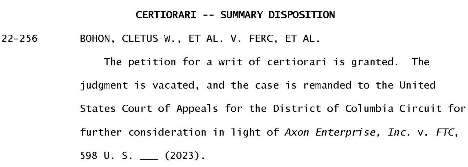
In this Order, the Supreme Court granted this cert petition which presents these questions:

Whether a facial challenge to Congress’s delegation of eminent domain power to private parties is properly filed in district court, as this Court held in PennEast Pipeline Co. v. New Jersey, 141 S. Ct. 2244 (2021), or with FERC, which has admitted it has no jurisdiction to adjudicate the constitutionality of this delegation.

Whether a facial challenge to Congress’s overly broad delegation of legislative power to FERC is properly filed in district court or with FERC, which has admitted it has no jurisdiction to adjudicate the constitutionality of this delegation.

Whether a facial challenge to Congress’s delegation of eminent domain power to FERC is properly filed in district court or with FERC, which has admitted it has no jurisdiction to adjudicate the constitutionality of this delegation.

As the Order notes:

Petition GRANTED. Judgment VACATED

Continue Reading SCOTUS GVR’s Pipeline Cert Petition On Delegation Of Eminent Domain To Private Parties

There’s a lot to digest in the 36-page Order of the U.S. District Court for the Southern District of Florida in case that mostly concerns the validity of an exaction a small property owner was required to pony up in order to tear down and replace an old home on its land.

Megladon bought the residentially-zoned property in 2016 to tear down the existing building and build a new one. Simple enough, right? It demolished the old house, and applied to the Village to build a new one. But the Village also needed a road, and began making noise about a “possible road dedication.” And sure enough, eventually the Village notified Megladon that “a certificate of occupancy will not be issued until dedication of the right-of-way is complete.” Slip op. at 4. There’s a dispute over exactly whose law requires such a dedication — Village or County? — but

Continue Reading Exactions, Takings, And Ripeness…Oh My! When Planning Officials Say “No,” That’s Enough (Even If They Might Have Said “Yes” Some Other Way)