Space. The final frontier. These are the voyages of the telescope Thirty Meter. Its five year continuing mission: to explore strange new worlds. To seek out a Conservation District Use Permit from the Board of Land and Natural Resources, and navigate the treacherous waters of Hawaii administrative law. To boldly go where twelve other telescopes have gone before

The “the cart before the horse,” is what the majority opinion authored by Chief Justice Recktenwald which invalidated the CDUP held the BLNR did when it “issued the permit before the contested case hearing was resolved and the hearing was held.” But the same might be said about the court’s procedural due process reasoning, because it could have reached the same result by employing a much narrower — and in our view, a much less opaque — statute-based rationale.

Dead Man Walking

Ironically — given the huge public interest in the

Continue Reading Carts Before Horses, And Pearls Before Swine: The Hawaii Supreme Court’s Fractured Rationale For Invalidating The TMT Permit

In Dimare Fresh, Inc. v. United States, No. 15-5006 (Oct. 28, 2015), the Federal Circuit held that the FDA wasn’t liable for a taking when it issued an incorrect food safety warning that hurt the tomato market, because it was just a warning and didn’t come with coercive action like a quarantine or a recall. In other words, just sayin.

The FDA thought that certain types of tomatoes from certain growing areas might be responsible for a salmonella outbreak. So it “went loud,” which in today’s internet-fueled media environment meant that over the course of the next few days, it issued two press releases, the first which identified the type of tomatoes it believed were involved (“raw red plum, red Roma, or round red” — a pretty wide net), and a second which let certain geographic areas off the hook. The FDA also briefed the media, narrowing the suspected

Continue Reading Just Sayin: No Taking For FDA Salmonella Warning Which Killed Tomato Sales

As noted in the Honolulu Civil Beat story, “Hawaii AG Backs Vermont GMO Labeling Law,” Hawaii has signed on to an amici brief in support of the State of Vermont in the Second Circuit appeal of a Vermont federal court’s ruling which rejected a challenge to Vermont’s requirement to label GMO products. The Civil Beat story reports on the brief, but as far as we can tell, doesn’t actually post the brief. Law nerds rejoice: here it is.

What is intriguing is that Hawaii chose to join this brief. Recall that Hawaii has no statewide GMO labeling laws, although it does have comprehensive laws that address the topic of GMO’s, a conclusion reached by at least two federal courts in challenges to county-adopted ordinances which deal with GMO issues (although none of the ordinances involve labeling). [Disclosure: we represented an amicus party in one of those District

Continue Reading Hawaii Joins Amici Brief In 2d Cir GMO Labeling Appeal

After the Supreme Court’s decision in Horne v. Dep’t of Agriculture, 14-275 (U.S. June 22, 2015), we were waiting for this shoe to drop. And now it has.

In “Raisin ruling seen as a lifeline for endangered species,Environment & Energy writes, “[a] Supreme Court ruling that struck down an odd Depression-era raisin program may have revived a critical government defense for endangered species and other wildlife protections, legal experts say.” 

The theory is based on the Horne majority’s rejection of Leonard & Leonard v. Earle, 279 U.S. 392 (1929), the case in which the Court upheld a Maryland state tax which required oyster farmers turn over to the state 10% of the empty oyster shells which they harvested, or pay a monetary equivalent. The Horne majority concluded that Leonard was not applicable because the oysters in Leonard were government property, in contrast to raisins, which —


Continue Reading Nice Try: No, The Supreme Court Didn’t Make Wildlife Public Property In The Raisin Case

There are many ways to keep nuisance birds off of your building or away from your crops.

There’s this one, a plastic owl perched on the 4th floor of the Maui courthouse.

6a00d83451707369e201bb08668850970d-800wi

There are other devices: scarecrows, balloons, and even dead birds. But our favorite is the scare gun, a “propane powered gas gun which produces a periodic loud explosion.” Sounds like fun.

But not to the powers-that-be in the Town of Trempealeau, Wisconsin. In 2013, the Town adopted an ordinance, amended the following year, which requires anyone who wants to use a scare gun to get a permit. These permits restrict the time, place, and manner in which the owner can employ said gun. 

Farmer Klein had used a scare gun on his property since 1962 to keep blackbirds from devouring his crops. He obtained a permit, but apparently didn’t follow the ordinance closely enough because he

Continue Reading Wisconsin App: Town’s “Scare Gun” Permit Requirement Not A Taking

We’re in Chicago this week participating in the ABA Annual Meeting. While we really are looking forward to a slate of thrilling committee meetings, what we’re really anticipating is the CLE programming. Here are what we think are the highlights:

  • Looming Land Use Constitutional Issues –  Friday, July 31, 2:45 – 4:15 pm, Westin Chicago River North Grand Ballroom B –  Four hot land use issues: land use aspects of medical marijuana legislation; takings and exactions in San Francisco’s requirement for owners to pay departing tenants huge sums; Horne and takingsNew Jersey’s dune program. With Tony Della Pelle and Stephen Schwartz (one of the counsel for the Hornes), among others. 
  • The 2014 Supreme Court Term in Review – Friday, July 31, 2015, 10am – noon, Westin Chicago River North Promenade Ballroom C – “This panel of noted legal professionals, academics and journalists provides an overview of the Supreme Court


Continue Reading ABA Annual Meeting Programming: Takings, Land Use, Supreme Court, Election Law, Appellate Traps

If you need CLE credits, you are in luck. There’s a plethora of upcoming programs that may be of interest to readers. 

First, the ones we’re involved with:

  • The Takings Issue – August 10, 2015, 1 – 2pm ET (webinar) – from the International Municipal Lawyers Association. We’re joining Professors Dan Mandelker and John Echeverria, and land use lawyer Michael Giairno, to talk takings. “Two titans of takings, who just happen to have profoundly opposing views of the world, have graciously agreed to discuss the latest developments and spar. This will be the Great Debate of 2015.” Sounds like fun, no? Registration free for IMLA members, $99 for everyone else. More information, including registration, here
  • Is Sharing Really Caring? The Law of Transportation Sharing: Uber, Lyft, and the Sharing Economy – July 30, 2015, 2:15-3:45pm CT (in-person) –  at the ABA Annual Meeting in Chicago. We’re moderating a session


Continue Reading Mark Your Calendars For Upcoming Events: Takings, Sharing Economy, Fair Housing, etc.

20150422_112618
The Hornes outside the Supreme Court

“Separate educational facilities are inherently unequal.”
Chief Justice Earl Warren,
Brown v. Board of Education

“The Fourteenth Amendment does not enact
Mr. Herbert Spencer’s Social Statics.”
Justice Oliver Wendell Holmes,
dissenting in Lochner v. New York

“…prejudice against discrete and insular minorities…”
Justice Harlan Fiske Stone, in footnote 4,
United States v. Carolene Products Co.

“Raisins … are a healthy snack.”
Chief Justice John G. Roberts,
Horne v. Dep’t of Agriculture

A Supreme Court win is a win, particularly by a margin of 8-1, so we’re not going to complain too much about the Court’s opinion in Horne v. Department of Agriculture, No. 14-275 (U.S. June 22, 2015), holding that the USDA’s requirement that raisin producers physically turn over a percentage of their yearly crops to the government without being provided compensation is a taking in violation of the Fifth Amendment.

I

Continue Reading Horne v. USDA: Way More Than Silly Raisin Jokes

LUI header

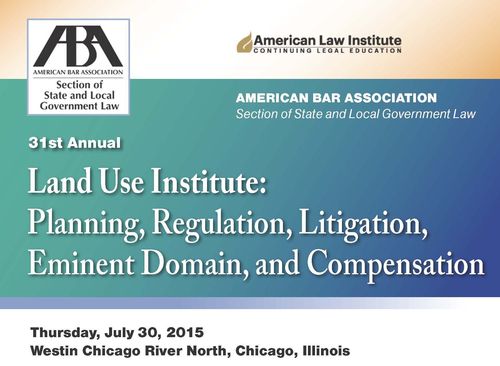
The Land Use Institute, a program that for many years has been planned by co-chairs Frank Schnidman and Gideon Kanner, has found a new home with the American Bar Association’s Section of State and Local Government Law as the main sponsor. It also has a new Planning co-chair, Dean Patty Salkin of Touro Law School, who has stepped in for Professor Kanner.

This program is designed for attorneys, professional planners, and government officials involved in land use planning, zoning, permitting, property development, conservation and environmental protection, and related litigation. It not only addresses and analyzes the state-of-the-art efforts by government to manage land use and development, but also presents the key issues faced by property owners and developers in obtaining necessary governmental approvals.

This year, the one-day program is being held in conjunction with the ABA Annual Meeting in Chicago. It will be held on Thursday, July 30, 2015

Continue Reading Land Use Institute: Planning, Regulation, Litigation, Eminent Domain, and Compensation – 31st Annual Conference, Chicago, July 30, 2015

We were involved with this issue in the days leading up to the initiative election, and we represent an amicus party in this case, so we will post the court’s order without comment.

The title of this post tells you what you want to know. 

Order Determining that the County of Maui GMO Ordinance is Preempted and Exceeds the County’s Authorit…

Continue Reading Federal Court: Maui County GMO Regulation Ordinance Preempted by Federal And State Law