PXL_20230509_183011703

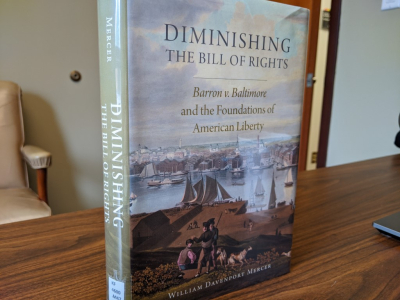
This Sunday, February 16, 2025, will be the day, 192 years ago, when — a mere 5 days after oral arguments — the U.S. Supreme Court issued its (in)famous opinion in Barron ex rel. Tiernan v. Mayor and City Council of Baltimore, 32 U.S. 243 (1833).

Generations of law students study this decision in their Con Law classes, and it is mostly known as the case in which the Court held that the Bill of Rights limits only the federal government and does not limit the power of states. For the latter, one must look to state constitutions. Barron, of course, was overruled or otherwise neutralized by the Fourteenth Amendment (privileges or immunities clause or the due process clause, take your pick). And it was formally abrogated in Chicago, Burlington and Quincy Railroad Co. v. City of Chicago, 166 U.S. 226 (1897) (states and their instrumentalities are bound
Continue Reading Feb. 16, 1833: Unhappy 192d Birthday To The First SCOTUS Takings Case, Barron v. Baltimore

Screenshot 2025-01-23 at 17-00-09 Supreme Court of Canada - SCC Case Information - Webcast of the Hearing on 2025-01-16 - 40908

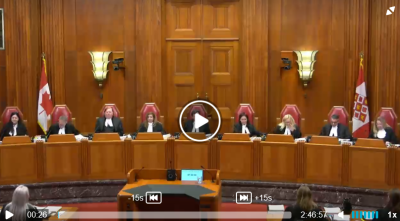
You know that from time to time — mostly thanks to our friend and colleague Shane Rayman and his firm — we cover property goings-on north of the border when a good property rights case comes before the Supreme Court of Canada (see here and here for past examples).

Well, here’s another one, this time involving the intriguing question of whether government-owned land is subject to adverse possession. Here’s where you can watch the arguments (in English or French, naturally!). As the summary of the case from the Supreme Court website notes:

The appellants are owners of a residential property in the City of Toronto. They sought an order for adverse possession of a parcel of City parkland that their predecessors in title had fenced off with a chain link fence and enclosed into their backyard. The City acknowledged that the appellants’ evidence satisfied the traditional test for adverse

Continue Reading Canada Supreme Court Hears Arguments: Is Govt Land Subject To Adverse Possession?

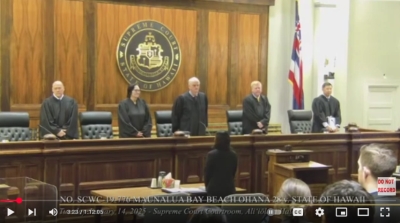
Screenshot 2025-01-18 at 14-58-03 No. SCWC-19-0000776 January 14 2025 10 30 a.m. Maunalua Bay v. State of Hawaiʻi - YouTube

Here’s the latest in a case we’ve been following for a long time.

As we previously noted, the Hawaii court of appeals affirmed a trial verdict that the just compensation owed to littoral property owners for the State’s regulatory taking of small portions of accreted beach is zero.

Last week, the Hawaii Supreme Court heard oral arguments. Here’s the video (sorry, can’t embed it here). Worth watching, if only because questions of just compensation and how it is calculated rarely are presented to this court (which is a frequent flyer in regulatory takings cases).

Here’s a description of the case and issues from the Hawaii Judiciary:

Petitioners Maunalua Bay Beach Ohana 28, Maunalua Bay Beach Ohana 29, and Maunalua Bay Beach Ohana 38 brought an inverse condemnation action against the State of Hawai‘i in 2005. At that time, they argued that the State effected a taking of accreted lands via Act 73 of 2005. In 2009, the Intermediate Court of Appeals (ICA) held that Act 73 “effectuated a permanent taking of littoral owners’ ownership rights to existing accretions to the owners’ oceanfront properties that had not been registered or recorded or made the subject of a then-pending quiet-title lawsuit or petition to register the accretions.” Maunalua Bay Beach Ohana 28 v. State, 122 Hawai‘i 34, 57, 222 P.3d 441, 464 (Ct. App. 2009).

On remand from the ICA, Petitioners sought just compensation for the alleged temporary taking of their accreted lands between 2005 and 2012. At trial, the circuit court concluded that $0 was just compensation for the alleged temporary taking of the accreted land and no nominal damages should be awarded to the petitioners. It also determined that the petitioners were not entitled to attorney’s fees.

The ICA affirmed the circuit court’s decision. With regard to attorney’s fees, the ICA held that the petitioners’ “claim for attorneys fees against the State for obtaining declaratory relief is barred by sovereign immunity.” The ICA further held that the Ohanas were not entitled to attorney’s fees under the private attorney general doctrine.

In their application for certiorari, the petitioners argue that the ICA erred in affirming the circuit court’s award of $0 in just compensation with no nominal or severance damages. Petitioners also contend that the ICA erred by concluding that sovereign immunity bars an award of attorney’s fees, and that they would not be entitled to fees under private attorney general doctrine. The State contends that the ICA did not err in affirming the circuit court’s award of $0 in just compensation or declining to award nominal damages to petitioners. It also argues that the ICA correctly held that sovereign immunity bars petitioners’ claim for attorney’s fees, and that even if it did not, petitioners would not be entitled to attorney’s fees under the private attorney general doctrine.

We watched live, and have a couple of thoughts:

  • Justice McKenna’s questions indicate she recalls that in an earlier regulatory takings case, the court concluded that even “speculation value” was enough to place a regulatory takings claim outside a Lucas wipeout analysis, an indicator that in this court’s view, property always has value, even if it has no use. Is that enough to say the owners here were entitled to, at the very least, nominal just compensation?
  • Does obtaining a decision holding the State to its constitutional obligation (after which the State repeals the unconstitutional statute) qualify the plaintiff for fee recovery from the State under the private attorney general doctrine, even where the adjudicated compensation is zero? We think so, because suing to keep the State in line when it has acted beyond its authority is exactly the kind of thing that the Attorney General should do (but didn’t here, because it has been too busy defending the State’s action). What about the advocate for the State who argued that there was no constitutional wrong here, because of the zero compensation verdict (the notion that the Takings Clause does not prohibit takings, only uncompensated takings)? The fact that the State withdrew the offending statute after the plaintiffs won the takings claim seems to contradict that argument because at the heart of it, the court ruled that the State should have used its eminent domain power to take future accreted land, and not the police power.

Stay tuned. We’ll continue to follow along and will post the court’s opinion when issued.

Continue Reading Hawaii Supreme Court Arguments: Is Just Compensation For Even A Small Slice Of A Primo Hawaii Beach Zero?

Here’s the latest in a case (and issue) we’ve been following.

In this latest iteration of what we call the “SWAT takings” issue, the Sixth Circuit, like every other federal appellate court, denied the owner of property severely damaged in the course of a police dislodging of a criminal suspect. But the court applied a different analysis. Instead of (incorrectly, we think) looking and whether the police were acting with the scope of their (ha!) police power, the court concluded that the police had a “privilege” to enter, so thus could destroy in the course of that entry, the petitioner’s property.

In short, your bundle of sticks never included the right to exclude the po-po.

Here’s the Question Presented:

A few weeks ago, this Court denied certiorari in Baker v. City of McKinney, 23-1363, a case about whether the Fifth Amendment’s Takings Clause re-quires compensation when a

Continue Reading New Cert Petition: SWAT Takings, Part X

Here’s a recently-filed cert petition to watch. We won’t go into the background, because the Questions Presented pretty much lay the foundation:

Respondent County of San Diego, et al. (County), a California land use agency, denied the land use permits for Village Communities et al. (Village) to develop a much-needed residential and mixed-use community in North San Diego County, California. The County denied the Project solely because Village “failed” to satisfy the County’s condition requiring Village to pay money to acquire offsite easements from 100 percent of the 50 property owners along a public road near Village’s property site in spite of the fact that the County made no individualized determination that the monetary exaction, a sum of approximately $2.5 million, bore an “essential nexus” and “rough proportionality” to the purported impacts associated with Village’s project as required by Nollan v. California Coastal Comm’n, 483 U.S. 825 (1987)

Continue Reading New Cert Petition: To Have A Nollan-Dolan-Koontz Claim, Must You Be Forced To Give Up Land And Money?

Two — count ’em two! — cert petitions from our shop, filed today. Both call for “clarifying or overruling” Penn Central.

Oh, have I got your attention now?

Both arise out of the Michigan governor’s orders shuttering some, but not all, businesses during Co-19. These had devastating consequences, and owners sued for, inter alia, a taking, asserting a Penn Central theory. As we noted here, the Gym 24/7 case went up through the Michigan court system, with the Supreme Court eventually denying discretionary review over an extensive dissent. The Mount Clemens Recreational Bowl case took pretty much the same path. 

We’re not going to say much more because

Continue Reading Two New Cert Petitions (Ours) – 50 Years Of Fruitless Trying Is Enough: Overrule Or Clarify Penn Central!

At first glance, it might seem like there’s a lot there in the U.S. Court of Appeals’ opinion in Becker v. City of Hillsboro, No. 23-3367 (Jan. 7, 2025).

After all, the city’s prohibition on new private wells and another requirement that newly built homes connect to the city’s water system seems a bit arbitrary (at least the opinion doesn’t give a lot of detail why, other than “the city said so”). And the opinion evaluates a Lucas wipeout, a physical invasion, a Penn Central ad hoc taking, and a Nollan/Dolan claim. Even a Murr denominator issue. This case could have been a good vehicle to examine those questions in more detail that many courts do.

But after taking a dive in, our initial impression that this case would provide a lot of insight — or even food for deeper thought — didn’t pan out. Take a

Continue Reading CA8 Misses An Opportunity For Penn Central Clarity: No Taking When City Bans New Private Wells, Requires City Water

Untitled Extract Pages

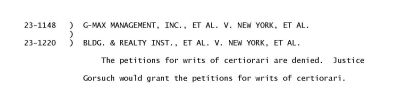
Here’s the latest in a case we’ve been following. This morning, in this Order, the Supreme Court denied cert in two cases which seemed to have a good chance at a grant, on two pressing issues which have divided lower courts, the physical occupation in tenancies (aka Yee), and the nature of the Penn Central takings test. Only Justice Gorsuch would have granted.

Here are the Questions Presented:

New York’s Housing Stability and Tenant Protection Act of 2019 transforms a temporary rent- regulation system into a permanent expropriation of vast swaths of private real estate, without just compensation, in the name of “affordable housing.” Among other things, the Act prohibits owners—even of small and midsized apartment buildings like Petitioners—from reclaiming rental units for their own personal use, and grants tenants a collective veto right over condo/co-op conversions. As Justice Thomas has observed, the constitutionality of regimes like New York’s

Continue Reading SCOTUS Declines To Review NYC Rent Control Challenge

Screenshot 2024-11-04 at 12-34-18 Texas Supreme Court
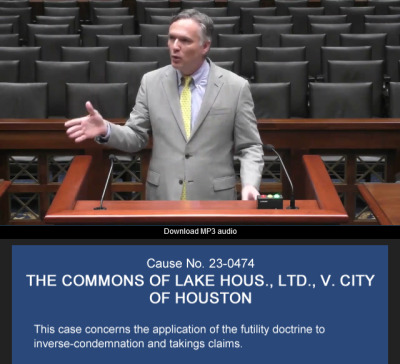
Charles McFarland, arguing.

Here’s the latest in a case we’ve been following closely (and disclosure: our firm filed an amicus brief in the Texas Supreme Court).

In The Commons of Lake Houston, Ltd. v. City of Houston, the Texas Court of Appeals held that the city could not be liable for a taking for an ordinance that limited development and use within the city’s 100-and-500-year floodplains because the ordinance was a valid exercise of police power and otherwise survived the rational basis test.

As we wrote here, that seems like utter nonsense to say that a valid police power reason categorically insulates a government action from a takings challenge. After all, the entire regulatory takings doctrine is built on the notion that an otherwise-valid exercise of government power (here, the police power, delegated from the State to the city) can so impact an owner’s property rights that

Continue Reading Oral Arguments In Texas Takings Case: If The Govt Limits Use For Healthsafetywelfaremorals, Is It Exempt From Takings?

Here’s the latest takings cert petition, in a case involving a California county’s refusal to rezone property back to its former zoning to allow residential development. The only uses permitted on the property presently are “scientific research facilities uses” and hiking trails. Or, at the petition puts it, “only public, park-like uses.” Pet. at 5. 

The District Court and the Ninth Circuit both held no taking.

Here are the Questions Presented:

Does a taking analyzed under Lucas v. S.C. Coastal Council require that the affected property be left with no value even if the regulation in question deprives the property of all economically beneficial uses?

Does Palazzolo v. Rhode Island leave any room for consideration of the landowners’ expectations in a Penn Central takings analysis?

Do the decisions in Loper Bright Enters. v. Raimondo, Cedar Point Nursery v. Hassid, Sheetz v. Cnty. of El Dorado and Lingle

Continue Reading New Cert Petition: Use vs Value, And Applying Penn Central