Each year, the Texas A & M Journal of Property Law publishes a symposium on some aspect of dirt law.

This year, the subject is “Day Zero: How Cities Run Out of Water.”

Here’s the program description:

This symposium is centered around Professor Rhett Larson’s (Arizona State University) forthcoming book, Day Zero: How Cities Run Out of Water (Cambridge University Press).

For many people around the world today, “Day Zero” refers to the day a city runs out of water. Cities across the globe have faced a Day Zero Crisis: Cape Town, South Africa; Chennai, India; and Mexico City, Mexico. The experience of potentially confronting Day Zero has given rise to prophets of doom, heroic reformers, complacency and overreaction, propaganda to frighten and mollify, false starts, and stagnant failures.

In this symposium, legal experts from across the country will explore how these and other cities experience Day

Continue Reading TAMU Law’s Journal Of Property Law 2026 Symposium: “Day Zero: How Cities Run Out of Water” (Feb 6, 2026)

Here’s one you don’t want to miss. Lawprof Shelley Ross Saxer has published “Forfeiture Takings, Police Power, and Necessity Destruction,” 80 U. Miami L. Rev. 147 (2025).

Here’s the Abstract:

Civil forfeiture laws allow law enforcement to seize property when there is probable cause it has been used or possessed in violation of legal rules, often before an owner has a chance to contest the government’s seizure in court. In the criminal context, forfeiture is typically an in personam action that requires a criminal conviction and is part of a defendant’s sentence. In the civil context, however, forfeiture is an in rem proceeding brought against the property derived from or used to commit an offense––not against the person who committed the offense. As such, a civil forfeiture may not require a criminal conviction or predeprivation hearing, and, under the “guilty property” theory, developed in England before eventually being

Continue Reading New Article: Shelley Ross Saxer, “Forfeiture Takings, Police Power, and Necessity Destruction,” 80 U. Miami L. Rev. 147 (2025)

Check out a newly-published law review article by lawprof Timothy Harris, “The Contracts Clause Can be Enforced via Section 1983, Period: The Nonexistent Circuit Court ‘Split’,” 78 SMU L. Rev. Forum 106 (2025).

The article delves into the issue of whether 42 U.S.C. § 1983 is the cause of action to bring a Contracts Clause challenge. The Contracts Clause prohibits states from passing any law impairing the obligation of contracts, and the fundamental question to be answered is whether your Contracts Clause rights are “rights, privileges, or immunities secured by the Constitution and laws” as described in section 1983.

Here’s the Abstract:

The Federal Circuit Courts are apparently split on whether 42 U.S.C. § 1983—which provides a civil cause of action for constitutional deprivation of rights— applies to actions brought under the Contracts Clause in article 1 of the U.S. Constitution. The “split” has existed since

Continue Reading New Article: Timothy Harris, “The Contracts Clause Can be Enforced via Section 1983, Period: The Nonexistent Circuit Court ‘Split’,” 78 SMU L. Rev. Forum 106 (2025)

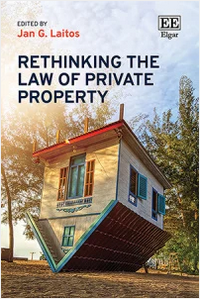
Rethinking
Available now. 

Just published: Rethinking the Law of Private Property, edited by lawprof Jan Laitos, with chapters by some of Dirt Law’s most notable luminaries. Here’s the abstract:

In Rethinking the Law of Private Property, eminent legal scholars consider how private property rights might be transformed and realigned to better cope with modern challenges. They rethink current paradigms around private property and natural resource ownership in light of police power regulations, health rules and expanded land-use regulations.

Vicki Been, Daniel Cole, Robin Craig, Richard Epstein, Jan Laitos, Roger Pilon, J.B. Ruhl, James Salzman and Ilya Somin are among America’s leading scholars on private property rights. Their chapters consider three critical issues facing private property owners in the 21st century. (1) To what extent may constitutional protections of private property resist police power limits restricting property uses? (2) Do developers of property for housing have the ability to provide affordable

Continue Reading New Book: Rethinking the Law of Private Property (J. Laitos, ed. 2025)

Catastrophe

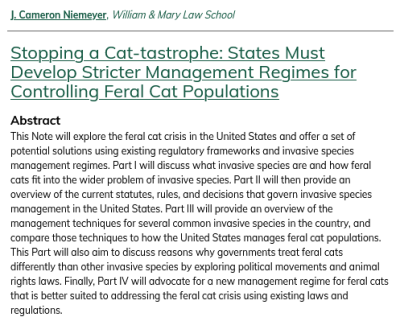
Check this out, a new student note published in the latest edition of the William and Mary Environmental and Policy Review, J. Cameron Niemeyer, Stopping a Cat-tastrophe: States Must Develop Stricter Management Regimes for Controlling Feral Cat Populations, 49 Wm. & Mary Env’t L. & Pol’y Rev. 739 (2025). 

Download the pdf here

Although this article isn’t about takings and related, the issue of feral cats can give rise to takings questions. See, for example, this post: “Hey All You Cool Cats And Kittens: Creating A Feral Cat Colony Next To Your Property Isn’t A Taking.” 

If cats and cat law isn’t necessarily your thing, we suggest reading this piece especially. It will change your mind: 

Cats are among the world’s most popular pets. Cute, cuddly, relatively easy to care for, and intelligent, cats have been part of humans’ lives for generations. In fact, the author

Continue Reading New Article: “Stopping a Cat-tastrophe: States Must Develop Stricter Management Regimes for Controlling Feral Cat Populations,” 49 Wm. & Mary Env’t L. & Pol’y Rev. 739 (2025) (J. Cameron Niemeyer)

Euclidsymposium

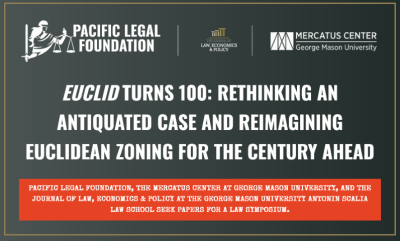
With the 100th anniversary of Village of Euclid v. Ambler Realty Co. nearly upon us in 2026, we’ve put together a series of events designed to reexamine the case that set the stage for a century’s-worth of intense land use regulations and restrictions.

Are Euclid‘s assumptions and conclusions still valid? If the original separation-of-uses and nuisance-prevention rationale of zoning made sense, does that rationale apply when “zoning” has become the shorthand for extremely granular regulation of property’s uses? What of the role of judicial review and a return to Nectowian review? 

Our Euclid series begins with a call for papers, and a follow-up conference at which these articles will be presented and discussed. For more, see the call for papers: “Euclid Turns 100: Rethinking an Antiquated Case and Reimagining Euclidean Zoning for the Century Ahead.” The link also has a few suggestions about

Continue Reading Call For Papers: “Euclid Turns 100: Rethinking an Antiquated Case and Reimagining Zoning for the Century Ahead”

JLEPcover

Last year, we attended a conference devoted to the future of regulatory takings, hosted by the Antonin Scalia School of Law (George Mason U), and Pacific Legal Foundation.

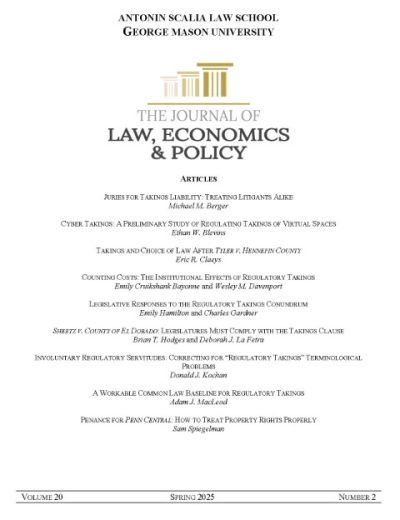
The publisher, the Journal of Law, Economics, and Policy has released the articles and essays from that conference, and made them available here

Here’s the list of articles:

  • Michael M. Berger, Juries for Takings Liability: Treating Litigants Alike
  • Ethan W. Blevins, Cyber Takings: A Preliminary Study of Regulating Takings of Virtual Spaces
  • Eric R. Claeys, Takings and Choice of Law After Tyler v. Hennepin County
  • Emily Cruikshank Bayonne and Wesley M. Davenport, Counting Costs: the Institutional Effects of Regulatory Takings
  • Emily Hamilton and Charles Gardner, Legislative Responses to the Regulatory Takings Conundrum
  • Brian T. Hodges and Deborah J. La Fetra, Sheetz v. County of El Dorado: Legislatures Must Comply With the Takings Clause
  • Donald J. Kochan, Involuntary Regulatory Servitudes:


Continue Reading New Property Rights Symposium Published – “Too Far: Imagining the Future of Regulatory Takings”

Bradyfrontpage

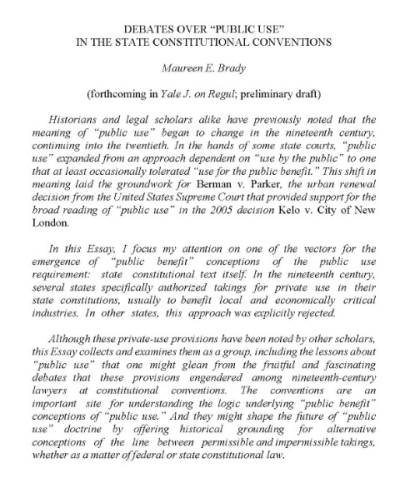
Be sure to check out the latest scholarship from lawprof Molly Brady, which sheds new light on the public use question in eminent domain, “Debates Over ‘Public Use’ in the State Constitutional Conventions,” forthcoming from the Yale Journal of Regulation. 

Here’s the Abstract:

Historians and legal scholars alike have previously noted that the meaning of “public use” began to change in the nineteenth century, continuing into the twentieth. In the hands of some state courts, “public use” expanded from an approach dependent on “use by the public” to one that at least occasionally tolerated “use for the public benefit.” This shift in meaning laid the groundwork for Berman v. Parker, the urban renewal decision from the United States Supreme Court that provided support for the broad reading of “public use” in the 2005 decision Kelo v. City of New London.

In this Essay, I focus my

Continue Reading Forthcoming Article: Maureen Brady, “Debates Over ‘Public Use’ in the State Constitutional Conventions,” Yale J. Regulation

Righttoretrievecover

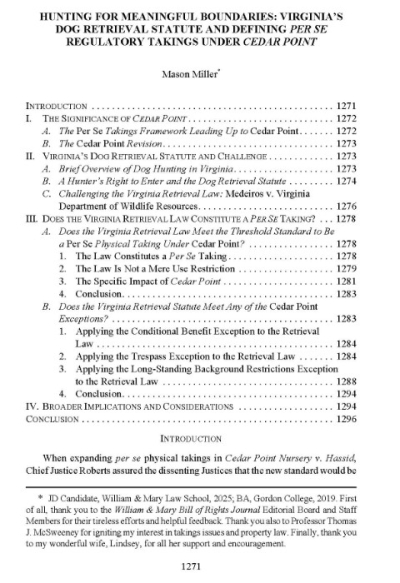
Be sure to read this recently-published piece in the William and Mary Bill of Rights Journal, Mason Miller, “Hunting for Meaningful Boundaries: Virginia’s Dog Retrieval Statute and Defining Per Se Regulatory Takings Under Cedar Point,” 33 Wm. & Mary Bill of Rights J. 1271 (2025). 

The article focuses on Virginia’s so-called “right to retrieve” law, Va. Code § 18.2-136 (“Fox hunters and coon hunters, when the chase begins on other lands, may follow their dogs on prohibited lands, and hunters of all other game, when the chase begins on other lands, may go upon prohibited lands to retrieve their dogs, falcons, hawks, or owls but may not carry firearms or bows and arrows on their persons or hunt any game while thereon.“).

Disclosure: our firm represented property owners in an earlier case challenging this statute, which is discussed in the piece. 

Here’s the Introduction

Continue Reading New Article: “Hunting for Meaningful Boundaries: Virginia’s Dog Retrieval Statute and Defining Per Se Regulatory Takings Under Cedar Point“

Backgroundprinciples

Here’s the latest, a student-authored note, “‘Background Principles’ and the General Law of Property,” 138 Harv. L. Rev. 2071 (2025).

Here’s the argument:

Background principles are a strong medicine. When a court analyzes a takings claim, it must first identify the property interest at issue before deciding the more complex, discretionary question of whether that property was “taken.” Background principles are “logically antecedent” to this analysis, meaning that they can foreclose an aggrieved property owner’s claim before the first step.

….

In recent years, the Supreme Court has increasingly defined property by looking beyond state-specific law, toward a more dynamic, unbounded body of what might be called “general property law” or “jurisdictionless property law.”

….

This Note fills that gap by demonstrating that the collision of ascendant general property law and the background principles exception could ultimately cause the Takings Clause to underprotect property interests. Part I provides

Continue Reading New Article: Note, “Background Principles” and the General Law of Property, 138 Harv. L. Rev. 2071 (June 2025)