


The Spring 2009 edition of The Urban Lawyer, the ABA Section of State & Local Government Law’s peer-reviewed quarterly law review, is now available on-line. This edition focuses on fair housing testing and Fair Housing Act issues. Abstracts of the articles and case summaries are available here. ABA members may grab pdf’s of individual articles here.Continue Reading New Issue Of The Urban Lawyer Posted
ABA Section Of State & Local Gov’t Law – Condemnation Law Committee
These past few days, I’ve been attending the annual meeting of the ABA in Chicago. It was a chance to meet new colleagues, associate faces with those whom I’ve only had e-contact, and reacquaint myself with old friends.
I’m also the new Chair of the Condemnation Law Committee of the State & Local Government Law Section. I’m honored to have been delegated the task of leading a group which includes some of the most experienced and learned condemnation lawyers in the country among its members, from both condemnor and condemnee perspective.
One of the jobs of the Chair is to encourage those who are not section and committee members to join us. In that vein, here are some of the benefits of participating:
- We’ll be continuing our program of regular teleconferences on new cases and hot developments in eminent domain and regulatory takings law. The last call
Continue Reading ABA Section Of State & Local Gov’t Law – Condemnation Law Committee
Hawaii Business Magazine Column: Using Blogs, Social Media To Connect
Hawaii Business magazine has published my column about how our firm is using web 2.0 tools to communicate and connect, “Connect with customers with blogs, Twitter.”
Ironically, the article is not (yet) available on-line, so here it is:
Connect with customers with blogs, Twitter
They’re easy to use and effective
Take note, small- and medium- business owners: blogs, Twitter and other “social media” aren’t for kids — they’re tools for taking on the big guys.
Learn how to use them, and you can leverage your lack of bureaucracy to communicate directly with potential clients, the media and your community.
Our 25-lawyer firm uses blogs and Twitter.
I started my blog on land-use and property law (www.inversecondemnation.com) more than three years ago. Mark Murakami followed, focusing on maritime law (www.hawaiioceanlaw.com). Soon, Tred Eyerly joined, writing about insurance issues (www.insurancelawhawaii.com).
We analyze court decisions
Continue Reading Hawaii Business Magazine Column: Using Blogs, Social Media To Connect
Conference: ABA Section Of State & Local Government Law Virtual Spring Meeting
Instead of an in-person Spring Meeting this year, the ABA Section of State & Local Government Law will be “meeting” virtually from March 31-April 2, 2009. As part of the meeting, the Section will be featuring a series of teleconference and live audio webcasts on a variety of subjects including topics near and dear to us: workforce housing, condemnation, land use, and green regulations. You can register for all programs, or individual subjects. A complete list of programs is posted here.
I will be participating as faculty in two of the programs: Condemnation Hot Topics (April 1, 2009 from 2:00 – 3:30pm EDT) and Hot Topics in Land Use Law (April 2, 2009 from noon – 1:30 EDT). I’ll be speaking about the issue of public use and pretext in eminent domain, and recent cases questioning the government’s ability to take property.
Registration information is available on the links.
Continue Reading Conference: ABA Section Of State & Local Government Law Virtual Spring Meeting
New Eminent Domain Book: Current Condemnation Law: Takings, Compensation & Benefits (2d ed.)
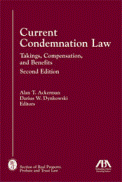 A recent book of interest to condemnation lawyers, Current Condemnation Law: Takings, Compensation & Benefits (2d ed.).
The book is co-edited by my Owner’s Counsel of America colleague Alan T. Ackerman. (He also has a blog about eminent domain issues.)
From the blurb:
Condemnation of property is an especially topical subject after the U.S. Supreme Court’s controversial decision in Kelo v. City of New London. This completely revised edition of Current Condemnation Lawexamines the many complexities involved in the practice of eminentdomain law in order to assist lawyers in best protecting the clients’interests in these cases. The book brings together experts in thespecialty to provide analysis of both major and specialty areas ofcondemnation law, providing “how to” tips along with currentdiscussions of case law and theory.
The chapters in Current Condemnation Lawprovide a thought-provoking mix of articles covering the key topics ofbusiness valuation, contamination issues, the right
2008 Land Use In Review: The Ninth Circuit Rediscovers Substantive Due Process
In a development that began in November 2007 (2005 actually, if the starting point is seen as the U.S. Supreme Court’s decision in Lingle v. Chevron, U.S.A., Inc., 544 U.S 528 (2005)), the Ninth Circuit finally ditched Armendariz v. Penman,75 F.3d 1311 (9th Cir. 1996) (en banc), and recognized that property owners are not limited to regulatory takings claims when challenging land use regulation, and the government can violate substantive due process as well. In 2008, the Ninth Circuit issued a number of decisions in which it recognized that Armendariz‘s forced election of a regulatory takings remedy has been truly overruled.
Rather than plow through multiple posts, it would be easier to just download a recently published article I wrote on the subject, collecting all the cases, The Ninth Circuit Rediscovers Substantive Due Process In Land Use Cases (31 Zoning and Planning Law Report (Thomson | West
Continue Reading 2008 Land Use In Review: The Ninth Circuit Rediscovers Substantive Due Process
New Article: The Ninth Circuit Rediscovers Substantive Due Process In Land Use Cases
 The Zoning and Planning Law Report (Thomson | West) has published my article about the post-Lingle developments in substantive due process in the Ninth Circuit. Download a pdf of the article here.
From the introduction:
Substantive due process asserted as a claim for relief has a whiff of danger about it. After all, a plaintiff claiming a violation of substantive due process is asking a court to override the judgment of the political branches and invalidate an ordinance, statute, or an administrative determination because the action is somehow illegitimate. After the demise of Lochner, courts are understandably reluctant to be seen as second-guessing the policy choices made by the elected branches of government, and a suggestion that a court is “Lochnering”—legislating from the bench by invalidating economic regulations based on a judge’s contrary economic or social beliefs—can be the equivalent of judicial kryptonite.
In
Two Recent Law Review Articles (Water Law and Shoreline Issues)
Two recent U. Hawaii Law Review articles worth mentioning. Although neither is available free on the web, they can be obtained through legal research services such as Westlaw or Lexis, or through the U. Hawaii Law Review. If you don’t have a UHLR subscription, you should. It’s only $30 per year for US addresses.
Water Regulation, Land Use and the Environment
David L. Callies and Calvert G. Chipchase; 30 U. Haw. L. Rev. 49 (Winter 2007)
In this article, the authors assert that the “public trust” doctrine, as misconstrued by the Hawaii Supreme Court, has distorted water law and the land use process:
Problems arise in the planning process when water and non-economic uses of water are given a sacrosanct status that abjures private use for the benefit of “the public.” This is increasingly happening under flawed interpretations of the public trust doctrine.
p. 49 (citing In re Water Use Permit Applications (Waiahole), 84 Haw. 97, 9 P.3d 409 (2000); In re Water Use Permit Applications, 105 Haw. 1, 93 P.3d 643 (2004); In re Water Use Permit Applications, 113 Haw. 52, 147 P.3d 836 (2006)). The article continues:
Many courts have forgotten that the jus privatem is as much a part of the public trust doctrine as the jus publicum. Certainly water should be available for future use, but is also should be readily available for current use. When the balance between current private and abstract or future public needs is distorted, water use and availability of water becomes the primary, or even sole, consideration in the process. This leads to the preservation of water for such uses as “minimum stream flows” and non-beneficial use by selected segments of the public and, ultimately, an elitist, communitarian regime that bears no relationship to either traditional notions of water rights or constitutionally protected rights in property.
Id
. The authors analyze the multi-layered land use planning laws in Hawaii, the state Water Code (Haw. Rev. Stat. ch. 174C), and the Hawaii Supreme Court’s extension of the public trust doctrine beyond navigation and commerce to the promotion of reasonable and beneficial use of water resources in Waiahole. p. 70. The article also discusses how Arizona, Colorado, and New Mexico regulate their water resources, and what lessons these jurisdictions may provide for Hawaii. pp. 77-92.
More Than a Line in the Sand: Defining the Shoreline in Hawai’i After Diamond v. State
Simeon L. Vance and Richard J. Wallsgrove; 29 U. Haw. L. Rev. 521 (Summer 2007)
In this article, the authors analyze the differences in the various definitions of the “shoreline” under Hawaii law, and the Hawaii Supreme Court decision in Diamond v. State, 112 Haw. 161, 145 P.3d 704 (2006) . As detailed in this post about the Diamond case, the term “shoreline” is used to define both the boundary between public and private property as well as the baseline for measuring the shoreline setback (a no-build zone on beachfront property).
The difference between a certified shoreline and a seaward boundary line has become a confusing and potentially divisive issue. Confusion is predictable because the definition of shoreline for certification purposes is essentially identical to the definition Hawai’i courts have used to determine property boundary lines. Despite their similarity, however, the two lines are not necessarily the same because their purposes, the impacts and the processes for determining these lines’ are uniquely and significantly different.
The most critical of these differences is that shoreline certifications are not designed to determine ownership. Instead, the line of ownership dividing public and private coastal property is the seaward boundary. Markedly different from the shoreline certification process outlined above, determinations of seaward boundary lines often take the form of quiet title actions, eminent domain actions, or land court petition actions. The state’s responsibility to uphold the public trust and preserve its interest in property triggers the need for a more rigorous and cautious approach. In these situations, the state does not rely on shoreline certifications, but conducts its own survey in recognition of the “importance of lateral [shoreline] access over state-owned lands for recreation, native gathering practices and other purposes.”
p. 532 (footnotes omitted). The article is a good introduction to Hawaii’s unique approach to shoreline law, and a worthy read. And I’m not just saying that because it cites several posts from this blog as authority (See, e.g., notes 92, 146, 179, and 180, and accompanying text).
Continue Reading Two Recent Law Review Articles (Water Law and Shoreline Issues)
New Article Published: “Because They Can: Judicially Excising the People from the Definition of ‘County’ in the Hawaii Constitution”
 The ABA Section on State & Local Government has published my article “Because They Can: Judicially Excising the People from the Definition of “County” in the Hawaii Constitution” in the State & Local Government Law News (Spring 2008).
The article is a summary and analysis of County of Kauai ex rel. Nakazawa v. Baptiste, 165 P.3d 916 (Haw.2007), the 3-2 decision in which the Hawaii Supreme Court creatively overcame justiciability problems to hold that the term “the counties” in the Hawaii Constitution’s provisions regarding property taxes means “county councils.” In doing so, the court invalidated a voter-enacted Kauai charter amendment that would have rolled back property taxes to 1998 levels, and set a yearly cap on increases. The dissenting justices accused the majority of “subverting the judicial process,” and would have dismissed the case for lack of standing.
The article is posted on the ABA’s web
▪ Meditations on the Practice of Law
This post has nothing whatsoever to do directly with land use law or property rights, but there’s an interesting article on the San Francisco Chronicle’s web site that is too good to resist. “Zen and the art of lawyering” reports on Bay Area lawyers who combat job-related stress by meditation. Continue Reading ▪ Meditations on the Practice of Law