Our thanks to our friends and colleagues at the ABA Section of Real Property, Probate & Trust Section’s Land Use and Environmental Group for inviting us to a discussion of the latest and greatest decisions of interest.

We only had an hour together, so naturally could not cover everything of interest (indeed, we reserved a big discussion of the biggest item, the Supreme Court’s decision in Cedar Point, assuming that the Group will schedule a full session on that decision alone). So here is our curated list of what we think are the most interesting recent decisions in areas of interest to the Group:


Continue Reading Links From Today’s ABA RPTE Session

It can be somewhat of a challenge to blog about many of the opinions from New York’s appellate courts (dun-dun) because they are typically short. What more (or less!) can you say about an opinion that is very short? We mean really short. Like 3 pages short.

Such it is with the Appellate Division’s opinion in Gabe Realty Corp. v. City of White Plains, No. D66651 (June 30, 2021). A total of 4 pages, actually, but when you cut out the caption, introductory fluff, and the clerk’s signature, you are down to a grand total of two pages of single-spaced text. It would take us more time to write about the decision than it would take you to just read the darn thing.

Highlights:

  • A New York court invalidates an urban renewal taking, supported by a claim of blight remediation. Read that again: this is from a


Continue Reading NY App Div: Potential Future Public Benefit Won’t Support Eminent Domain

In which we pay a return visit to Clint Schumacher’s Eminent Domain Podcast to catch up with Clint about our new gig, Cedar Point (briefly, since the opinion came down the day we recorded the podcast), just compensation and attorneys’ fees, assessing severance damages in appraisals supporting jurisdictional offers, public use, and our favorite cool courthouses (let’s just say that they range from historic courtrooms to converted doublewide trailers).

If you are not already a regular listener to the Eminent Domain Podcast, you should be! It’s a great one-stop convenient way to keep current on the latest goings-on in the takings business. Continue Reading We Pay A Return Visit To The Eminent Domain Podcast To Talk Takings

A detour from our usual fare today, as we post what now is the final complete case that we participated in before we traded in our private practice hat for public interest law back in February.

In a short (5 page) Summary Disposition Order, the Hawaii Intermediate Court of Appeals held that any member of the public has standing to request that a court unseal previously sealed documents, and that a court must hold a hearing on the request. Here, the trial court concluded that Judges for Justice (an association of retired judges who are interested in remedying wrongful criminal convictions) lacked standing to request the unsealing of certain documents that the court had previously kept from public disclosure, and sanctioned Judges for Justice $17,000 for making the request. The appeals court not only concluded it was error to deny the request, but that the trial court abused its discretion

Continue Reading Hawaii Court Of Appeals: You Can’t Sanction A Member Of The Public For Merely Asking To Unseal Court Records

2012-02-06_11-19-51_574

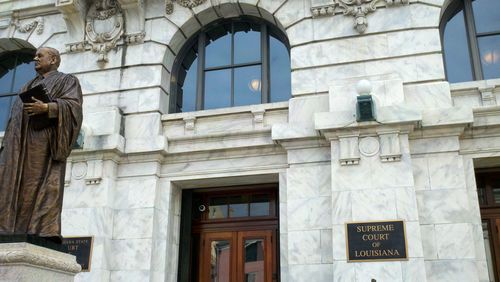
A private pipeline did what pipelines often do: it started negotiating with property owners for the property needed, but at the same time pressed forward. It reached agreement with some owners, others not. It filed “expropriation” lawsuits (for it is in Louisiana that our scene lies). It started to build, even before judgments of expropriation.

Aaslestad, owner of 38.00 acres (more or less) sued the pipeline to enjoin further construction. He also asserted in the expropriation case a counterclaim for due process and trespass (again, this is Louisiana, so they call that a “reconventional demand). Trial followed.

The trial court issued a judgment of expropriation and concluded the takings were for a public purpose. But it also upheld the property owner’s trespass counterclaim. The owner’s interest was pretty minor, so the total award was a whopping $150. Seventy five bucks for the expropriation and the same amount for the trespass.

Continue Reading Louisiana SCT: No Statutory Attorneys’ Fees For Pipeline Taking – But LA Constitution’s Just Comp Clause Requires Owners Recover “The Full Extent” Of Their Loss (Which Includes Fees)

Check out the North Dakota Supreme Court’s opinion in Cass County Joint Water Resource District v. Aaland, No. 20200171 (Mar. 24, 2021). It’s a quick read, and worth your time.

North Dakota has one of those “precondemnation entry” statutes allowing a (potential) condemnor to enter private property to check it out to see if this property is suitable for the anticipated public use. Indeed, North Dakota’s statute is modeled on California’s pre-1963 entry statute (the one analyzed by the California Supreme Court in the somewhat-recent decision in Property Reserve):

In all cases when land is required for public use, the person or corporation, or the person’s or corporation’s agents, in charge of such use may survey and locate the same, but it must be located in the manner which will be compatible with the greatest public benefit and the least private injury and subject to the provisions of

Continue Reading N. Dakota: We Understand The Right To Exclude – Non-Permanent Precondemnation Entries Went Too Far

We suggest you take a read through the California Court of Appeal’s opinion in Felkay v. City of Santa Barbara, No. B304964 (Mar. 18, 2021). It’s all there: Lucas wipeout takings, futility and exhaustion, coastal zone property rights.

This is an inverse condemnation case, seeing compensation for the city denying the owner any economically beneficial use of his property, because it was on a bluff face. Under the city’s ordinances, bluff faces can’t be built on. The planning commission staff said so, but they also recommended to the commission that this would be a taking, and the commission should therefore employ the takings safety-valve provision in the ordinance which allows the city to approve development if denial would be a taking (to paraphrase that old lung-dart commercial, “it’s better to switch than to fight”).

“No deal” the commission said, rejecting staff’s recommendation, “we’ll show ’em who is boss!

Continue Reading Cal App: Taking Verdict Affirmed – When City Asserts That Its No-Development Law “trumps whatever you might submit,” It Would Have Been Futile For Property Owner To Submit Development Application

Goofus-gallant

Yes, it starts tomorrow, Thursday, January 28, 2021, but we’re “remote” this year, so it is not too late to register to join us for the 38th Annual ALI-CLE Eminent Domain & Land Valuation Litigation Conference. This is the “big one” where the nation’s best practitioners, scholars, jurists, and other industry professionals gather to talk shop about the subjects we know and love.

Details here (ALI-CLE’s page with faculty, agenda, and times), or here (a recent episode of Clint Schumacher’s Eminent Domain Podcast, where we preview the Conference). Here’s your chance to be a part of what is the best conference on these topics.

We have set it up to take advantage of the remote format, and tuition has been reduced (thank you to ALI-CLE for recognizing this, and for our sponsors for being so generous). We’re seeing a lot of first-time registrations, and this is a great opportunity

Continue Reading Still Time To Join Us: ALI-CLE Eminent Domain & Land Valuation Litigation Conference (Online!) This Thursday & Friday. Tuition Deals! #EminentDomain2021

The docket is pretty crowded today, so we don’t have that much time to digest and summarize the Nebraska Supreme Court’s opinion in Douglas County School Dist. No. 10 v. Tribedo, LLC, No. S-19-986 (Nov. 6, 2020). But we recommend you read it (or at least scan it).

Short story: Tribedo got the better of the School District at an eminent domain valuation trial on a partial taking. Although Tribedo’s appraiser opined to a higher figure, the jury was closer to his number than the District’s expert’s. So the District appealed, arguing the trial court wrongly rejected the District’s jury instruction, and that the jury’s verdict — which included severance damages — was not supported by the evidence because neither party’s expert specifically opined about severance damages.

As we know, both of these are hard hills to climb. And sure enough, the Supreme Court rejected both arguments. First, it

Continue Reading Nebraska: Condemnor Asking To Overturn Jury’s Compensation Verdict For (Alleged) Evidentiary Errors Asks Too Much

When an opinion starts off with “[t]his case offers a feast of legal issues – ranging from procedural to constitutional – but its main course is a cautionary tale to government entities: they must follow the exact statutory requirements for bringing a condemnation action[,]” you just know that you have to read the entire thing.

That’s exactly what we recommend with the Utah Court of Appeals’ opinion in Salt Lake City Corp. v. Kunz, No. 20190010-CA (Oct. 16, 2020). The court concluded that when a statute requires that a condemnor provide the property owner with at least 10 days written notice and an opportunity to be heard before the condemnor takes a final vote to approve exercising eminent domain, “substantial compliance” isn’t sufficient. We make this recommendation that although this sort of statutory requirement is quite common — as are examples of condemning agencies not strictly adhering to

Continue Reading Utah App: “All bets are off for any actions other than exactness.” Close Enough Isn’t Good Enough In Condemnation – When The Statute Requires Notice To Property Owners Within 10 Days, It Means 10 Days