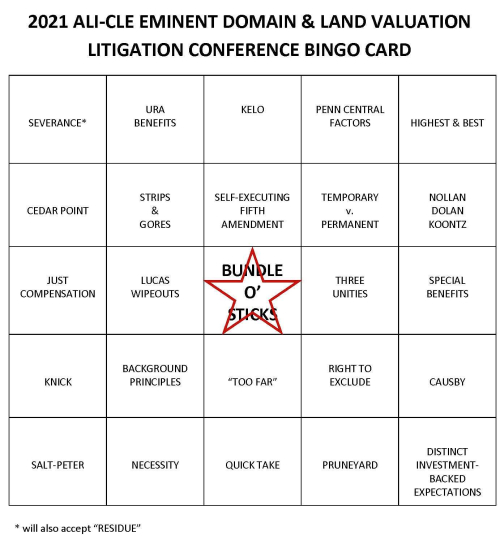
ALI-CLE 2021 Bingo card

If you “get” this, you should be registered for the 38th Annual Eminent Domain & Land Valuation Litigation Conference, to be held remotely on Thursday and Friday, January 28-29, 2021.

The list is growing rapidly, and you need to join us!

This is the “big one” where the nation’s best practitioners, scholars, jurists, and other industry professionals gather to talk shop about the subjects we know and love. We’re having programs with intriguing subjects such as “Planning to Win: Practical Strategies for a Successful Inverse Condemnation Case,” “How Do I Keep My Firm’s Doors Open When the Courthouse Doors Are Closed? Making Your Practice More Efficient When You Can’t Try Cases,” “Where Is the Supreme Court Headed on Takings Cases? Regulatory Takings Update and Cedar Point Preview,” “No Show and All Tell: Breaking News in Property Rights and Takings,” “More Than the Fifth Amendment: Other Tools for Upholding
Continue Reading Your 2021 ALI-CLE Eminent Domain & Land Valuation Litigation Conference (Jan 28-29, Remote) BINGO Card

In City of Chicago v. Eychaner, No. 1-19-1053 (May 11, 2020), the Illinois court of appeals revisited a case that it ruled on once before. 

Five years ago, in City of Chicago v. Eychaner, 26 N.E.3d 501 (Ill. Ct. App. 2015), the same court held that a redevelopment taking of Eychaner’s property qualified as a public use. We won’t go into the details of facts or that opinion’s reasoning. Instead, we’ll refer you to our summary, analysis (and criticism) of the opinion here (“The Chicago Way: City Taking Non-Blighted Property For Economic Development Was Not Pretextual Because … Studies“). After approving the taking, the court remanded the case for a determination of the compensation owed.

Flash forward. On remand, the jury determined just compensation was $7.1 million. Also while the case was remanded, the City changed its redevelopment plans. You know, the basis for the court

Continue Reading Illinois App: We Haven’t Changed Our Mind – Chicago’s Sketchy Redevelopment Taking Is Still For Public Use

One does not simply walk to nashville

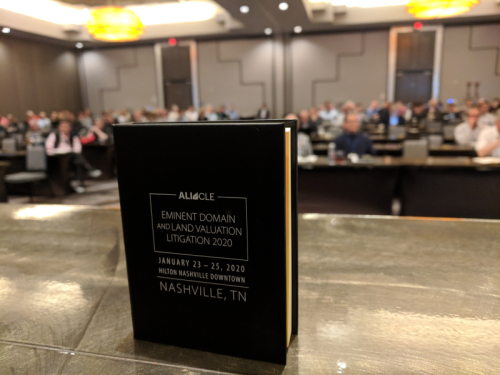
You can also fly, drive, or bike to the upcoming 37th Annual ALI-CLE Eminent Domain & Land Valuation Litigation Conference. in Nashville. Limited space still available, so don’t delay further and register now. We’re on track to record attendance, so you don’t want to miss the best nationally-focused three-day program on our area of law.

Takings, Knick, compensation, appraisals … and a bit of fun thrown in. We have many new attendees, and many new speakers, too.  Continue Reading (Nearly) Last Chance To Join Us In Nashville For ALI-CLE’s Eminent Domain Conference

6a00d83451707369e2022ad3b86fce200d-800wi

You overwhelmingly asked for Nashville, and we’re bringing it to you!

Get ready, and hold your place now: here’s the list of programs and speakers for the 36th Annual ALI-CLE Eminent Domain and Land Valuation Litigation Conference, to be held at the Downtown Nashville Hilton, January 23,- 25, 2020. Two-and-a-half days with top-notch national faculty (lawyers from both sides, judges, legal scholars, appraisers, relocation experts, and others).  

Early registration and group rates are available now

Here are just some of the programs:

  • Featured Presentation: Property Rights as Civil Rights: Seeking Justice Though the Fourth and Fifth Amendments. Hon. Jonathan Apgar, Jamila Johnson, Alan Ackerman. Moderator: Leslie Fields.
  • Making Sense of the New Rules After Knick v. Township of Scott: Where Do I Go, What Do I Do? David Breemer, Smitha Chintamaneni, Professor Bethany Berger. Moderator: Professor Steven Eagle.
  • When A River Runs Thought It: Water Rights and


Continue Reading Here’s The Agenda And Faculty For The 2020 ALI-CLE Eminent Domain And Land Valuation Litigation Conference, Nashville, Jan 23-25, 2020

17CA0595-PD

Here’s the latest in a case we’ve been following, involving what Colorado calls “bad faith” condemnations. 

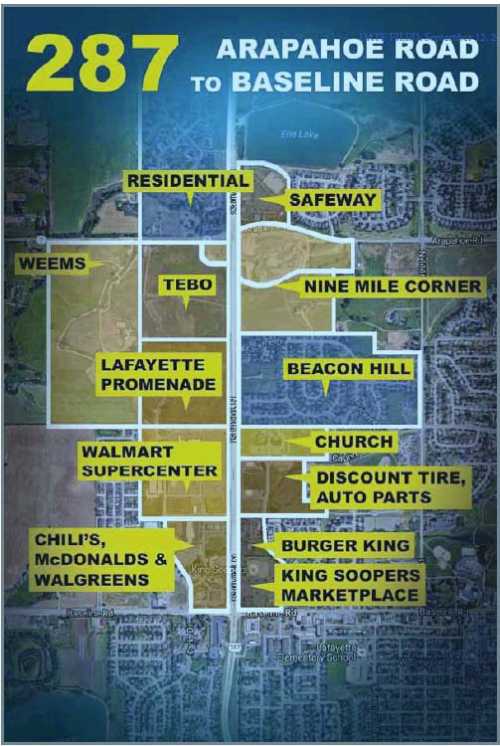
In this order, the Colorado Supreme Court has declined to review the Court of Appeals’ conclusion that a taking ostensibly to preserve open space and a buffer zone between two municipalities, was an invalid exercise of the eminent domain power because the true reason for the taking was to prevent the condemnee-municipality from luring a big-box retailer, King Sooper, to its territory and away from the condemnor’s. 

So even though the case has ended with a whimper and not a bang, this does mean that the Court of Appeals’ hard look at the actual motives of the condemnor — and not merely its stated purpose — is the way to do things. The court examined the factual record, and not just the stated reasons for the taking, and tested whether the condemnor’s

Continue Reading Colorado Supreme Court Denies Cert In “Improper Motive” Condemnation

Here’s the decision in a case we’ve been following from afar in which our colleagues Anthony Della Pelle and Robert McNamara are on the side of property owners, Borough of Glassboro v. Grossman, No. A-4556-17T2 (Jan. 7, 2019). 

This is redevelopment, New Jersey style. We ask that you read the opinion (it isn’t terribly long, and it is worthy of your perusal in its entirety), but here’s the bottom line:

[W]e hold that if a landowner within the redevelopment area contests the necessity of a condemnation pursuant to N.J.S.A. 40A:12A-8(c), the statute logically requires the condemning authority to articulate a definitive need to acquire the parcel for an identified redevelopment project. That articulated need must be more specific than the mere “stockpiling” of real estate that might, hypothetically, be useful for a redevelopment project in the future. In addition, the condemning authority in such a contested case must present

Continue Reading NJ Appellate Division On Land Banking: “Take Now, Decide Later What To Do With It” Isn’t Good Enough

A short, but published, opinion from the U.S. Court of Appeals for the Fifth Circuit.

In Archbold-Garrett v. New Orleans, No. 17-30692 (June 22, 2018), the court held that the plaintiffs’ Fourth Amendment, Fifth Amendment, and Fourteenth Amendment claims (search and seizure, compensation, and procedural due process) were ripe for federal court, even though the plaintiffs had not sought compensation in a Louisiana court under Louisiana law. 

Quick background: the city demolished a building the plaintiffs owned which they had purchased from the city at a lien sale. The prior owner had racked up a bunch of code enforcement fines, and the city claimed the building was dangerous and should come down. But after the sale to the plaintiffs and days before the demolition, the city cancelled the code enforcement lien. Predictably, the city sent the new owners a bill for the demolition. They sued in federal court, arguing

Continue Reading Fifth Circuit: Williamson County Doesn’t Require District Court Dismiss Due Process Or Takings Claim

You might not think that the conclusion which the U.S. Court of Appeals for the Tenth Circuit reached in M.A.K. Investment Group, LLC v. City of Glendale, No. 16-1492 (May 14, 2018) would be all that controversial: when private property is declared by a municipality to be “blighted” and subject to redevelopment (and eminent domain), the municipality needs to tell the owner about it, even if the taking may occur somewhere down the road. But apparently it was not obvious, for it took years of litigation to figure it out.

Colorado’s urban renewal statute permits local governments to designate private property as blighted (by looking at eleven factors), take it any time within the next seven years, and transfer the land to a new private owner. An owner has a very short time window — 30 days — to challenge the blight determination by filing a lawsuit in a Colorado

Continue Reading 10th Cir: When City Declares Property Blighted And Subject To Condemnation, It Must Tell The Property Owner

20180419_150416_HDR

We’re in Detroit the rest of the week at the Mercy Law School for the venerable Land Use Institute, now in its 32nd iteration.

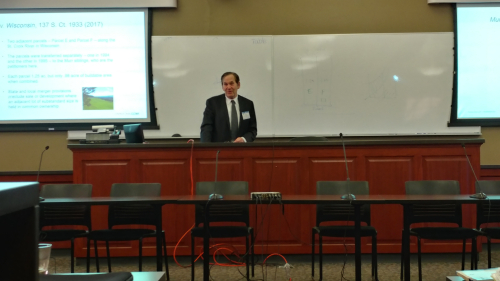
Planning Chair Frank Schnidman has assembled a great faculty including out Detroit colleague Alan Ackerman (above, talking about takings liability for flooding), and we’ll be spending the time talking inverse condemnation, public trust, planning law, homelessness, autonomous vehicles, affordable housing, RULIPA, and similar topics. We’ll be presenting on “Eminent Domain, Vested Rights, and Regulatory Takings,” “Client Representation: Developer, Government, and Citizens Groups,” and “Federal Laws Affecting Local Land Use Decision Making.” 

If you are here with us in Detroit, stop by and say hello. If you aren’t here, shame on you! This is one of the best and most affordable tuition deals in CLE.

But all kidding aside, if you are not in Detroit now, be sure to calendar these

Continue Reading Land Use Institute – Detroit

2018 LUI header Detroit-1

Mark your calendars, plan to come: Detroit, April 19-20, 2018. For what is perhaps the best deal in CLE (tuition as low as $400), the 32d Annual Land Use Institute, sponsored by our section of the ABA, the Section of State and Local Government Law.

The venue is the Detroit Mercy School of Law, and the conference hotel is the historic Westin Book Cadillac in downtown Detroit. The Land Use Institute is being held in conjunction with the Section’s Spring State and Local Law Conference. Register for one conference, and you are free to move between sessions (no additional registration fees).

Planning Chairs Frank Schnidman and Dean Patrica Salkin have assembled an excellent faculty and program for the two days. Topics include: “Nuts and Bolts of Land Use Practice: Vested Rights and Regulatory Takings,” “Public-Private Partnerships,” “Climate Change and Resilient Development,” “Client

Continue Reading 32nd Annual Land Use Institute: Detroit, April 19-20, 2018