ALI-CLE-2016-masthead

Here’s the full agenda for the 2016 Eminent Domain and Land Valuation Litigation / Condemnation 101 Conference, January 28-30, 2016, in Austin, Texas. 

Together with our friend and colleague Joe Waldo, we think we’re put together a pretty good program that covers a lot of ground. This is the first time the conference has been to Austin, and we’re starting off with a talk by Austin Mayor Steve Adler, who in his former life was an eminent domain lawyer. Other highlights:

  • Professor Ilya Somin will speak about his recently-published book in a segment entitled “The Impact of Kelo and the Limits of Eminent Domain.”
  • Pipelines and Energy Corridors: Valuation Perspectives of Condemnors and Condemnees” with the lawyers on the front lines of one of the hottest topics in eminent domain law nationwide.
  • Retired Minnesota Supreme Court Justice Paul H. Anderson will give us his tips

Continue Reading It’s Here – 2016 ALI-CLE Eminent Domain Conference: Complete Agenda, Faculty, Registration Information

A piece on the humor site Cracked, “4 Thriving Communities That Rich People Destroyed On Purpose,” tells an old story: modest-but-decent places “redeveloped” into (1) Dodger Stadium, (2) Brazil’s Olympic venues; (3) the Salton Sea, and (4) Central Park, respectively.

(We note that the segment on the Salton Sea is the odd man out, and we can’t figure out how that one fits with the other three. But no matter.)

In telling the story of the destruction of Los Angeles’ Chavez Ravine to make way for the ballpark, the piece links to the above video, which contains interviews with many of the Ravine’s former residents. The video also recounts how, using eminent domain, the City of Los Angeles condemned the homes in the village, supposedly to make way for a new, modern housing project.

The homeowners were offered about $10,000 for their homes and promised

Continue Reading Breaking Up Communities For Redevelopment

Apa_2015_planning_law_review

On Wednesday, July 1, 2015, the American Planning Association is putting on the 2015 Planning Law Review, a program highlighting the most important and topical cases decided by the courts recently. Here’s the program description:

Planning feels the impact of decisions from the U.S. Supreme Court, federal district courts, and state courts. How will their rulings affect you? Get a briefing on the year’s legal developments, from First Amendment issues to environmental actions, housing, and equal access. Presenters also will discuss major legislative initiatives and APA’s amicus filings. Join in a lively, informative program you and your staff, colleagues, and officials won’t want to miss. This program is also suitable for planning commissioners.

Joining me on the faculty are Jason Jordan, Director, Policy and Communications, American Planning Association (Moderator); Nancy Ellen Stroud, Lewis, Stroud & Deutsch; John M. Baker, Greene Espel; and John Echeverria, Professor of

Continue Reading Upcoming APA Webinar: 2015 Planning Law Review

In case you somehow missed it, takings junkies, today, June 23, 2015, is the tenth anniversary of the U.S. Supreme Court’s excreable 5-4 decision in Kelo v. City of New London, 545 U.S. 469 (2005), and just about anyone who is anyone in our field has weighed in with a retrospective. We don’t have much to add, since wiser minds than ours have some very cogent thoughts.

But here’s how we view the decision, ten years on:

  • Still stinks. A decade has not lessened the odor.
  • We filed an amicus brief in Kelo explaining why economic development wasn’t enough to support New London’s taking of a perfectly good home, and we still think we’re right. 
  • Many states and local jurisdictions reacted and adopted legislative reforms. Some helpful, many not. Guess which state did nothing, despite several proposals made over several legislative sessions? Hawaii, where we say we like the little


Continue Reading Kelo At 10: Still Stinks, And A Decade Has Not Lessened The Odor

Hardly seems like a decade ago that the Supreme Court gave us eminent domain lawyers something to talk about at cocktail parties: the Court’s infamous and widely-hated decision in Kelo v. City of New London

Find out about what the intervening ten years has brought us from the Cato Institute, which is sponsoring a program later this week  about “Property Rights on the 10th Anniversary of Kelo v. City of New London.” 

Featuring Ilya Somin, Author, The Grasping Hand: Kelo v. City of New London and the Limits of Eminent Domain, and Professor of Law, George Mason University School of Law; Scott Bullock, Senior Attorney, Institute for Justice and Plaintiffs’ Counsel, Kelo v. City of New LondonKelo v. City of New London

The full agenda and registration information is here. If you can’t be in D.C. this week, you can watch the conference live

Continue Reading Upcoming Conference On Kelo’s 10th Anniversary

A few years ago, in Gallenthin Realty Development, Inc. v Borough of Paulsboro, 191 N.J. 344 (2007), the New Jersey Supreme Court held that in order to target property for redevelopment as “blighted,” the government must show that it is in such condition that it “negatively affects surrounding areas” by promoting conditions that can develop into blight. In that case, the targeted property was mostly undeveloped wetlands, and the “blight” of which it stood accused was the owner’s failure to put it to a more intensive economic use. But that was not sufficient to support a blight finding, and the court held that the government must have done more than simply recited the standards for blight redevelopment, and declare they were met. 

We were going to do a complete write-up of the New Jersey court’s latest foray into blight and redevelopment, 62-64 Main Street LLC v. City of Hackensack

Continue Reading New Jersey: When Designating Blight, Baby Can Be Tossed Without First Showing The Bathwater’s Dirty

This is a longer post, but since we think this case may be going further and is worth watching, we’re going to hit it up in some detail.

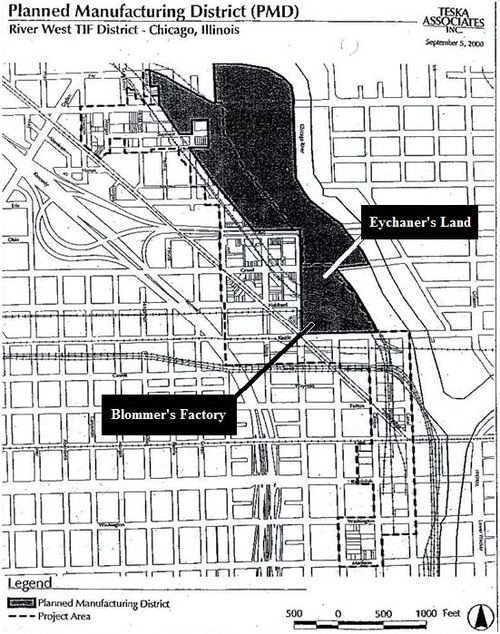
In City of Chicago v. Eychaner, No. 05L050792 (Jan. 21, 2015), the Illinois Appellate Court upheld the taking of private vacant land near the Chicago Loop (Eychaner’s Land on the map below) so that it could be transferred to the owners of a nearby chocolate factory (Blommer’s Factory).

The court viewed this “A-to-B” taking as merely a part of an area redevelopment and tax increment finance plan, which would keep the chocolate factory from moving out as the area gentrified.


1131833

The opinion contains a long recitation of the reasons for the taking, how the Planned Manufacturing District (PMD) was designed to “protect[] the 2,800 industrial jobs located in the area, [to] prevent[] residential encroachment on the existing manufacturing facilities, and

Continue Reading The Chicago Way: City Taking Non-Blighted Property For Economic Development Was Not Pretextual Because … Studies

131996

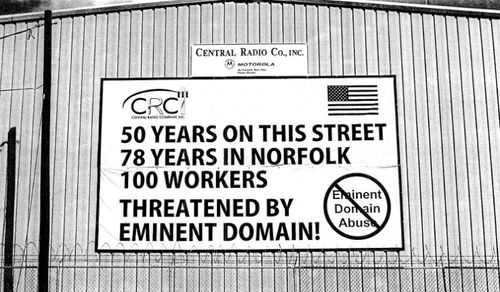
In a 2-1 decision, the U.S. Court of Appeals for the Fourth Circuit concluded that Norfolk, Virginia’s sign ordinance did not violate the First Amendment, when it was applied to bar the anti-eminent domain banner shown above.  

Central Radio Co. Inc. v. City of Norfolk, No. 13-1996 (4th Cir. Jan. 13, 2015), arose from a situation that also resulted in a property-owner favorable ruling from the Virginia Supreme Court in 2013. See PKO Ventures, LLC v. Norfolk Redevelopment and Housing Authority, 747 S.E.2d 826 (Va. Sep. 12, 2013) (a case won by our Owners’ Counsel colleagues at Waldo & Lyle). The city’s redevelopment authority planned on taking property to transfer it to Old Dominion University, but the Supreme Court shut it down, holding that the agency did not have the authority to take non-blighted property. See our write up of that decision here

While it was

Continue Reading 4th Cir OK’s City’s Sign Ordinance: You Can “Whisper” Your Anti-Eminent Domain Message, But You Can’t “Shout” It

The Texas Supreme Court is generally pretty good about property rights. See this opinionthis one, and this one, for examples.

So when the legal analysis in one of its regulatory takings/inverse condemnation opinions has the following language — especially in a case where a municipal government has treated the plaintiffs/property owners very badly — it would be understandable if you predicted the court was coming down on the side of the property owners:

The right to acquire and maintain private property is among our most cherished liberties. As Locke explained, the value of private property lies not only in its objective utility, but also in any personal investment therein. See John Locke, Two Treatises of Government 134 (Thomas I. Cook ed., Hafner Press 1947) (1689). Accordingly, the right to undisturbed enjoyment of residential property is all the more sacred. The unique importance of the home is reflected in our Bill of

Continue Reading Texas (Reluctantly) Finds No Regulatory Takings Claim

Little-pink-house

Little Pink House, Jeff Benedict’s book about the Kelo v. City of New London case, looks like it is going to become a feature film. 

Earlier, we heard it was going to be a TV (Lifetime) movie with Brooke Shields in the protagonist role, but it appears that they’re going for your local multiplex or arthouse instead, according to an op-ed in USA Today with the interesting title of “Culture can help tame eminent domain abuse” (“We are producing a feature film based on Kelo’s historic saga, and we hope to achieve some of the impact garnered by Erin Brockovich, another underdog film about a real-life working-class woman.”).

The authors, producers of the film, suggest that if only the public knew about Susette Kelo’s story, attitudes would shift about eminent domain abuse:

Erin Brockovich showed how culture can elevate otherwise obscure issues to

Continue Reading Kelo On The Silver Screen: “Culture can help tame eminent domain abuse”