Like a lot of us, Ball State University student Keller Mellowitz didn’t care for “remote” or “Zoom” virtual classrooms which were imposed on us in varying degrees during the Co-19 thing.

But he didn’t take it lying down. Believing that remote learning wasn’t what was promised to him in return for his tuition dollars, he sued the University for breach of contract and unjust enrichment. He was fighting the fight for not just himself: he brought the claim as a class action on behalf of his fellow students similarly deprived.

Not to allow that sort of thing, the Indiana legislature adopted a statute — applicable retroactively — that prohibits class actions against “postsecondary educational institutions for contract or unjust enrichment claims to recover losses stemming from COVID-19.” In response, the trial court limited Mellowitz’s claims to those only on his own behalf, and not on behalf of the class
Continue Reading Indiana: Depriving Litigant Of Ability To Bring Class Action Challenging Co-19 Zoom Classes Isn’t A Taking

Here’s the latest in a case we’ve been following.

Not that long ago, the Ninth Circuit held that a challenge to Washington state’s Co-19 eviction moratorium was moot because the moratorium had ended, and the plaintiffs had only sought declaratory relief. Thus, the court concluded, the moratorium did not have a “brooding presence” affecting the plaintiffs.

The owners have now asked the Supreme Court to review the case, and in this cert petition have posed these Questions Presented:

1. Because the Takings Clause of the Fifth Amendment demands just compensation for governmental takings, including temporary ones, did the Ninth Circuit err in dismissing as moot a challenge to Washington State’s COVID-19 eviction moratoria by landowners who suffered great losses by bearing the social burden of providing public housing during the pandemic against their will because those moratoria had ended by the time the case reached the Ninth Circuit on

Continue Reading New Cert Petition: Is Preventing Owners From Recovering Rental Units From Nonpaying Tenants A Compensable Taking?

Another must-listen episode of Clint’s Eminent Domain Podcast. He’s joined by Pepperdine Law School Professor Shelley Ross Saxer:

Professor Shelley Ross Saxer joins the show to discuss the role that the damaging clauses found in more than half of state constitutions across the United States play in inverse condemnation claims related to natural disasters such as the recent Hawaii wildfires.

Definitely worth a listen (as always with EDP). Stream above, or download here. Continue Reading Inverse Condemnation And Hawaii’s Wildfires: Lawprof Shelley Saxer Joins Clint Schumacher’s Eminent Domain Podcast

A short one from the Ninth Circuit on a topic that we keep revisiting, whether the various eviction moratoria adopted and enforced by the feds and many states and local governments during Co-19.

We keep revisiting the topic because the courts keep getting it wrong.

And before we go on, a disclosure: this is one of ours, and our law firm and our colleague Jon Houghton rep the property owners.

This moratorium is from the State of Washington (yes, the same State of Washington whose moratorium was recently challenged unsuccessfully in the state courts). But this challenge is to the City of Seattle’s moratorium, and is in federal court.

Thus, it was the Ninth Circuit considering the question of whether, by commandeering rental property as pandemic public housing, Washington was on the hook for just compensation. Requiring to house residents — whatever the reason — is a physical

Continue Reading CA9: No Physical Commandeering In Eviction Moratorium Because Yee Says “You Let The Tenants In, So You Can’t Complain About Keeping Them (For Free)”

A short one from the U.S. Court of Appeals for the Ninth Circuit.

In Jevon v. Inslee, No. 22-35050 (Aug. 8, 2023), the panel summarily concluded that a takings challenge to the Washington governor’s eviction moratorium — imposed in response to the Co-19 emergency — is moot.

The plaintiffs limited the relief sought to a declaratory judgment (understandable, because as a federal court lawsuit, they likely wanted to avoid the usual Eleventh Amendment fight if suing a state in federal court for retrospective monetary relief), and the court thus concluded that a declaratory judgment today, now that the moratorium has expired, would not do much of anything:

[A] declaratory judgment merely adjudicating past violations of federal law — as opposed to continuing or future violations of federal law — is not an appropriate exercise of federal jurisdiction.” Thus, this case is moot because the challenged activity — the eviction

Continue Reading No “Brooding Presence” – Takings Challenge To Co-19 Eviction Moratorium Seeking Declaratory Relief Is Moot

We’re not going to ask you to read the entire 24 pages of the Washington Supreme Court’s 5-4 opinion in Gonzales v. Inslee, No. 1000992-5 (Sep. 28, 2023), in which the court seriatim rejects every challenge to the Governor’s Co-19 emergency eviction moratorium for tenants, which allowed tenants who did not pay rent to remain in occupation for the up to 15 months the moratorium was in place.

Instead, we’re going to focus only on the takings challenge under the Washington Constitution. The plaintiffs asserted a physical takings claim, based on their right to exclude nonpaying tenants. Rejecting the argument (as several other courts have done), the Washington court concluded that the moratorium on evictions was merely regulation of the “voluntary relationship” between an owner and tenant.

Hang on, you say, what do you mean “voluntary relationship?” If I am an owner, yes, I voluntarily handed over the keys

Continue Reading PruneYard Revisited: Washington SCT Says No Physical Occupation Taking In State’s Eviction Ban – You Invited Tenants In, So Forcing Owners To House Them For Free Is Merely Regulating That Voluntary Relationship

This is one of ours — argued by our Pacific Legal Foundation colleague Kady Valois — so we won’t be offering any commentary.

But we just have to post the U.S. Court of Appeals’ opinion in Iten v. County of Los Angeles, No. 22-55480 (Aug. 30, 2023), because it discusses two significant issues, and sets out a roadmap for how to successfully plead a Contracts Clause claim.

First, standing. The court held that a commercial property owner — a retired auto mechanic who leased his premises to an auto repair shop — has Article III standing to challenge the County’s commercial eviction moratorium which prevented the owner from evicting the tenant when it stopped paying rent but did not vacate. The court distinguished the standing requirement of “demonstrating injury in fact” from the question of whether the plaintiff has actually been injured. The first is a pleading requirement and

Continue Reading CA9: Property Owner Has Standing To Challenge Commercial Eviction Moratorium Under Contracts Clause

Screenshot 2023-08-23 at 16-13-54 To tackle highest housing costs in the country Hawaii's governor declares YIMBY martial law

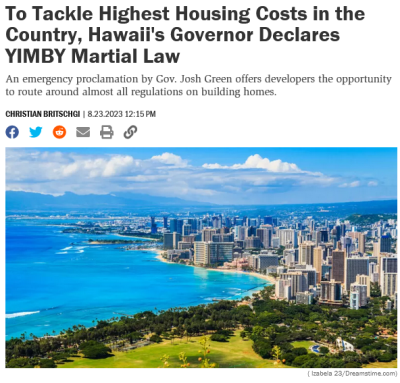
Here’s an excellent report on a situation we’ve been following, the Hawaii governor’s proclamation of a housing emergency. In “To Tackle Highest Housing Costs in the Country, Hawaii’s Governor Declares YIMBY Martial Law,” Christian Britschgi at Reason writes:

Developers with a [Beyond Barriers] working group [what we cheekily referred to as the “Privy Council”]–certified project wouldn’t have to comply with normal zoning restrictions. They wouldn’t have to go through Hawaii’s cumbersome environmental review process (which can add months or years to a project’s approval). They could avoid historic preservation regulations, and get relief from normal impact fees and taxes. They could also skip the need to get approval from the state’s Land Use Commission—a duplicative zoning body.

The story is an excellent summary of the substance of the emergency proclamation, the support and objections it has received, and some prognostication (including ours):

Thomas says that

Continue Reading “YIMBY Martial Law” – More On Hawaii Gov’s Gordian Knot Cutting

ExecOrder

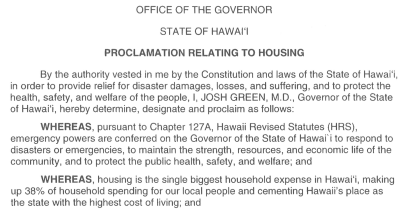
The two-plus years under the declared Co-19 emergency surely have given Hawaii’s executive-branch officials a clear vision of how much easier they could get their agendas accomplished without all that pesky democracy.

Hawaii’s Sweeping Emergency Management Act: Governor is the “Sole Judge”

Hawaii’s Emergency Management Act gives state and county executives broad and nearly unreviewable authority to suspend a wide spectrum of the usual laws, regulations, and rules. As we wrote in Hoist The Yellow Flag and Spam® Up: The Separation of Powers Limitation on Hawaii’s Emergency Authority, 43 U. Hawaii L. Rev. 71 (2020), Hawaii’s Act confers among the nation’s most muscular and sweeping powers. For example, the governor is the “sole judge of the existence of the danger, threat, or circumstances giving rise to a declaration of a state of emergency.” The Act’s one limitation — the 60-day time limit on how long an

Continue Reading What If The Hawaii Governor’s Cutting Of The Gordian Land Use/Environmental Knot Actually Works?

Screenshot 2023-07-31 at 08-01-31 Necessity Exceptions to Takings

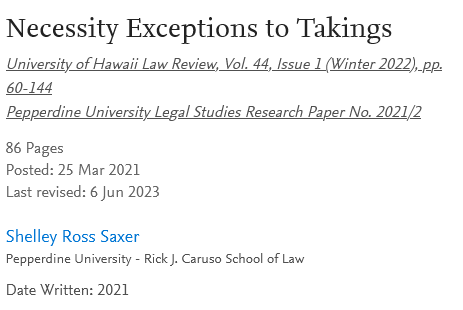
Worth checking out: a new article from Pepperdine Law School’s Shelley Ross Saxer, published in the University of Hawaii Law Review, “Necessity Exceptions to Takings,” 44 U. Haw. L. Rev. 60 (2022). [Disclosure: as noted in the author’s note, we reviewed an earlier draft of the piece and provided some thoughts.]

Here’s the Abstract:

The doctrine of necessity has strong roots in the common law of tort and property going back hundreds of years. In the United States the doctrine has been applied in various situations to negate judicial review of constitutional challenges to government action, most recently in some of the wildfire and flood claims resulting from disasters. But now, the states’ responses to the COVID-19 pandemic have brought one of these necessity doctrines—the public health necessity relying on Jacobson v. Massachusetts—to the forefront as courts across the country review constitutional challenges to state public

Continue Reading New Article – “Necessity Exceptions to Takings” (Shelley Ross Saxer)