Court of Federal Claims | Federal Circuit

Here’s what we’re reading this Friday:


Continue Reading Friday Round-Up: California Inverse Condemnation, Lawprof Epstein Litigates Public Trust, Property In Ecology, And More

If you are going to be attending the ABA Annual Meeting in San Francisco next month, here are some of the CLE and other programs of interest to property, land use, and eminent domain types, sponsored by our Section, the State and Local Govt Law Section: 

Thursday, Aug. 8

  • Knick Overrules Williamson County: What Does it Mean for Eminent Domain (in person, or webinar)

    In June 2019, the Supreme Court overruled its Williamson County precedent, which required that property owners, as a practical matter, must bring their Fifth Amendment takings claims against state or local governments in state courts. The Court’s new decision, in Knick v. Township of Scott, allows them to bring their inverse condemnation claims directly in federal court. Their insights into this important decision and its ramifications will be discussed by panelists who pled both sides of this case. Moderator: Steven J. Eagle, Professor Emeritus,


Continue Reading Dirt Lawyer CLE At ABA Annual Meeting (San Francisco)

Back to Knick for a bit. Our colleague Dwight Merriam has penned a response to a recent op-ed by U.S. Senator Sheldon Whitehouse (D – RI).

The good senator, if you weren’t aware, was also the guy who argued and lost the Palazzolo case all the way back in 2001. Apparently, he’s still sore about that, because in response to Knick, he wrote, ‘Knick’-Picking: Why a Recent Supreme Court Ruling Signals a New Day,” in which he argued that the decision “is a gift for big-money developers and regulated industries.” (Neither Ms. Knick nor Mr. Palazzolo is or were a big-money developer or a regulated industry, in case you were wondering.)

Merriam doesn’t see it the same way as the august senator. In “Senator is Wrong About ‘Knick’ Ruling,” he sets the record straight (originally published at law.com). 

* * * *

Senator Whitehouse

Continue Reading Guest Post: Senator Is Wrong About Knick Ruling

34s75v

We’ve resisted for as long as we can.

Here’s our take at telling the Williamson County and Knick story, 100% in memes.

Why, you may rightly ask? 

Well, it started with our Knick amicus brief, which included a meme that we thought captured well the injustice of property owners being prohibited by Williamson County from raising their federal constitutional claims in federal court (or anywhere, for that matter).

And then, as these things often do these days, the tail started wagging the dog. Readers didn’t want our cogent and deep analysis, they wanted more Knick memes. And rather than post those willy-nilly, we decided to do ’em all in a single post, and be done with it. 

So here you go. For those of you who dig this stuff, read on. If you think we missed any, or would like to send your own to fill

Continue Reading Knick, Entirely In Memes

20170918_171025_Richtone(HDR)

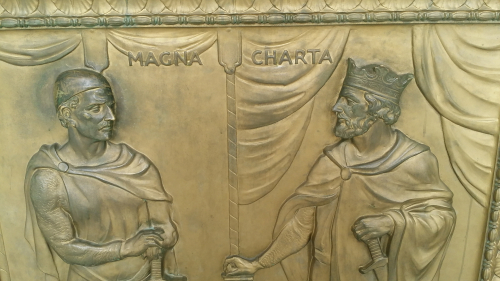
Yes, this is detail from the Supreme Court’s front door.

This is the first in what will be a short series of five posts with thoughts on the landmark decision in Knick. In this installment, a crash course in the extensive doctrinal background necessary to understand why the Knick Court did what it did. Here are the related posts:

* * * *

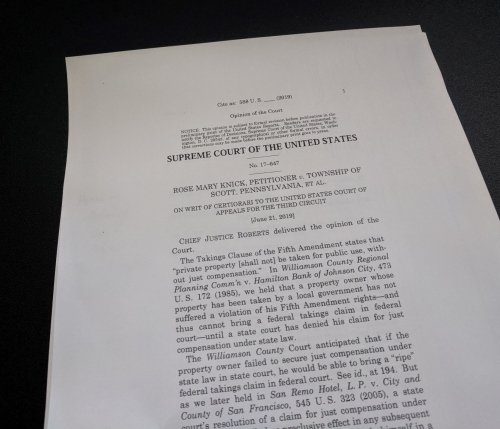
The opinions in last week’s ruling by a sharply-divided Supreme Court, Knick v. Township of Scott, No. 17-647 (June 21, 2019) employed a lot of very evocative language: “aborning,” “Catch-22,” “loot,” “shaky,” “sue me,” “overthrows,” “smashes,” “smithereens” “first crack,” “points for creativity.” But ultimately, the most important

Continue Reading Knick Analysis, Part I: After More Than 30 Years, Supreme Court Reopens The Federal Courthouse Door To Property Owners

This is the second in a series of five posts taking a look at last week’s landmark ruling by a sharply-divided Supreme Court, Knick v. Township of Scott, No. 17-647 (June 21, 2019). Here are the related posts:

In this post, we’ll take a look at the case which finally convinced the Supreme Court that it was time to revisit the Williamson County state-litigation ripeness rule, Knick v. Township of Scott, 862 F.3d 310 (3d Cir. 2017). What we call the Case of the Zombie Zoning Inspectors

* * * *

The Township of Scott, Pennsylvania, apparently

Continue Reading Knick Analysis, Part II: The Court Finds A Vehicle In A Zombie-Zoning Case

IMG_20190621_150358

This is the third in a series of five posts taking a look at last week’s landmark ruling by a sharply-divided Supreme Court, Knick v. Township of Scott, No. 17-647 (June 21, 2019). Here are the related posts:

In this post, we’ll take a deeper dive into the three opinions: Chief Justice Roberts for the five-Justice majority (Roberts, Thomas, Alito, Gorsuch, Kavanagh), Justice Thomas’ short stand-alone concurring opinion, and Justice Kagan’s dissent (joined by Justices Ginsburg, Breyer, Sotomayor, and Kagan).  

* * * *

BLUFs

Here are the bottom lines up front, the lenses though which we think you should read each of

Continue Reading Knick Analysis, Part III: What It Means To “Take” Property Without Just Compensation – “A bank robber might give the loot back, but he still robbed the bank.”

Ill_be_back

This is the fourth in our series of five posts with thoughts on the landmark decision in Knick. In this installment, the dissent. Related posts:

* * * *

We cannot mask our disappointment with the dissenting opinion. We usually appreciate Justice Kagan’s opinions and measured approach, even while dissenting. And after the first oral arguments in October, we thought there was a chance, albeit slim, that she might see things Ms. Knick’s way.

But even though we were pretty sure she would rule for the government, we didn’t anticipate as vehement a defense of Williamson County‘s “no violation until you sue the government for

Continue Reading Knick Analysis, Part IV: Why Not Let Sleeping Dogs Lie? The Dissent And Stare Decisis

One does knick meme

This is the fifth and last in our series of posts with thoughts on the landmark decision in Knick. In this post, we’ll be puling out our crystal balls, and doing a bit of forecasting. Here are the related posts:

 * * * *

The execrable state-litigation ripeness requirement is overruled. Ding-dong, the wicked witch is dead. No longer will our only federal review of a federal constitutional issue be limited to petitions for cert at SCOTUS. We can “simply” go to federal court. 

So now what?

Continue Reading Knick Analysis, Part V: What’s Next?

A lot is being written about Friday’s Supreme Court opinions in Knick v. Township of Scott, No. 17-647 (U.S. June 21, 2019) (including us). Here’s a sampling. 


Continue Reading Knick Round-Up