Court of Federal Claims | Federal Circuit

20180717_135234_HDR

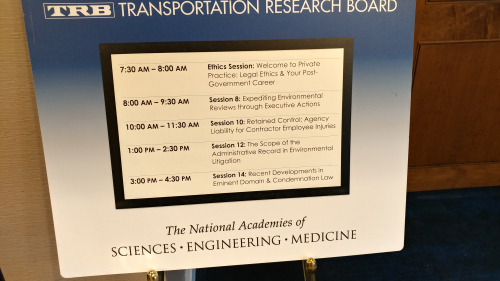
Here are the cases and other items I either spoke about or mentioned at today’s Transportation Research Board‘s 57th Annual Workshop on Transportation Law in Cambridge, Massachusetts:


Continue Reading Links And Materials From Today’s Transportation Research Board Session
The plaintiffs owned mining and homestead claims on land in the Santa Fe National Forest. They claimed they own easements to access these lands, recognized by federal statutes. The government said no, these are just access rights, not easements. 

Then a fire, followed by flooding which severely damaged the Forest Service roads which the plaintiffs used for access. The Forest Service declined to repair the roads, but the plaintiffs said they’d intended to do so. But you have to do so by our rules, the Forest Service responded. Meaning the landowners would need to get a permit first. Apparently, they didn’t.

Instead, they brought suit in the Court of Federal Claims, asserting the loss of their easements was a physical taking. The CFC dismissed because the case was not ripe under Williamson County‘s “final decision” rule — the plaintiffs had not sought permission to repair the roads. 

In Martin

Continue Reading Fed Cir: Takings Claim For Loss Of Access To National Forest Land Not Ripe

Here’s the latest in a case we’ve been following. In Alimanestianu v. United States, No. 17-1667 (May 7, 2018), the U.S. Court of Appeals for the Federal Circuit affirmed the Court of Federal Claims’ ruling rejecting takings liability for the government wiping out a money judgment in favor of terrorism victims against the Libyan government.

Libyan terrorists blew up a plane, and plaintiffs, the survivors of one of the victims, sued Libya and obtained a $1.3 billion judgment in U.S. District Court. Libya appealed and before the appeal was resolved, the U.S. government settled all claims with Libya and vacated the judgment. The settlement with Libya referred claims to a settlement commission, which awarded plaintiffs $10 million. Plaintiffs sued the U.S. for the difference.

The CFC held there was no Penn Central taking because the plaintiffs had no reasonable expectation for any recovery greater than what they got from

Continue Reading Federal Circuit: Restoration Of Foreign Govt’s Sovereign Immunity For Terrorist Acts Isn’t A Physical Taking Of Victim’s Money Judgment

Here’s the latest in the Houston flood cases against the federal government asserting inverse condemnation, which we’ve been following. 

In this Opinion and Order, the Court of Federal Claims (Judge Lettow) rejected the Government’s motion to dismiss, deferring it until trial. If you want a quick rundown of the case, the procedures, and the claims, you can’t do better than the order. It also sets out the Arkansas Game test established by the Supreme Court:

To establish a viable takings claim, a plaintiff must prove two things. First, he or she must show that he or she has “a property interest for purposes of the Fifth Amendment.” Members of the Peanut Quota Holders Ass’n v. United States, 421 F.3d 1323, 1330 (Fed. Cir. 2005) (citing Conti v. United States, 291 F.3d 1334, 1339 (Fed. Cir. 2002)); Wyatt v. United States, 271 F.3d 1090, 1096

Continue Reading The Latest In The Houston Flood Cases: CFC Rejects Gov’t’s Motion To Dismiss

If you understand this post’s headline, congratulations: you are the nerdiest of law nerds, checking no less than two boxes in the obscure law category, takings and patent law.

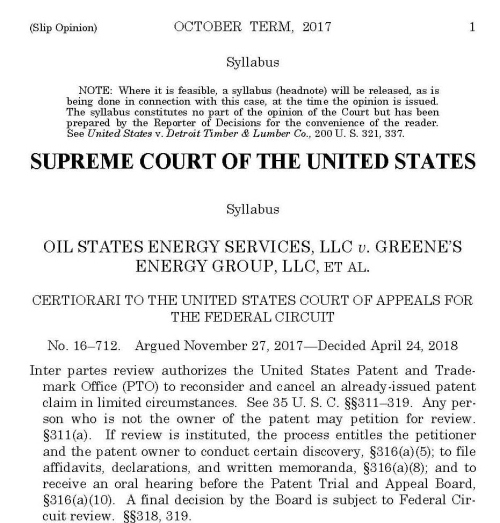
But if you have been paying attention here, you know that recently, the Supreme Court, in Oil States Energy Services, LLC v. Greene’s Energy Group, LLC, No. 16-713 (Apr. 24, 2018) (which we wrote about in “Property Lawyers, Read The Supreme Court’s Latest Patent Case“), held that “inter partes” review of previously-issued patents (a form of property), does not run afoul of the Constitution. 

Yes, these patents could be reconsidered in inter partes review. But the Court expressly left open the question of whether revoking a previously-recognized patent would be a taking:

Finally, our decision should not be misconstrued as suggesting that patents are not property for purposes of the Due Process Clause or the Takings Clause. See, 

Continue Reading The (First?) Post-Oil States Shoe Drops In Patent Takings By Inter Partes Review

DSCF3357

Two cases which we’ve been following are up for consideration on the Supreme Court’s conference schedule today. Indeed, by the time we post this, the conference will likely be over, although we won’t know the results until next week. Check these out, and hold your breath:

  • Petro-Hunt, LLC v. United States, No. 17-1090. As we wrote here, the question in this case is “whether the Takings Clause applies to the decisions of federal courts.” Well, if you have been following our threads on judicial takings, that’s a pretty tall order. Download the cert petition, the USG’s BIO, and the Reply brief here
  • Stanford v. United States, No. 17-809. The question here is when a federal court takes possession of an innocent spouse’s property for her husband’s securities fraud, is this a judicial taking? Check out the briefs here

Sidebar: one of things that that has

Continue Reading Judicial Takings On The Supreme Court Conference Calendar Today

IHtakings

Another week, another Federal Circuit panel opinion on takings authored by Judge Timothy Dyk (following the recent MR-GO opinion). And you know what that means: property owners lose.

The Court of Federal Claims concluded that the feds had taken the plaintiff’s lease of of a part of Dallas’ Love Field — under both a Lucas and Penn Central regulatory and physical taking theory — and rendered a verdict of $135 million in just compensation.  In Love Terminal Partners, L.P. v. United States, No. 16-2276 (May 7, 2018), the Federal Circuit, in the Judge Dyk-authored opinion, reversed. 

The facts of the case are not terribly complex. Back in the day, Braniff Airways (those of you of a certain age will remember Braniff) leased land at Love Field. Decades later, in order to spur the growth and use of Love Field’s competition Dallas-Fort Worth airport (DFW), Congress adopted the

Continue Reading Judge Dyk Strikes Again: No Love For Taking Of Leasehold Of Love Field

Untitled Extract Pages

Here’s one we’ve been waiting to drop, but when it did, we were tied up so couldn’t get to it quickly. 

Yes, it’s a patent case. But as we explained here, a case that property mavens should be following because it deals with what is “property,” and where an owner goes to resolve disputes about that property. 

In Oil States Energy Services, LLC v. Greene’s Energy Group, LLC, No. 16-713 (Apr. 24, 2018), the Court’s majority held that patents are a form of “public property” (more like a government-created entitlement), and thus Congress can withhold the usual Article III tribunal and a jury when the validity of that property is challenged. In an opinion by Justice Thomas (joined by everyone but the Chief Justice and Justice Gorsuch), the Court held that “inter partes review,” under which the Patent and Trademark Office administratively reconsiders (and may cancel) previously-issued

Continue Reading Property Lawyers, Read The Supreme Court’s Latest Patent Case

Thanks to colleague Chris Kramer, we’ll be speaking later this week (Friday, May 4, 2018) in Phoenix at the 22nd Condemnation Summit at the Arizona Biltmore.

Our session will cover “Condemnation Trends: Nationwide & Arizona.” The rest of the day’s agenda looks mighty good too, with session on valuation of easements, paying for transportation infrastructure, airport takings, and a presentation by Justice Lopez of the Arizona Supreme Court. Well worth the very affordable $129 registration cost.

Sign up here.

See you there!Continue Reading Arizona Takings: Condemnation Summit XXII

IMG_2947
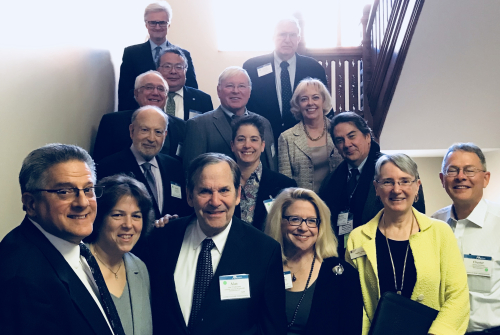
Some of the Land Use Institute faculty, including (front row left), Planning Chair Frank Schnidman and Planning Co-Chair Patty Salkin

Last Friday at the 32nd Annual Land Use Institute in Detroit, I was honored to moderate a freewheeling discussion by a panel of takings experts, Professor Steven Eagle, Minnesota lawyer Howard Roston, and Michigan’s own Alan Ackerman on “Takings, Eminent Domain, and Vested Rights.”

Here are the cases and other materials we discussed, as well as a few others which we did not have time to cover (but wish we could have):


Continue Reading Cases And Materials From The Takings And Eminent Domain Session At The Land Use Institute