


Court of Federal Claims | Federal Circuit

What we learned from the Federal Circuit’s opinion in Shinnecock Indian Nation v. United States, No.14-5015 (Apr. 7, 2015):

  • A $1,105,000,000 (that’s $1.1 billion and change) is the Nation’s claim in the U.S. Court of Federal Claims for what the Hamptons are worth. Slip op. at 3. Sounds about right
  • The Nation sued the State of New York in U.S. District Court, alleging that in the mid-19th Century, the State “enacted legislation allowing thousands of acres of the Nation’s land to be wrongfully conveyed to the government of the Town of Southampton.” Slip op. at 2.
  • USDC: case dismissed (laches, you know). Appeal to the Second Circuit remains pending.
  • Off to the CFC they went, seeking the abovementioned $1.1 billion, claiming the federal government violated its trust obligations when it failed to provide the Nation with a remedy for the misappropriation of its land (at New York’s hands).

Continue Reading Fed Cir: Claim That U.S. District Court Judicially Took Property Can’t Be Brought In The Claims Court

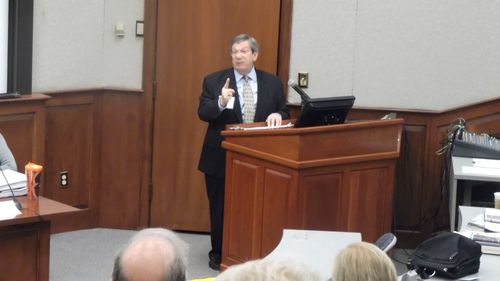
With rare exception, we don’t cover unpublished, nonprecedential decisions. But we’re posting Fuller v. United States, No. 2014-5117 (Mar. 10, 2015), an unpublished opinion from the Federal Circuit, because it reminded us of a presentation by Jim Burling at the recent ALI-CLE Eminent Domain conference, “Novel Takings Theories: Testing the Boundaries of Property Rights Claims.” 

Jim’s presentation didn’t focus on cases quite like this one (which was really borderline), where Dr. Fuller, a neurosurgeon and pro se litigant, argued that it was a taking when a dissatisfied patient of his, a marine biologist who was employed by the National Marine Fisheries Service of NOAA (an agency of the Department of Commerce), posted a comment on “runningforums.com” pointing out Dr. Fuller’s use of hyaluronidase, which noted that it posed a “remote risk” of transmitting mad cow disease. Doc Fuller sued in California state courts for defamation, and

Continue Reading Fed Cir (Nonprecedential): A Federal Employee Posting On The Internet From A Gov’t Computer Isn’t A Taking

This one from the Federal Circuit is a must read, particularly for those interested in takings claims where the federal government is involved. But even if that doesn’t describe you, we think you should review Ministero Roca Solida v. United States, No. 14-5058 (Feb. 26, 2015), because the issues raised — especially in Judge Taranto’s concurring opinion — could have impact far beyond the narrow confines of the case.

The core issue is one we’ve dealt with extensively before, and which the Supreme Court addressed in United States v. Tohono O’odham Nation, 131 S. Ct. 1723 (2011), the effect of 28 U.S.C. § 1500 when the federal government is sued both in the Court of Federal Claims and in a District Court. That statute deprives the CFC of subject matter jurisdiction when there is a case pending in “any other court” against the United States which involves “any claim for or

Continue Reading Tohono’s “Jurisdictional Ambush” And The Tucker Act Shuffle In The Federal Circuit

20150117_084032

This could be your view, winging your way to San Francisco in a couple of weeks, to join us for the 2015 ALI-CLE Eminent Domain and Land Valuation Litigation Conference (and the concurrent Condemnation 101 program), at the Hotel Nikko, February 5-7, 2015. 

There’s still a few spaces left, and time to register. We’re the co-Planning Chair of the Eminent Domain and Land Valuation Litigation program along with Joe Waldo, and we’ve assembled an exciting agenda, presented by a faculty comprised of the nation’s best-of-the-best in our field of law.

Winter in San Francisco is the one time of the year when you are likely to not be fogged in, and in addition to the 2 and a half days of programming, there are networking and social events so you can get to know your colleagues and the faculty better.

Please come and join us, if you

Continue Reading Still Time To Join Us For The 2015 ALI-CLE Eminent Domain Programs In San Francisco

It’s been accepted for such a long time that it’s become one of those things that “everyone knows we’ve always done it that way,” but most probably don’t quite know why that is so: if you have to sue the United States for a regulatory taking or inverse condemnation, you go to the Court of Federal Claims.

In the CFC, just compensation determined isn’t determined by a jury, nor is your case presided over by an Article III judge. In other words, your case is wholly decided by a judge with a 10-year appointment who technically is an employee of the Executive branch, instead of your peers and a guy or gal with life tenure, who is independent and in the Judicial branch. 

Comes now a complaint, filed in the United States District Court for the Western District of Michigan earlier this week, that one would normally expect

Continue Reading Right To Compensation Self-Executing: Property Owners Entitled To Jury & Article III Judge In Federal Inverse Cases

Congratulations to friend and colleague Thor Hearne for his being named as one the Top 50 Litigation Trailblazers by the National Law Journal. Or should we say Rails-to-Trails-Blazer?

Readers of the blog are familiar with his guest posts (see also this one), our coverage of his work, and his own Federal Takings blog, which covers his focus, recovering compensation for property owners for rails-to-trails takings in the Court of Federal Claims, the Federal Circuit, and the Supreme Court. 

More on the kudos for Thor here.  Here’s the complete write up from NLJ:

Pioneer Spirit: Thor Hearne’s first case on behalf of a landholder was when his client, a little village, had some of its property taken by the federal government under the Trails System Act. “We litigated and got into the U.S. Court of Federal Claims, where few people practice.” From there, his practice

Continue Reading Property Rights Lawyer Among National Law Journal’s “Litigation Trailblazers”

Biafora v. United States, No, 2013-5130 (Dec. 10, 2014), is one of those opinions that you don’t really look forward to reading. Something about the Federal Circuit seems to attract these type of takings cases, where the parties are many, the alphabet-soup regulatory environment is byzantine, and the effort of understanding the context often takes more time than figuring out what the court did, and why. 

But fret not, that’s why we’re here with the high points, so you don’t have to. 

This is another case involving the federal government’s legislative efforts to encourage private developers to build and manage low-income housing projects (see this post for an earlier iteration). Congress adopted statutes insuring mortgages on these projects in return for “a 40-year mortgage term, an agreement to maintain affordability restrictions on the housing for the duration of the mortgage, and prepayment limiations or prohibitions on the mortgage.” Slip

Continue Reading Federal Circuit On Williamson County Ripeness And Other Takings … Stuff

For those of you who couldn’t join us at the William & Mary Law School last month for the Brigham-Kanner Property Rights Conference (see our report here), the law school has made videos of the four panel presentations available here

They’re high quality videos, so be prepared for big downloads, but the presentations are worth it. While they are all good, our favorite was the impromptu discussion/debate during the third panel, “Balancing Private Property and Community Rights,” featuring panelists Kames Burling (Pacific Legal Foundation), Professors Richard Epstein (NYU), Steven Eagle (Geo. Mason), Mark Poirer (Seton Hall), and James Stern (William & Mary). 

Continue Reading Brigham-Kanner Property Rights Conference – Panel Videos Now Available

To all who were able to join today’s ABA Section of Real Property, Trust and Estate’s Condemnation, Zoning and Land Use Committee’s call on the AIG takings trial, currently pending in the U.S. Court of Federal Claims, thank you for participating. I’ve posted the entire talk (minus questions) above.

Here are the links to the stories, analysis, and materials I mentioned: 

  • The original complaint, first filed in the CFC in November 2011. 
  • Second Amended Complaint in the CFC case, along with Mr. Boies’ quote that this will be “an easy case to litigate.” We described the case as “audacious,” if only because it seeks $25 billion in just compensation. 
  • Professor Gideon Kanner’s (who has been following this case more closely than we have) first thoughts on the complaint. 
  • The CFC’s Opinion and Order granting in part and denying in part the United States’ motion to dismiss.  


Continue Reading Links From Today’s ABA Talk On The AIG Bailout Takings Case

  DSCF2208

You can’t have rights without advocates.”

                              – Michael Berger

We’re at the William and Mary Law School in Williamsburg, Virginia today for the 11th Brigham-Kanner Property Rights Conference. As we’ve noted earlier, Michael Berger is this year’s B-K Prize honoree, for his career contributions to property law and his “scholarly work and accomplishments [which] affirm that property rights are fundamental to protecting individual and civil rights.”

The list of past recipients is an All-Star roster of property scholars and jurists, including lawprofs Frank Michelman, Richard Epstein, James Ely, Carol Rose, Thomas Merrill, and Supreme Court Justice Sandra Day O’Connor (the latter perhaps more for where she ended up in her Supreme Court career than where she started). See the plaque on the Law School’s wall for the complete list of

Continue Reading 2014 Brigham-Kanner Property Rights Conference Report: Honoring Michael Berger