


Court of Federal Claims | Federal Circuit

Here are the final two amicus briefs supporting the petitioner in Marvin M. Brandt Revocable Trust v. United States, No. 12-1173 (cert. granted Oct. 1, 2013). That’s the case in which the Court is considering the meaning of the term railroad “right of way” as used in an 1875 federal statute. As our amici brief argues, if the Court accepts the government’s theory in the case, it could wipe out an entire class of rails-to-trails takings cases.

Next up, the government’s merits brief.

Brief of Amicus Curiae New England Legal Foundation in Support of Petitioners, Marvin M. Brandt Revocable T…

Brief for the Northwest Legal Foundation as Amicus Curiae in Support of Petitioners, Marvin M. Brandt Revo…

Continue Reading Last Two Amicus Briefs In SCOTUS Rails-To-Trails Case
Here are two more amici briefs supporting the petitioner in Marvin M. Brandt Revocable Trust v. United States, No. 12-1173 (cert. granted Oct. 1, 2013). That’s the case in which the Court is considering the meaning of the term railroad “right of way” as used in an 1875 federal statute. 

The Cato, et al brief argues:

We doubt there is serious dispute that protecting individuals’ right to their property is a foundational purpose for which our national and state governments were established. But we begin from this point because the right landowners have to be secure in their property is undermined

Continue Reading More Amici Briefs In SCOTUS Rails-To-Trails Case

Here’s the amici brief of Pacific Legal Foundation and the Center for Constitutional Jurisprudence in Marvin M. Brandt Revocable Trust v. United States, No. 12-1173 (cert. granted Oct. 1, 2013). That’s the case in which the Court is considering the meaning of the term railroad “right of way” as used in an 1875 federal statute.

As we’ve explained, although this case is a quiet title action out of a Colorado U.S. District Court, it could have huge implications for rails-to-trails takings cases in the Court of Federal Claims and the Federal Circuit. The issue is whether the federal government retained an “implied reversionary interest” when it issued railroad patents, or whether these grants were subject only to a railroad easement. The difference is that easements may be extinguished, while reversionary interests cannot.

The Tenth Circuit, in contrast to other courts, held that the right of way is subject to an implied reversionary interest in favor of the United States, meaning that the property owner doesn’t have “property” that was taken when the railroad was abandoned and was turned into a recreational trail. The merits brief of the petitioners is posted here.

We filed an amicus brief in the case, available here

The PLF/CCJ brief argues:

This case raises important questions regarding the common law system of property ownership and the certainty of titles in property.

In the decision below, however, the Tenth Circuit repudiated the common law rules of property ownership in favor of a per se rule, holding that the United States—the original grantor of the railroad easement and the Brandts’ fee estate—will retain an “implied reversionary interest” in an 1875 Act right-of-way, even after the government patents the underlying land and conveys it to a private party without any express reservation of reversionary rights. … The decision below extended the Tenth Circuit’s rule, holding that all private landowners whose titles are traceable to a federal land patent will be subject to the government’s unexpressed reservation of a reversionary interest in a railroad right-of-way, regardless of the rights and expectations established by their titles.

If not reversed, the Tenth Circuit’s rule will unsettle the rights and expectations of tens of thousands of landowners across the nation. … Amici urge this Court to reverse the Tenth Circuit’s opinion in this case and to reaffirm the fundamental common law principle that ownership of land will be determined by title, not implication.

More background on the case in a piece in Jurist by PLF’s Brian T. Hodges, “Brandt v. US: Should the Common Law of Propert be Scrapped?”  

Amicus Curiae Brief of Pacific Legal Foundation and Center for Constitutional Jurisprudence in Support of P…


Continue Reading Amici Brief In Rails-To-Trails Case: Tenth Circuit Repudiated Common Law Rules Of Property

Here’s the amici brief we are filing (along with our firm colleagues Mark Murakami and Bethany Ace) in Marvin M. Brandt Revocable Trust v. United States, No. 12-1173 (cert. granted Oct. 1, 2013). That’s the case in which the Court is considering the meaning of the term railroad “right of way” as used in an 1875 federal statute. 

As we explained here, although this case is a quiet title action out of a Colorado U.S. District Court, it could have huge implications for rails-to-trails takings cases in the Court of Federal Claims and the Federal Circuit. The issue is whether the federal government retained an “implied reversionary interest” when it issued railroad patents, or whether these grants were subject only to a railroad easement. The difference is that easements may be extinguished, while reversionary interests cannot.

In this case, the railway abandoned its use, after which

Continue Reading New Amici Brief: Attempting To Derail Rails-To-Trails Takings Cases

Hey, that rhymes! Today, in a not-entirely-unexpected move, the U.S. Supreme Court granted cert and agreed to review United States v. Brandt Revocable Trust, No. 09-8047 (Fed. Cir. Sep. 11, 2012).

We say not-unexpected for two reasons. First, the Tenth Circuit expressly noted its ruling created a circuit split (that’s catnip to counsel considering a petition). Second, the Solicitor General did not oppose the petitition, but agreed that it should be granted to resolve the split in the government’s favor. 

The issue in the case is whether the federal government retained an “implied reversionary interest” when it issued these patents, or whether these grants were subject only to a railroad easement. The difference is that easements may be extinguished, while reversionary interests cannot. In this case, the railway abandoned its use, after which the federal government instituted a quiet title action in federal court asserting it owned the

Continue Reading Cert Grant In Brandt

DHM_IMLA

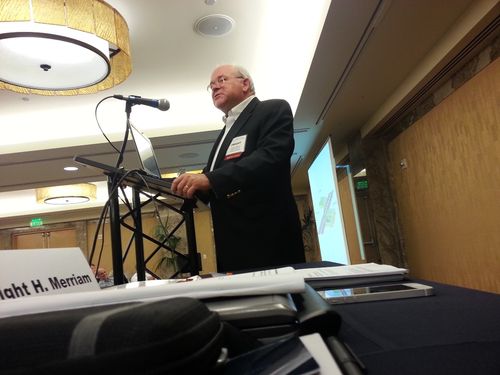
A big thanks to my Owners Counsel of America and ABA State and Local Government Law Section colleague Dwight Merriam for emceeing today’s well-attended double session on land use and takings law at the International Municipal Lawyers Association’s 2013 annual meeting in San Francisco. Dwight and I were joined by land use expert Cecily Barclay, who presented sessions on Harvey Cedars, while I covered Koontz and Dwight did the relevant parcel/Lost Tree sessions. Continue Reading IMLA Conference Session On Koontz, Harvey Cedars, Relevant Parcel

IMLA
On Monday, September 30, 2013, we’ll be speaking along with Dwight Merriam and Cecily Barclay at the International Municipal Lawyers Association’s annual meeting in San Francisco, about three important cases/issues: Koontz, Harvey Cedars, and Lost Tree.

That’s a pretty wide range of cases, but we have some time and we’re sure we’ll have a good discussion. If you are attending the IMLA conference, please be sure to join us: 2:15 – 3:15pm, Hilton San Francisco Union Square (Plaza B, Lobby Level). Continue Reading Upcoming IMLA Panel On Koontz, Harvey Cedars, And Lost Tree

This past term, the U.S. Supreme Court in Arkansas Game and Fish Comm’n v. United States, 133 S.Ct. 511 (2012), held that government-induced flooding could result in takings liability, even if the flooding was merely temporary. The Court remanded the case to the Federal Circuit to determine whether the flooding resulted in liability.

The Federal Circuit ordered supplemental briefing, and the parties and amici responded. Earlier this month, the court held oral arguments.

2009-5121_962013

The government’s counsel argued that the Supreme Court adopted a new test for temporary flood takings that looks like a hybrid Penn Central test, while the Commission’s counsel argued that the Court expressly did not adopt a new test, and that temporary flooding cases are to be treated just like any other physical invasion under the existing test.

With the arguments submitted, now we wait. Continue Reading But … What If Penn Central Terminal Is Flooded?

Here’s one we’ve been meaning to post for a while. It’s a Court of Federal Claims opinion in a case involving an indian nation’s takings lawsuit, seeking compensation for its inability to challenge the 1859 conveyance of what is now the town of Southampton, New York without the required tribal consent. Shinnecock Indian Nation v. United States, No. 12-836 L (Aug. 29, 2013).

The judicial taking part of the long opinion (21 single-spaced pages) starts on page 18, where the court rejected the plaintiff’s request to amend its complaint to add a claim for judicial taking. The opinion recounts the judicial takings theory but refused to allow amendment because, “the portion of the Supreme Court’s decision in Stop the Beach that discussed the standard for finding that  judicial taking had occured and stated that a judicial taking was a valid cause of action was signed by only four justices.”

Continue Reading CFC: No Amendment Of Complaint To Allege Judicial Taking Because Theory Not Adopted By The Federal Courts

Here’s the Opinion and Order of the Court of Federal Claims after the damages trial in Childers v. United States, No.  08-1981 (Aug. 5, 2013). It’s a very long opinion (145 pages, with a table of contents!), so we’re not going to summarize it, but if you want to know how a rails-to-trails case is tried, you can’t do better than this. Here’s the court’s overview:

This Fifth Amendment taking case comes before the Court following a trial on damages. Plaintiffs, landowners of 13 separate properties in Sarasota, Florida, seek just compensation stemming from the imposition of a recreational trail across their properties pursuant to the Rails to Trails Act. Specifically, Plaintiffs seek $8,703,800, representing $4,938,200 for the encumbrance of the trail and $3,765,600 in severance damages. Defendant asserts that compensation should be limited to the encumbrance, which it claims is properly valued at $2,220,900. The Court awards just

Continue Reading Major CFC Decision On Rails-To-Trails Takings