Court of Federal Claims | Federal Circuit

Here’s a case that illustrates the weird results that can occur in takings cases where a property owner can be deemed to be too late (the statute of limitations) or too early (ripeness), take your pick.

In 1996, Mr. Smith got disbarred by the Tenth Circuit and a few other federal courts, and in 1999 by the Colorado Supreme Court as a reciprocal matter. In 2007, he was reinstated in all but the Colorado courts. Because the Colorado court did not reinstate him, however, the U.S. District Court for the District of Colorado reversed itself and denied reinstatement, and in 2010, the Tenth Circuit affirmed. Smith then sued in the Court of Federal Claims under the Tucker Act, seeking  damages for due process, equal protection, and — you guessed it — a taking. A judicial taking. Smith claimed that his law license was property taken by the federal court.

Now

Continue Reading Federal Circuit Discusses Judicial Takings … In A Disbarment Case?
Update: Gideon Kanner’s thoughts on the case here.

As we mentioned in this post about earlier proceedings in the case, when the plaintiff/property owner’s name is “Jerry McGuire” and he is asserting a claim for compensation, it’s inevitable that we all make reference to the “show me the money” catchphrase from Jerry Maguire, the 1996 Cameron Crowe film. So we have.

With that out of the way, let’s get to the Federal Circuit’s opinion in Maguire v. United States, No. 2012-5073 (Feb. 20, 2013), in which the court held that McGuire’s takings claim was not ripe and he had no “property” that was taken.

First, the facts. McGuire leased farmland from an Arizona indian tribe, administered by the Bureau of Indian Affairs. The BIA removed a bridge that connected two of the parcels over a canal, which effectively landlocked one of the parcels. The bridge

Continue Reading Fed Cir Doesn’t Show Jerry McGuire The Money: Property Owner Required To Pursue “Ambiguous and Informal” Permit Procedure

Here’s the amicus brief filed today on behalf of the International Municipal Lawyers Association in Horne v. United States Dep’t of Agriculture, No. 12-123 (cert. granted Nov. 20, 2012). The brief argues:

Petitioners have needlessly complicated the vindication of their asserted rights under the Takings Clause of the Fifth Amendment by failing to file a straightforward claim for just compensation in the U.S. Court of Federal Claims. Petitioners have long participated in the raisin industry marketing program which they now believe results in a taking. Thus, they could easily have filed a claim for just compensation in the U.S. Court of Federal Claims based on this asserted taking. Instead, petitioners decided to disregard federal law requiring that they participate in the program and now seek to invoke the Takings Clause to defend against the sanctions imposed as a result of their illegal action.

This effort should fail for three

Continue Reading IMLA Amicus Brief In California Raisin Takings Case: Tucker Act Is Exclusive Method Of Raising Takings Arguments

Here’s the Federal Circuit’s Order for additional briefing in the Arkansas Game & Fish Comm’n v. United States case. As you know, the U.S. Supreme Court earlier reversed the Federal Circuit’s conclusion that government-induced flooding could not be a taking because it was not “permanent, ” and remanded the case to the Federal Circuit for more.

Now that the Supreme Court has rejected that per se rule of no liability, the Federal Circuit must “weigh carefully the relevant factors and circumstances” in the case (to quote the Supreme Court describing the task) and determine whether the flood damage that occurred was a taking under the new, multi-factor test set out in the Court’s opinion:

  • “[T]ime is indeed a factor in determining the existence vel non of a compensable taking”
  • Was the flooding “temporary and unplanned” and a result of “exigent circumstances?”
  • “[T]he degree to which the invasion is intended or


Continue Reading Fed Cir: More Briefing On Arkansas Game & Fish

We’re sensing a trend here: takings cases where the property owners/plaintiffs are dead by the time their cases get considered by the Supreme Court. The week before last, the Court heard arguments in Koontz v. St Johns River Water Mgmt Dist., No. 11-1447 (cert. granted Oct. 5, 2012), a case where the original landowner has passed on to his final reward after arguing for decades that his property was taken. Yet the District argues a taking hasn’t even occured yet.

Now comes a cert petition, recently filed, seeking review of a similiar situation, the Federal Circuit’s decision in Estate of Hage v. United States, 687 F.3d 1281 (Fed. Cir. 2012). In that case, the court held that a 22-year old takings case was not ripe because even though the agency denied Hage’s every application for a grazing permit, it might issue a special use permit that might

Continue Reading New Cert Petition: Is Interference With Use Of Vested Water Right A Per Se Or Penn Central Taking?

43_ELR_10189_Page_01Thanks to the folks at the Environmental Law Institute, who have allowed us to reprint an article from a recent Environmental Law Reporter which brings some clarity to the subject of the “denominator” issue in regulatory takings.

In Temporary Takings, Tahoe Sierra, and the Denominator Problem, William W. Wade, Ph.D., a resource economist with the firm Energy and Water Economics (Columbia, Tennessee), writes:

Hundreds of briefs, decisions, and journal articles debating “how much loss is enough” should be sufficient proof that the Keystone Bituminous “taking fraction” provides poor guidance to decisionmaking in partial regulatory takings. The Penn Central court intended to measure the severity of economic impact by interference with distinct investment-backed expectations. Where lost income from use of the property is at stake, standard economics requires the denominator in the “taking fraction” to be the owner’s investment in the property. Instead, too many judicial decisions have

Continue Reading Temporary Takings, Tahoe Sierra, and the Denominator Problem

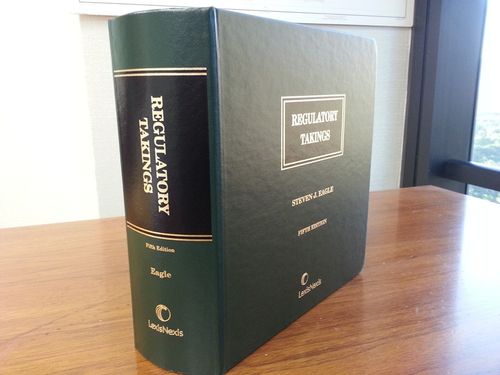
Regulatory_takings-5th_edition

I just received my copy of the latest edition of of Professor Steven J. Eagle‘s definitive treatise Regulatory Takings (Lexis/Nexis 5th ed. 2012). It switched formats and is now a looseleaf and not a bound hardcover, which hopefully means it will be easier to update.

Like the earlier editions, this is a must-have for every land use and property law attorney’s back bookshelf. Chapters include “Property Rights and Their Sources,” “The Ascendancyof Land Use Regulation,” “Analytical Issues in Regulatory TakingsLitigation,” and “Regulatory Takings Remedies.” Get your copy here (oddly, the Lexis-Nexis web site only has the 4th edition for purchase, but I expect that to be remedied shortly).

I have the honor of counting Professor Eagle as a colleague, as he is my immediate past predecessor as the Chair of the Condemnation Committee of the ABA’s Section of State and Local Government Law.

Get this book. 

Continue Reading The Eagle Has Landed – Latest Edition Of “Regulatory Takings” Treatise

Here‘s what we think is the final top-side amicus brief in Horne v. United States Dep’t of Agriculture, No. 12-122 (cert. granted. Nov. 20, 2012), supporting the petitioner/property owner. Filed by the Chamber of Commerce of the United States, the brief argues that where “the government requires a direct transfer of funds, and where a party seeks equitable relief in resisting application of that statute in an enforcement action, that party need not seek ‘compensation’ in a duplicative second lawsuit under the Tucker Act.” Br. at 5.

In Horne, the question is whether farmers who assert that an agricultural regulations known as “marketing orders,” by which they are forced to surrender large percentages of their raisin crops to the USDA without payment or else face massive fines, can raise the argument that to do so would be a taking when defending against the fine, or if their

Continue Reading Final Amicus Brief In Cal Raisin Takings Case: Property Owner Can Raise Equitable Takings Defense

Here’s the brief amici curiae submitted by five law professors who teach constitutional law, in Horne v. United States Dep’t of Agriculture, No. 12-122 (cert. granted. Nov. 20, 2012), supporting the petitioner/property owner. In that case, the Ninth Circuit held the District Court had no jurisdiction to hear a takings defense to the USDA’s imposition of a fine, and the only way to raise a takings claim was for the Hornes to institute separate litigation in the Court of Federal Claims for compensation.

Their brief makes two points. First, that Williamson County is “mistaken,” and there’s nothing standing in the way of the Hornes asserting a takings defense. Second, the Tucker Act does not require the Hornes to raise their takings claims only in the context of a suit for just compensation. 

Simply put, Williamson County’s second “ripeness” requirement is a mistake.

Williamson County’s constitutional ripeness rule

Continue Reading Lawprofs’ Amici Brief In California Raisin Takings Case: Williamson County “has prevented scores of litigants from raising perfectly valid Fifth Amendment claims in federal court”

We’re used to knee-jerk reactions by state and local governments to takings claims: whatever the circumstances, the property owner is wrong, and loses. So it’s nice to see a brief where a state government stakes out a more objective position.

Texas has filed an amicus brief in Horne v. United States Dep’t of Agriculture, No. 12-122 (cert. granted. Nov. 20, 2012), in support of the petitioner/property owner. In Horne, the question is whether farmers who assert that an agricultural regulations known as “marketing orders,” by which they are forced to surrender large percentages of their raisin crops to the USDA without payment or else face massive fines, can raise the argument that to do so would be a taking when defending against the fine, or if their only option is to pay the fine and file a lawsuit in the Court of Federal Claims to recover just compensation.

Continue Reading Texas’ Amicus Brief In California Raisin Takings Case: Y’all Don’t Need To Make This So Complicated