Muchmagnacarta

Here’s the latest in a case we’ve been following which presents an important issue. So much so that we filed an amicus brief in support of the property owner.

In Town of Apex v. Rubin, No. 206PAA21 (Aug. 22, 2025), the North Carolina Supreme Court held that if a taking is determined to be for private benefit and not a public use or purpose, title and right of possession “revest” with the original owner.

The court also held that if, as here, the condemnor had already seized the land and completed construction, a court is not powerless to address it and may order the condemnor to “restore the land to its pre-construction condition. Whoa.

In short, this is an important one that is well worth your review. 

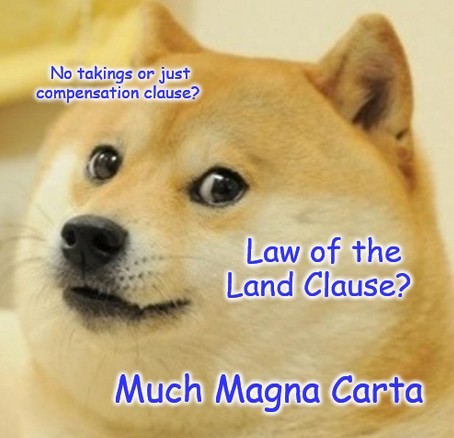
Before we get underway, a note: recall that the North Carolina Constitution does not have a “takings” or “just compensation” clause. Does

Continue Reading NC: If A Taking Is Determined To Lack A Public Use, Title Revests In Private Owner. If Construction Already Taken Place, Restoration Is An Available Remedy



One of the frustrations of challenging the power to take is … let’s say you win. Yay! You’ve stopped the taking!

So now what? Go back to your life safe in the belief that your property rights are secure? Maybe. If the government has had enough and says “no mas,” your win may be the end of it.

But what if the government really really wants your property? Can it come at you again, armed with with the blueprint your successful public use challenge just provided for how to do it right this time? Probably. There are few situations where the usual “one shot” principle in civil cases — also known as claim preclusion (res judicata to you traditionalists) — ties a condemnor’s hands and prevents it from taking a second, or third, or more shot.

So what about settling your public use challenge? If you

Continue Reading CA8: You Believed The County When It Promised In The Settlement Agreement To Not Take Your Land In The Future? Shame On You!

Screenshot 2024-10-25 at 13-19-32 Housing and Exactions The Next Frontiers After Sheetz Pacific Legal Foundation

Our outfit (Pacific Legal Foundation) has put out a call for papers. on the topic of land use exactions and housing law. Honorarium included for accepted papers, and there will be a workshop to follow.

Here’s the description:

This workshop seeks to build on the result of Sheetz v. County of El Dorado and chart the course of the next steps in exactions/unconstitutional-conditions law. From Nollan v. California Coastal Commission, through Dolan v. City of Tigard and Koontz v. St. John’s River Water Management District, and now including Sheetz, the Supreme Court has looked to the doctrine of exactions and unconstitutional conditions to ensure property rights are protected. In doing so, it has created a constitutional bulwark protecting the right to build housing on private property, an important stick in the property rights bundle.

The Supreme Court’s unanimous decision in Sheetz held that legislatively-imposed development-fee schedules are

Continue Reading Call For Papers: “Housing and Exactions: The Next Frontiers After Sheetz“

PXL_20240422_045016733.MP
There are some rewards for working late in the 808

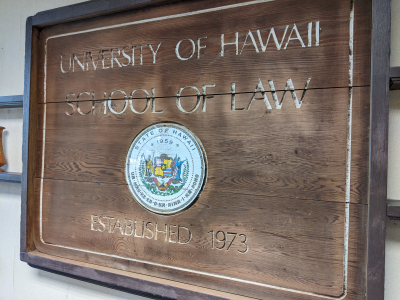
Yesterday was the last day of instruction for the Spring 2024 semester at the University of Hawaii Law School. Did these last few months ever go by fast. 

A big thank you to Professor Mark M. Murakami, with whom I guest-lectured at the Old School (both of us earned our JD’s at the Law School) over the semester, on such topics as Euclid, vested rights and development agreements, and of course limitations on the police power such as takings.

Although our students have another couple of weeks to finish up with their final papers, we can say with certainty that the future of Hawaii land use law is in good hands. We had some very intriguing and educational discussions over the past few months. 

PXL_20230426_222214630

Law of the Splintered Paddle

PXL_20240423_050055849.MP       
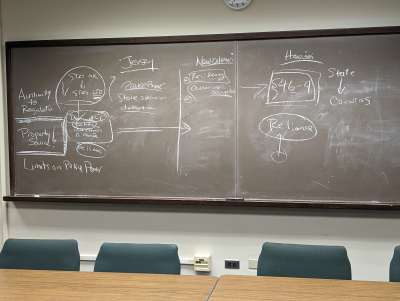
Old School chalkboards remain in some of the classrooms.

Continue Reading Aloha To Another Semester Of U. Hawaii Land Use

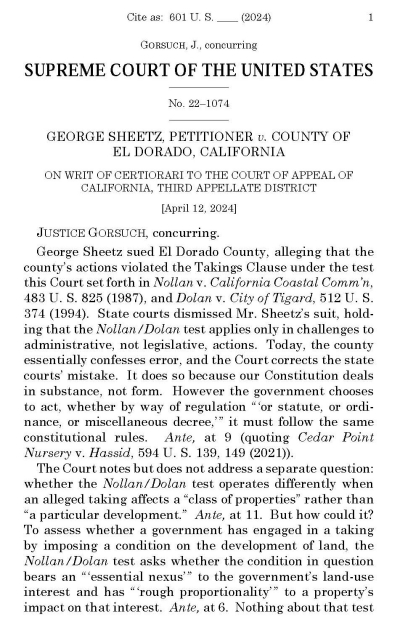
Gorsuch concurring

Note: this is the second of our posts on the recent Supreme Court opinions in Sheetz v. County of El Dorado, the case in which the unanimous Court held that exactions imposed by legislation are not exempt from the essential nexus (Nollan) and rough proportionality (Dolan) standards. Here’s our first post, which covers the case and the main opinion (“Sheetz pt. I – ‘Radical Agreement’ At SCOTUS: ‘Your Money Or Your Rights’ Isn’t OK Just Because A Legislature Does It“).

[Disclosure: this case is one of ours.]

In this post, we cover the three very short concurring opinions.

* * * *

The Court took no position on whether the County’s traffic impact fee has an essential nexus to the Sheetz development, or whether $23 grand is roughly proportional to any traffic his proposal might be responsible for. For this and more

Continue Reading Sheetz pt. II: The Concurrences – Does Nollan/Dolan Operate Differently When Exaction Affects A Class?

PXL_20230223_024826759

Starting in January, we’ll be helping our friend and former law partner Mark M. Murakami with the venerated and oh-so-important Land Use course (Law 580) at the University of Hawaii’s Law School.

We’re temporarily stepping into some mighty big slippers (this is Hawaii, so we don’t always wear shoes), as this is the course that our mentor Professor David Callies taught for decades. And is there a better venue in which to teach and study land use law and regulation, and its limits? After all, Hawaii may be the most heavily-regulated land on the planet, and is a focal point for every issue you can think of, from zoning to environmental restrictions to takings to public trust to subdivision to admin law to … well, you get the drift.

We’ll cover those topics, as well as the fundamentals. And we have a few surprises up our sleeves — some impressive

Continue Reading Hawaii Five-80: More Land Use (Law 580) At The University Of Hawaii

Here’s what we’re reading about the Supreme Court’s property rights docket — some good, some disappointing — this day.

  • Niina Farah, “Supreme Court flooding case could ripple across the energy sector (E & E News / Energywire) – About the Devillier case (which we summarized here), in which we were quoted: “The Supreme Court decision to hear the Devillier case comes after a concerted effort in recent years to convince the court to address procedural maneuvers that have made it challenging for property owners to bring their claims to court, said Robert Thomas, director of property rights litigation at the Pacific Legal Foundation. The nonprofit is among the groups that has asked the court to address takings cases and has lent its support for the property owners in Devillier in a ‘friend of the court‘ brief. ‘There’s a lot of gamesmanship going on


Continue Reading Supreme Court Property Rights Round-Up

We’re not going to dwell all that much on the California Court of Appeal’s recent opinion in Discovery Builders, Inc. v. City of Oakland, No. A164315 (June 22, 2023), mostly because it seems entirely predictable.

The developer thought it had an agreement with the city to pay certain fees (dare we say “exactions”) the city required in order to approve and provide what the court calls “project oversight.” The contract “provided that the fees set forth in the agreement satisfied ‘all of the Developer’s obligations for fees due to the City for the Project.'” Slip op. at 1. You know where this is headed, don’t you?

That’s right, eleven years later while the project was still underway, the city adopted new ordinances imposing new impact fees. When the developer sought additional building permits … no permit without paying the additional exactions. The trial court thought the contract took care

Continue Reading Chump Alert! Developer’s Claim That City Can Be Held To Its Contract Limiting Exactions Goes About As Well As You’d Expect

We really want you there…

One (nearly) last reminder that there’s still time to register for your space at the 40th ALI-CLE Eminent Domain & Land Valuation Litigation Conference, February 1-4, 2023, in Austin. In the past several years, we have sold out due to the conference room capacity and the conference hotel block. But there’s still space, although we are nearly full. So register now – don’t delay any further! 

Here’s the brochure with the complete agenda, schedule, and faculty listing. But to tempt you, here are some of the highlights of the program:

  • Everything Old is New Again: Why Today’s Practitioners Need to Understand the Original Meaning of the Takings and Just Compensation Clauses
  • When the SWAT Team Comes (No) Knocking: Police Power Takings
  • Private Utility Takeovers – Lessons From a 67 Day Trial

  • “Contraband”: How Property Rights Helped Pave the Way for Civil Rights

  • Valuation


Continue Reading (Nearly) Last Call: There’s Still Time To Join Us For The 40th ALI-CLE Eminent Domain & Land Valuation Litigation Conference, Feb 1-4, Austin

Anyone who reads this blog regularly knows Tiburon, California, even if you’ve never stepped foot there. Yes, that Tiburon. Well, the beat goes on: the Agins litigation wasn’t the only time that the town and its residents combined forces to try and draw up the drawbridge and prevent the building of more homes in this very exclusive and chichi Marin County waterfront and hilltop community with commanding multi-million dollar views of San Francisco and the Bay. 

For the latest example, read the California Court of Appeal’s opinion in Tiburon Open Space Committee v. County of Marin, No. A159860 (May 12, 2022). It’s 110 pages, but don’t let that discourage you (it’s not necessary to dig into the details, unless you are a true California Environmental Quality Act nerd). The facts alone are hair-raising. But on the other hand, the story may be an old story to

Continue Reading “Something is very wrong with this picture.” Cal Ct App Calls Out CEQA (“fearsome weapon”), Tiburon’s “official hostility,” And “combined animus of two levels of local government”