In Turner v. Jordan, No. 22-13159 (Sep. 17, 2024), the U.S. Court of Appeals for the Eleventh Circuit held that even though the federal courts have jurisdiction over Turner’s takings claim, the court nonetheless has the discretion to choose to wash its hands of the case in order to protect a state’s administrative procedures.

This is one of those home equity takings cases, with the twist here being that Turner claims that because Florida officials failed to account for his homestead exemption, his property sold for half of what it should have at a property tax foreclosure sale. He alleged that with the exemption, the sale would have netted him some equity to which he was entitled. The district court dismissed for comity reasons, and the Eleventh Circuit affirmed.

Of course, the opinion pays lip service to the more-often-in-the-breach-than-in-the-observance principle that “federal courts have a ‘virtually unflagging obligation …
Continue Reading Comity Of Errors: CA11 Chooses Nondisruption Of State’s Administrative Process Over Constitutional Right To Compensation

Sticks bundle
We don’t see any free public education here.

Some old-school property “sticks” analysis from the U.S. Court of Appeals for the Ninth Circuit in Zeven v. Jones, No. 23-35438 (Aug. 23, 2024), worth checking out.

The Idaho Constitution has a “free common schools” clause:

The stability of a republican form of government depending mainly upon the intelligence of the people, it shall be the duty of the legislature of Idaho to establish and maintain a general, uniform and thorough system of public, free common schools.

Idaho Const. art. IX, § 1.

According to some parents, the term “free” means that school districts cannot charge fees for “certain educational and extracurricular opportunities.” In one case, the fees ranged from $4 for locker use, to a $32 optional fee to cover the cost of purchased items for a “health occupations” store. In another, the fees ranged from $15 to $300.

Continue Reading CA9: No Taking For Charging School Fees, Because Idaho’s “Free Common Schools” Clause Does Not Create Private Property Interest

This would not be authorized.

Here’s the latest in an issue that found new vitality after the U.S. Supreme Court’s decision in Cedar Point affirming that government-authorized physical entry to private property is presumptively a taking.

This is the “precondemnation entry” issue in eminent domain which several courts have addressed:

This is where a condemnor contemplates taking property and wants to get on site to check it out. Do things like surveys, examinations, tests, and sample-taking. Often, the owner of the property doesn’t mind: pay me a bit for my trouble, indemnify me in the event someone gets injured, and you can have limited access to do your business and then go on your way, condemner. But sometimes, an owner says no.

In Betty Jean Strom Trust v. SCS Carbon Transport, No. 30317 (Aug. 21, 2024), SCS is planning a CO2 pipeline though South

Continue Reading S Dakota: Only Way To Read Precondemnation Entry Statute Constitutionally Is Allowing “minimally invasive superficial inspections” and “minor soil disturbances”

Here’s the latest in the solved-but-not-quite-solved issue of whether the government can keep the surplus which remains after a tax-foreclosure sale (see Tyler v. Hennepin County), the Michigan Supreme Court’s opinion in Schafer v. Kent County, No. 164975 (July 29, 2024), where the court concluded that its earlier decision in Rafaeli v. Oakland County is applicable not merely going forward (prospectively) but applies to those cases which are not final and closed out.

There’s a lot there — especially on the nuances of whether judicial decisions on constitutional rights apply only prospectively, or govern cases instituted in the past — but we are focused on the opinion’s analysis of property rights and takings as matters of history and tradition. We’re not going to comment here because this case is one of ours, argued by Christina Martin and Pacific Legal Foundation’s Home Equity Theft team. That said, here’s

Continue Reading Michigan: “few rights and legal principles have greater legal, historical, and constitutional pedigrees than the protection against uncompensated takings”

DJK was adding a bedroom to an existing residence and needed a wastewater permit from Vermont’s environmental agency. The agency has a “presumptive isolation zone” around potable water supplies and septic systems in which a property owner is presumed to be barred from doing anything sewage related. In this case, the isolation zone for DJK’s property crossed over onto the property of their neighbors, the Crowleys.

The agency granted DJK the permit, which contained a provision that not only no sewage-related construction could take place in the isolation zone, but that “[n]o buildings” could be construction which “might interfere with the operation of a wastewater system or potable water supply[.]” Remember, the isolation zone was located partially on the Crowley property.

The Crowleys were not very appreciative, so appealed (to a Vermont trial court sitting as the Environmental court). They argued that the permit was invalid because it worked a

Continue Reading Vermont: Environmental Court Doesn’t Have Jurisdiction To Determine Property Rights, But We’re Going To Find No Cedar Point Taking Anyway

Here are three federal circuit opinions, all unpublished. None of them worthy of a stand-alone post, but also not to be overlooked entirely.

  • GHP Management Corp. v. City of Los Angeles, No. 23-55013 (9th Cir. May 31, 2024): Lessors “failed to state a claim for a Fifth Amendment per se physical taking[,]” in their challenge to LA’s eviction moratorium. You know why: you waived your right to exclude by renting your properties, so the government prohibiting you from getting breaching tenants out is merely a regulation of the landlord/tenant relationship. Yee.
  • Innova Investment Group, LLC v. Village of Key Biscayne, No. 21-11877 (11th Cir. May 29, 2024): After the Village tagged Innova with a NOV and $4k fine for not obtaining an interior demolition permit and Innova failed to correct the violations within the 60-day deadline, the Village imposed $4k per day fines and “aggregate penalties of


Continue Reading Unpublished Wednesday: Eviction Moratorium Taking, Excessive Fines Taking, And 1983 Zoning Statutes Of Limitations

1000002646

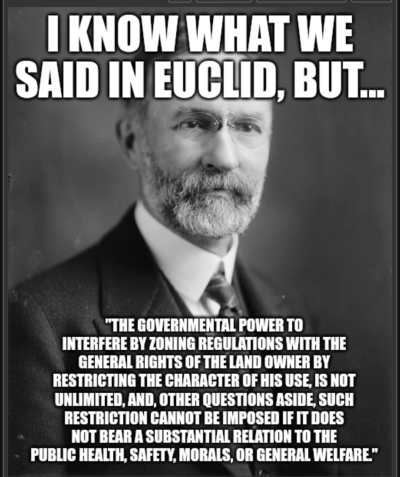
It was on this day in 1928 when the U.S. Supreme Court issued its second most famous decision about zoning, Nectow v. City of Cambridge., 277 U.S. 183 (1928). 

We say “second” because everyone knows that the first is the Court’s decision issued just two years earlier which generally upheld comprehensive use, height, and density regulations as a valid exercise of the government’s police power to regulate property uses to further the public health, safety, welfare, or morals. See Village of Euclid v. Ambler Realty Co., 272 U S. 365 (1926). 

Partly because of the hype surrounding Euclid and the broad governmental embrace of exclusionary land use policies that Euclid unleashed, we think that Nectow has not received the attention it is due. After all, it should be seen as the companion case to Euclid: it was authored by same Justice who wrote Euclid (Justice Sutherland)

Continue Reading Happy Birthday, Nectow v. City of Cambridge!

PXL_20240422_045016733.MP
There are some rewards for working late in the 808

Yesterday was the last day of instruction for the Spring 2024 semester at the University of Hawaii Law School. Did these last few months ever go by fast. 

A big thank you to Professor Mark M. Murakami, with whom I guest-lectured at the Old School (both of us earned our JD’s at the Law School) over the semester, on such topics as Euclid, vested rights and development agreements, and of course limitations on the police power such as takings.

Although our students have another couple of weeks to finish up with their final papers, we can say with certainty that the future of Hawaii land use law is in good hands. We had some very intriguing and educational discussions over the past few months. 

PXL_20230426_222214630

Law of the Splintered Paddle

PXL_20240423_050055849.MP       
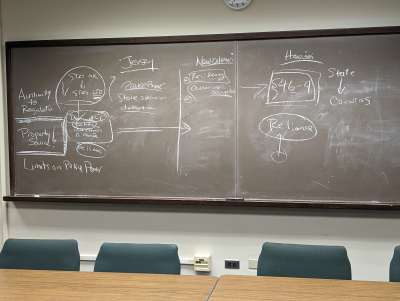
Old School chalkboards remain in some of the classrooms.

Continue Reading Aloha To Another Semester Of U. Hawaii Land Use

PXL_20231101_125417762.PORTRAIT (Small)
Guess where we stopped for coffee this morning?
(A reminder: this case has nothing to do
with the convenience store.)

Note: this is the first of two posts on the recent Supreme Court opinions in Sheetz v. County of El Dorado, the case in which the unanimous Court held that exactions imposed by legislation are not exempt from the essential nexus (Nollan) and rough proportionality (Dolan) standards. Here’s the second post, which covers the concurring opinions.

[Disclosure: this case is one of ours.]

In this post, we cover the background, and the Court’s unanimous opinion.

* * * *

Does the government have the unfettered ability to demand “the goodies” (as one municipality’s chief land use planner famously called them in the 1980s), simply because a property owner needs the government’s approval to make use if his or her land?

That’s the

Continue Reading Sheetz pt. I – “Radical Agreement” At SCOTUS: “Your Money Or Your Rights” Isn’t OK Just Because A Legislature Does It

Screenshot 2024-03-26 at 09-12-12 Meme Generator - Imgflip

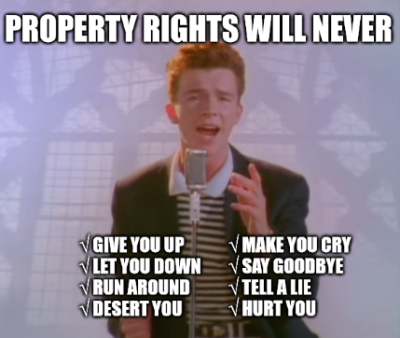
Check this out: lawprof Ilya Somin has posted “Squatters’ Rights Laws Violate the Takings Clause” at Volokh.

His thesis is just as the title suggests, arguing that state statutes that treat trespassers as tenants are government-authorized physical occupations, and thus are takings:

Ideally, state and local governments should make it easy for property owners to swiftly remove squatters, and should subject the trespassers to civil and criminal sanctions. But where they instead facilitate this violation of property rights, the laws that do so violate the Takings Clause of the Fifth Amendment, which requires payment of “just compensation” whenever the government takes “private property.”

Professor Somin relies on Cedar Point, and addresses the narrow exception to the general rule from that case that all physical invasions and occupations are takings without regard to the diminution in use or value or the owner’s expectations, where the government had enabled

Continue Reading Lawprof Ilya Somin: “Squatters’ Rights Laws Violate the Takings Clause”