


So you think you’ve seen accretion (the growth of new land on littoral or riparian property)? Check out the above video (also here), showing the latest dramatic lava flow on the Big Island of Hawaii. Now that’s accretion.

Is there a legal angle to this? Of course there is. To start you off, here’s a multiple choice test.

Who owns the new land created when lava flows over private property and into the sea and hardens into fast land:

A.  The property owner over whose land the lava flowed.

B.  The United States.

C.  The State of Hawaii Office of Hawaiian Affairs.

D.  The State of Hawaii.

(And you thought weird hypotheticals only occurred in law school exams.) A hint: the issue was resolved by the Hawaii Supreme Court in 1977, in an opinion authored by Chief Justice William Richardson.

Seriously, do you need to know anything
Continue Reading “Accretion,” Hawaii Style

The old adage is that a waterway is “navigable” for purposes of federal law if it is deep enough to float a Supreme Court opinion. Seriously, though, the less cheeky test of navigability is whether a waterway is capable of being used in its natural state as an avenue of commerce, meaning whether it was actually navigable at the time of a state’s admission into the Union. Really, that’s the test.

But as the Supreme Court reminded more than 30 years ago, when applying this general test for navigability, you must keep in mind the purpose  

T

Wednesday’s oral arguments in PPL Montana v. Montana, No. 10-218 (cert. granted June 20, 2011) started off on familiar territory with Justice Kennedy breaking the ice quickly, asking Petitioner’s counsel Paul D. Clement whether his point is “that there should be a Federal rule of — laches or estoppel, or are

Continue Reading What Does It Mean To Be “Navigable?” – Supreme Court

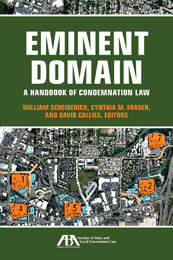
5330215_big To those who were able to join us this evening for the celebration of the publication of Eminent Domain – A Handbook of Condemnation Law, thank you.

The University of Hawaii Law School sponsored the reception, and it was good to see so many colleagues and friends in attendance. U.H. put the event together since Professor David Callies was one of the book’s editors, and six U.H. alums contributed chapters.

I was privileged to author two chapters (Prelitigation Process and Flooding & Erosion), and my Damon Key colleagues Mark Murakami and Christi-Anne Kudo Chock co-authored the chapter Damages Resulting from a Taking: An Overview.   

A complete Table of Contents is available here. This book is an overview of the law from folks who have been practicing in that area for a long, long time. It is intended as a “deskbook” — a quick and

Continue Reading Book Report: Eminent Domain – A Handbook of Condemnation Law

In Joffe v. City of Huntington Park, No. B222880 (published Dec. 2, 2011), the California Court of Appeal affirmed the trial court’s dismissal (technically, the trial court “demurred” —  remember, this is California) of the plantiffs’ claim for inequitable precondemnation activities under Klopping v. City of Whittier, 8 Cal.3d 39 (1972). 

Plaintiff manufactures furniture at its property in Huntington Park, California, and

[b]eginning in 2002, the City defendants and the developer defendants repeatedly expressed the intent and desire to acquire and develop two adjacent 40 acre sites for the purpose of building and developing 920,000 square feet of buildings which would include numerous retailers, shops and restaurants. . . . It specifically included the property owned by Joffe, where Plycraft conducted its furniture manufacturing business. The project development was designated “El Centro de Huntington Park” (hereafter, the project).

During the period 2002 through 2008, plaintiffs were repeatedly

Continue Reading If The City Wasn’t Taking Steps To Condemn The Property, What Was It Doing?

For those who tuned in to today’s webinar Eminent Domain: Redevelopment Challenges for Local Government, here are the cases I spoke about during my session:

  • County of Hawaii v. C&J Coupe Family Ltd. P’ship, 198 P.3d 615 (Haw. 2008) (under Kelo, trial courts presented with prima facie evidence that the stated public use is a pretext to cover up private benefit must look to the real motive for a taking even if the taking is for a “classic” use).


Continue Reading Links From Today’s Webinar “Eminent Domain: Redevelopment Challenges for Local Government”

This is a post for those who decided they wanted to visit a law blog today instead of (a) filling their bellies with the usual Thanksgiving fare; (b) watching football on TV; (c) gearing up for the insanity of the day-after shopping; or (d) pretty much anything else.

Seriously, what are you doing reading a law blog this day?

Anyhow, here’s the deal if you are: On Thursday, December 1, 2011 at 1:00pm-2:30pm EST (10:00am-11:30am PST, 8:00am – 9:30am HST) we’ll be presenting the on-line webinar “Eminent Domain: Redevelopment Challenges for Local Governnment – Navigating Federal Funding Requirements, Challenges for Public Utilities in Right-of-Way Projects, and Objections to Taking for Public Use (click the link for more information), and if you’d like to join us with the $250 registration fee waived (yes: free, gratis, no charge, free-ninety-free), and you are one of the first three people

Continue Reading T-Day Door Prize. Second Prize Is A Set Of Steak Knives.

We’ve been kind of busy in the last few days with a couple of appellate briefs, so haven’t had a lot of time to post up the latest cases and articles of interest. But here’s what we are reading today, in between brief writing:

  • Hawaii Supreme Court Nominees Will Be Public – Courthouse News Services writes about the case in which we represent the Star-Advertiser in its case to compel the governor to publicly disclose the lists of judicial nominees he receives from the Judicial Selection Commission. More on the case here. The Reporters Committee for Freedom of the Press also reported on the story here
  • Beyond “NIMBY” – a post on Legal Planet, a blog produced by enviro lawprofs, advocates that we abandon the term NIMBY. I like “I GOT MINE.”


Continue Reading Friday Round Up

Here’s what’s going on:

  • The Honolulu Star-Advertiser‘s story on yesterday’s decision by Circuit Judge Karl Sakamoto in the Star-Advertiser’s lawsuit to compel Governor Abercrombie to cease keeping the names of judicial nominees from the public: Judge to gov: Make names public. We represent the plaintiff:

“We are extremely pleased,” said newspaper attorney Diane Hastert. “Judge Sakamoto thoroughly analyzed all of the complex issues in the case and concluded the public has the right to know the names of individuals on the Judicial Selection Commission lists.”

. . . .

Deputy Attorney General Charleen Aina defended the governor’s position that the release would be a “frustration” of the government’s interest in the appointment process.

She told Sakamoto the process includes the commission screening and recommending the names confidentially, and the disclosure by the governor would “interfere” with that process.

But attorney Robert Thomas, who also represents the newspaper

Continue Reading Tuesday Round-Up: JSC List Case, California Eminent Domain

This just in: In Los Angeles County Metro. Trans. Auth. v. Alameda Produce Market, LLC, No. S188128 (Nov. 14, 2011), the California Supreme Court held:

Under California’s “quick-take” eminent domain procedure, a public entity filing a condemnation action may seek immediate possession of the condemned property upon depositing with the court the probable compensation for the property. (Mt. San Jacinto Community College Dist. v. Superior Court (2007) 40 Cal.4th 648, 653 (Mt. San Jacintothe lender’s withdrawal of a portion of the deposit constitutes a waiver of the property owner’s claims and defenses, except a claim for greater compensation. We find that the Court of Appeal‘s conclusion is inconsistent with the relevant statutory language and framework. We therefore reverse the Court of Appeal’s judgment.

Slip op. at 1-2 (footnote omitted).

We’ll review the opinion and post more when we get a chance. But this looks about right.

Continue Reading Cal Supremes: Lender’s Withdrawal Of Condemnation Deposit Does Not Waive Property Owner’s Defenses

5330215_big Hold the date: on Tuesday, December 6, 2011, from 5:30 – 8:00 p.m., the University of Hawaii School of Law is sponsoring a reception at the Pacific Club, in Honolulu to celebrate the publication of Eminent Domain, a Handbook of Condemnation Law by the American Bar Association.

Since so many of the people who worked on the book are associated with the U.H. Law School (I authored two chapters, my Damon Key colleagues Mark Murakami and Christi-Anne Kudo Chock authored another, the appendix was authored by three Honolulu lawyers who are also alums, and Professor David Callies is one of our editors), the law school is being kind enough to throw a little party. It turned out it was just a happy coincidence that we were all associated with the project, and Professor Callies promises that he did not round up his former students to pitch in. 

The book, as

Continue Reading Book Reception: Eminent Domain – A Handbook of Condemnation Law (Honolulu, 12/6/2011)