Skip to content

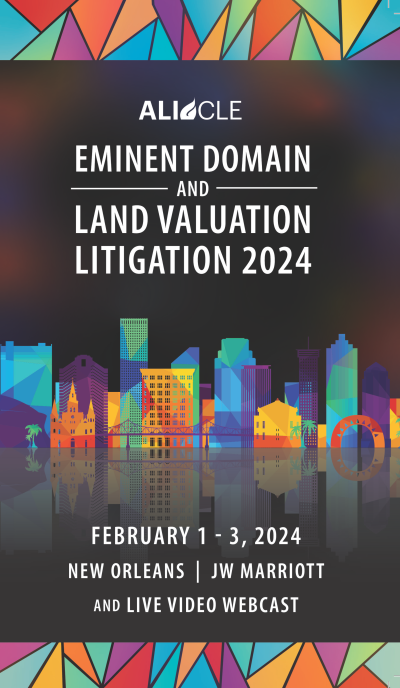
ALI-CLE brochure cover page

Here’s the brochure and the full agenda and registration information for the upcoming ALI-CLE Eminent Domain and Land Valuation Litigation Conference at the JW Marriott in New Orleans, February 1-3, 2024.

This is the long-running nationally-focused conference on all things eminent domain, takings, valuation, and related. We have three tracks, from which you can choose a la carte – Practice, Substantive, and Condemnation 101:

For over 40 years, we’ve been bringing eminent domain practitioners together to examine the latest issues, engage in healthy debate, and get the information they need to stay current in their practice. This year – our 41st – is THE perfect time to reunite with your eminent domain colleagues. There will be plentiful opportunities to meet and mingle with the faculty and other registrants – throughout the conference and at evening social events. Attendees come back year after year to make new friendships and renew
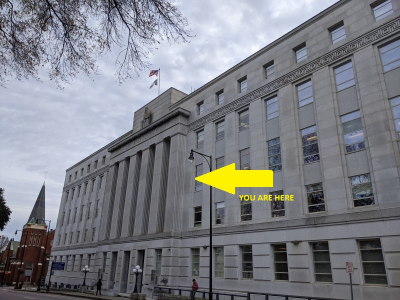
Continue Reading Here’s The Program For The 41st ALI-CLE Eminent Domain And Land Valuation Litigation Conference, Feb 1-3, 2024, New Orleans

NCSCT

Here’s the latest on a kind of strange case we’ve been following.

Our case starts off as a somewhat typical public use challenge. After a developer failed to negotiate purchase from Rubin an easement for a sewer line to serve a nearby housing project, the developer enlisted the Town of Apex to lend a hand.

Next, whaddaya know, the Town is taking the easement for the developer’s sewer line from Rubin by eminent domain, with the developer paying the compensation and the costs of the lawsuit. If this sets off your private benefit radar, you’d be right. The North Carolina courts sure thought so. No public use. 

You might think that this would signal the end of the matter. We know what would happen if the Town had affirmatively abandoned the taking. In that case, it wouldn’t be off the hook if it walked away, and although it would

Continue Reading Midnight Quick Take: NC Supreme Court To Consider Remedies For Failed Takings – What Happens When A Taking Lacks A Public Use, But They’ve Already Seized The Property?

HSBA 10-2023

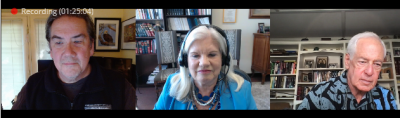
Yesterday, during the Annual Meeting of the Hawaii State Bar Association, we participated in a program sponsored by the Real Property and Financial Services Section, “Inverse Condemnation & Paying for Disasters.”

As you can see above, we joined lawprofs Shelley Saxer and David Callies to share thoughts about inverse claims, and the difference between these property arguments and tort negligence claims.

Here are some of the key cases and materials which we mentioned (or should have):


Continue Reading Links And Materials From “Inverse Condemnation & Paying for Disasters”

We don’t regularly cover unpublished opinions, but the U.S. Court of Appeals for the Fourth Circuit’s Columbia Gas Transmission, LLC v. 0.12 Acres of Land, No. 23-1069 (Oct. 11, 2023) got our attention because it involves a slight twist on the the Supreme Court’s ruling a couple of years ago in PennEast Pipeline Co. v. New Jersey, 131 S.Ct. 2244 (2021).

There, the Court held that a private actor exercising the delegated federal power of eminent domain may take property from a state in a federal court action, notwithstanding the state’s usual Eleventh Amendment immunity. Employing a historical analysis, the Court held that when the states entered the Union they consented to the federal government’s eminent domain power. And the later-adopted Eleventh Amendment didn’t change that.

The caption of the latest case should tell you a couple of things. First, this is also a federal taking (plaintiff vs.

Continue Reading CA4 (unpub): We’re Not Going To Adopt Justice Gorsuch’s Dissent In PennEast And Prohibit A State From Having Its Property Taken In Federal Court

If you happen to be in the Hampton Roads neighborhood later this week, you may want to consider paying a visit to Hampton University for what looks like an intriguing program:

The Virginia Center for Investigative Journalism at WHRO and ProPublica Present “Erasing the Black Spot” – How Virginia Universities have Disrupted Black Neighborhoods

October 19, 6 p.m.
Robert P. Scripps Auditorium
Scripps Howard School of Journalism and Communications, Hampton University
200 William R. Harvey Way
Hampton, VA 23669
Register to attend

Virginia’s public universities have a long history of expanding campuses in the name of progress and economic growth. But often, these expansions used eminent domain and property seizures to disrupt and diminish thriving Black communities across the state.

An investigative series by The Virginia Center for Investigative Journalism at WHRO and ProPublica uncovers the damaging social and economic


Continue Reading Wed Oct 19 6pm ET – “‘Erasing the Black Spot’ – How Virginia Universities Have Disrupted Black Neighborhoods” (Hampton University)

In MB Financial Bank N.A. v. Brophy, No. 128252 (Sep. 21, 2023), the Illinois Supreme Court clarified that in non-quick take actions (aka straight takings), the date on which title transfers — which is the date on which the owner actually is deprived of the property — is when the owner is relieved of the obligation to pay property taxes. Until then, the owner is on the hook, even though the owner is under the cloud of condemnation. .

In 2005, the City of Joliet filed a condemnation action to take an apartment building owned by MB Financial Bank. This was not a quick take action, but rather a straight taking. Which meant that neither title nor possession transferred from the owner to the condemnor. These would have to wait until ascertainment of the amount of compensation, the agreement of the City that it wanted to pay that amount

Continue Reading Illinois: In Straight Takings, Title Transfers Only After Compensation Is Paid, So Property Owner Is Responsible For Property Taxes During The Litigation

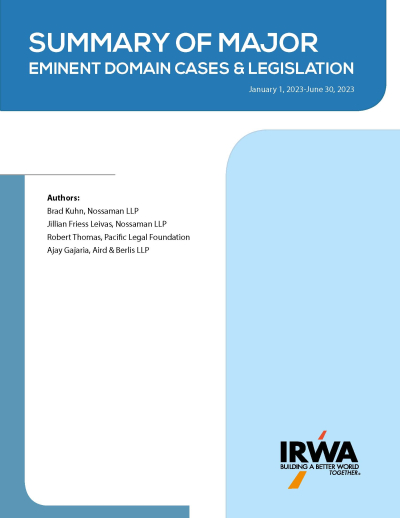
IRWA 6-2023 summary jpg

Thanks to our co-authors for the latest issue of this recurring update.

The International Right of Way Association’s Real Estate Law Committee produces twice-a-year reports “which contain summaries of eminent domain decisions and legislation within the United States.” (This is the “international” right of way association, so that last qualifier is important.)

And what is really nice is that they make the report available.

The laboring oars on this are really Brad Kuhn and Jullian Friess Leivas (both from the Nossaman firm), but they were kind enough to include us. Brad and Jillian wrote up more at the California Eminent Domain Report:

We recently had the pleasure of collaborating with Robert Thomas and Ajay Gajaria once again for the International Right of Way Association’s (IRWA) biannual report covering numerous eminent domain cases at local, state and federal levels from January through the end of June 2023. This


Continue Reading Just Published – IRWA’s “Summary of Major Eminent Domain Cases & Legislation: Jan 1, 2023 – June 30, 2023”

Why is it, you ask, that the ALI-CLE Eminent Domain & Land Valuation Litigation Conference (scheduled next February 1-3, 2024, in New Orleans) is an event that seems to be growing in popularity and attendance. In recent years, we have standing room only in the Conference halls, and have sold out the hotel block. After all, this is a pretty niche area of law. So what gives?

When we were in Austin earlier this year, we thought it might be nice to try and answer that question. We asked Conference participants why they come, year-after-year (and in Austin, despite massive travel disruptions). Yes, it is the various venues (Nashville, Austin, Scottsdale, Palm Springs, to name a few recent locations), and yes, it is the excellent and useful programming.

But as we suspected it is more than that. As the above video notes

Continue Reading ALI-CLE’s Eminent Domain & Land Valuation Litigation Conference (Feb 1-3, 2024, New Orleans): Why Attend? Here’s Why.

Screenshot 2023-08-26 at 10-33-05 Brigham-Kanner Property Rights Conference

Heads-up: the registration page for the 20th Brigham-Kanner Property Rights Conference, October 26-27, 2023, at the William and Mary Law School in Williamsburg, Virginia, is now up.

Early registration is a good thing because space is limited, especially at the Wren Building banquet on the 26th, at which the 2023 B-K Property Rights Prize will be presented to Prof. Gregory Alexander.

So please don’t miss out.

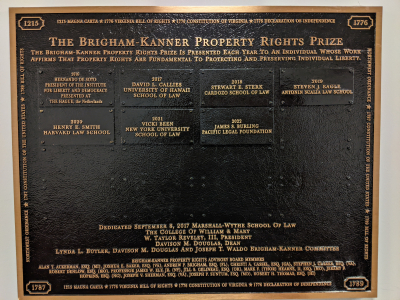
2022 BK plaque
The Property Rights Hall of Fame (second plaque)

If you are not already familiar with the Conference, it is (in our opinion) the best one-day event on property and property rights theory and practice. Expressly designed to bring together the legal academy and the practicing dirt law bar, the conference is where we discuss the burning property and property rights issues of the day. Here’s the 2023 Program:

  • Property and Propriety (or a Well-Ordered Society): A Tribute to Gregory S.


Continue Reading Register Now For The 20th Brigham-Kanner Property Rights Conference, Oct. 26-27, 2023

On this morning’s drive-time program, we joined KHVH’s Rick Hamada about whether Hawaii might adopt California’s version of inverse condemnation liability in wildfire cases. We also tried to clear up a few misconceptions (gad, I used “disinformation,” a term I try to eschew).

Here’s the program description:

Inverse Condemnation and Maui Wildfires: A Conversation with Robert Thomas

Tune in to a thought-provoking episode where we engage in a conversation with legal expert Robert Thomas on the topic of inverse condemnation in relation to the recent Maui wildfires. As the community grapples with the aftermath of the devastating fires, we delve into the legal aspects of property rights, government accountability, and compensation for affected individuals. Join us as we explore the implications of inverse condemnation, a legal doctrine that holds governments accountable for taking private property without just compensation. Gain insights into the challenges faced by property owners in the wake

Continue Reading Our Drive-Time Conversation About Hawaii Inverse Condemnation And Wildfires