A teaser for The Battle of Brooklyn, produced by the Moving Picture Institute (which “nurtures promising filmmakers who are committed to protecting and sustaining a free society”) about the ongoing redevelopment dispute in Brooklyn over the Atlantic Yards project. The summary describes the film:

The Battle of Brooklyn explores the poorly understood phenomenonof eminent domain abuse. A feature-length documentary from filmmakersMichael Galinsky, Suki Hawley, and David Beilinson, this filminvestigates how real estate developers, local government, communityactivists, and the media have clashed over the largest single-sourcedevelopment project ever proposed in New York City. Widely known as theAtlantic Yards project, this undertaking has for the past four yearsbeen a major source of contention as local residents resist abillionaire developers attempt to use eminent domain to seize theirhomes and businesses. Done in the name of “development,” schemes suchas this one eviscerate private property rights and make a mockery ofthe Fifth Amendment–and yet

Continue Reading Preview of “The Battle of Brooklyn” Doc About Atlantic Yards

Develop Don’t Destroy 104597/07 (Brooklyn) v. Urban Dev. Corp., 2009 NY Slip Op 01395 (Feb. 26, 2009) is the latest decision involving Brooklyn’s Atlantic Yards redevelopment project. See “A Hole Grows In Brooklyn” from the Wall Street Journal for more.  An earlier constitutional objection to the public use of the taking was rejected in Goldstein v. Pataki,516 F.3d 50 (2d Cir. 2008). The most recent case involves the amount of scrutiny a court should give a blight designation that is used as a trigger to eminent domain. The short answer: none.

Six of the eight city blocks needed for the project had been designated as blighted since 1968 and there was no dispute that redevelopment was appropriate in that area. Another two blocks, however, were recently deemed to be blighted even though they are not “substandard and insanitary,” and property owners challenged the designation.

The Appellate

Continue Reading Might Makes Blight In The New York Appellate Division

In Lichoulas v. City of Lowell, No. 08-1485, 08-2023 (1st Cir., Jan. 30, 2009), the U.S. Court of Appeals declined to rule on a property owner’s objection to a taking for redevelopment, holding that public use challenges belong in state court. Interestingly, the court cited Williamson County Regional Planning Comm’n v. Hamilton Bank of Johnson City, 473 U.S. 172 (1985) for the proposition that “any objection to the taking, or deficiency in adequate compensation, could be and preferably is to be done in state proceedings.” Slip op. at 6.

In 2006, the city took Lichoulas’ property, on which sat a hydroelectric power facility, inactive since 1994. The Federal Energy Regulatory Commission earlier sent a notice to the owner that unless the facility began operating, it would consider the federal license abandoned. The property owner responded that he would forward a work plan to FERC, but it was never

Continue Reading First Circuit: Williamson County Applies To Eminent Domain Challenges

Lph Certain addresses — real and fictitious — are instantly recognizable: 1600 Pennsylvania Avenue NW, Washington, DC and 221B Baker Street, London for example.

8 East Street, New London, Connecticut, however, isn’t an address that most people recognize. 

is the former address of the “little pink house” which is the subject of Jeff Benedict’s Little Pink House – A True Story of Defiance and Courage (Grand Central Publishing 2009) (available from Amazon here)

County of Hawaii v. C&J Coupe Family Ltd. P’ship, 119 Haw. 352, 198 P.3d 615 (2008) 

Disclosure: we filed an amicus brief (posted here) supporting Susette Kelo’s arguments in the U.S. Supreme Court.Continue Reading Book Review: Little Pink House – A True Story Of Defiance And Courage

Some interesting items have crossed my desk on Friday and Saturday:

  • From the Grand Theft: Property blog, Jim Mattson posts his thoughts about Monks v. City of Rancho Palos Verdes, 67 Cal. App. 4th 263 (Cal. Ct. App. 2008), the case in which a California Court of Appeals held that a municipality’s development moratorium was a Lucas taking.
  • From the New York Zoning and Municipal Law blog comes a summary and analysis of the recent oral arguments in the latest phase of the Atlantic Yards eminent domain fight from Brooklyn. 
  • More on AmeriSource v. United States, No. 08-497 (cert. petition filed Oct. 15,


Continue Reading Weekend Round-Up

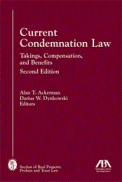
5430464_big A recent book of interest to condemnation lawyers, Current Condemnation Law: Takings, Compensation & Benefits (2d ed.).

The book is co-edited by my Owner’s Counsel of America colleague Alan T. Ackerman. (He also has a blog about eminent domain issues.)

From the blurb:

Condemnation of property is an especially topical subject after the U.S. Supreme Court’s controversial decision in Kelo v. City of New London. This completely revised edition of Current Condemnation Lawexamines the many complexities involved in the practice of eminentdomain law in order to assist lawyers in best protecting the clients’interests in these cases. The book brings together experts in thespecialty to provide analysis of both major and specialty areas ofcondemnation law, providing “how to” tips along with currentdiscussions of case law and theory.

The chapters in Current Condemnation Lawprovide a thought-provoking mix of articles covering the key topics ofbusiness valuation, contamination issues, the right

Continue Reading New Eminent Domain Book: Current Condemnation Law: Takings, Compensation & Benefits (2d ed.)

Eminent domain in the news:

It’s a stark contrast between new and old, progress and past. The tension between the two has landed the university in the middle of a lawsuit that could set a precedent for redevelopment projects under way in Virginia.
A year ago, Norfolk’s Redevelopment and Housing Authority moved to condemn the house and three other buildings to the south of ODU’s University Village, saying the land was in a blighted area and is needed for the university’s expansion.
The owners responded with a suit, saying the housing authority has no right to take their property, in part because the development of University Village in the past decade has cleaned up the blight.
The property owner’s lawyer is my Owner’s Counsel of America colleague Joseph Waldo.

Separately, [Carol] Browner [President Obama’s special advisor on climate change and energy] said the administration was also going to create an inter-agency task force to site a new national electricity transmission grid to meetboth growing demand and the President’s planned renewable energy expansion.Siting has been a major bottleneck to renewable growth, and lawmakers andadministration officials have said they’re likely to seek greater federal powersthat would give expanded eminent domain authorities.Continue Reading Eminent Domain Round-Up

Some interesting reports today:

  • Hawaiians urge Obama to step in on ceded lands –  an AP story reporting that “Hawaii legislators and legal groups are asking President Barack Obama to intervene in the Hawaiian lands case set to be heard by the U.S. Supreme Court next week.” (via KPUA.net). The Obama Administration has “intervened” in the case, but not in a way the groups probably had in mind: the acting Solicitor General sought and was granted 10 minutes oforal argument time to support the State of Hawaii’s argument, as noted here. “The groups believe leftover appointees of former President George W. Bush are arguing a position that’s inconsistent with Obama’s views.” That would be odd, if true,


Continue Reading “Ceded Lands” Case, Land Use Round-Up

Here are the links to the cases that I spoke about in my session in today’s seminar “Supreme Court, Regulatory Takings and Eminent Domain Update.”  Not all of the cases we discussed today are included below, so if you would like a link or more information about a case that is not listed, please email me at rht@hawaiilawyer.com and I will send it to you.

The majority opinion by Justice Acoba, joined by Justices Nakayama and Duffy is posted here:

We hold that (1) a landowner in a condemnationaction is entitled to damages under HRS § 101-27 where the property atissue is not finally taken in the context of a particular condemnationproceeding, irrespective of whether the government attempts to take theland through subsequent condemnation proceedings; (2) abatement doesnot apply where the relief sought in two concurrent actions is not thesame; and (3) although our courts afford substantial deference to thegovernment’s asserted public purpose for a taking in a condemnationproceeding, where there is evidence that the asserted purpose ispretextual, courts should consider a landowner’s defense of pretext. Therefore, (1) automatic denial of statutory damages under HRS §101-27in Condemnation 1 is vacated and the case remanded for a determinationof damages, (2) the court’s conclusion that Condemnation 2 was notabated by Condemnation 2 is vacated and the case remanded for adetermination of whether the public purpose asserted in Condemnation 2was pretextual.

Slip op. at 5. Here’s the concurring and dissenting opinion by Chief Justice Moon joined by Justice Levinson. The briefs in the case are available here:  Opening Brief, Answering Brief of the County of Hawaii, Reply Brief. Disclosure: we represent the property owner.

  • No private right of action to enforce zoning – The Hawaii Intermediate Court of Appeals, in Pono v. Molokai Ranch, Ltd.,119 Haw. 163, 194 P.3d 1126 (2008), held that a private party had nostanding to enforce the state’s land use laws. The Hawaii Supreme Courtrejected certiorari review of the case.  Disclosure: we represent thelandowner. More here.

Continue Reading Materials From 2/20/2009 Land Use Seminar