Our thanks to our friends and colleagues at the ABA Section of Real Property, Probate & Trust Section’s Land Use and Environmental Group for inviting us to a discussion of the latest and greatest decisions of interest.

We only had an hour together, so naturally could not cover everything of interest (indeed, we reserved a big discussion of the biggest item, the Supreme Court’s decision in Cedar Point, assuming that the Group will schedule a full session on that decision alone). So here is our curated list of what we think are the most interesting recent decisions in areas of interest to the Group:


Continue Reading Links From Today’s ABA RPTE Session

It can be somewhat of a challenge to blog about many of the opinions from New York’s appellate courts (dun-dun) because they are typically short. What more (or less!) can you say about an opinion that is very short? We mean really short. Like 3 pages short.

Such it is with the Appellate Division’s opinion in Gabe Realty Corp. v. City of White Plains, No. D66651 (June 30, 2021). A total of 4 pages, actually, but when you cut out the caption, introductory fluff, and the clerk’s signature, you are down to a grand total of two pages of single-spaced text. It would take us more time to write about the decision than it would take you to just read the darn thing.

Highlights:

  • A New York court invalidates an urban renewal taking, supported by a claim of blight remediation. Read that again: this is from a


Continue Reading NY App Div: Potential Future Public Benefit Won’t Support Eminent Domain

Here’s the latest (maybe last?) in a case we’ve been following for a long time.

On Friday, the Court denied the petition for writ of certiorari, with three Justices noting that they would have granted the petition. Justice Thomas, joined by Justice Gorsuch dissented from the denial of cert, while “Justice Kavanaugh would grant the petition[.]” 

Here’s Justice Thomas:

We should grant certiorari for two reasons.

First, this petition provides us the opportunity to correct the mistake the Court made in Kelo. There, the Court found the Fifth Amendment’s “public use” requirement satisfied when a city transferred land from one private owner to another in the name of economic development. See 545 U. S., at 484. That decision was wrong the day it was decided. And it remains wrong today. “Public use” means something more than any conceivable “public purpose.” See id., at 508–511 (Thomas, J., dissenting).

Continue Reading So Close: SCOTUS Declines To Revisit Kelo (For Now)

In this post — the third in a series of deeper dives that we’ll be posting about last week’s U.S. Supreme Court opinion in Cedar Point Nursery v. Hassid, No. 20-107 (June 23, 2021) — we’ll be discussing whether the “right to exclude” is absolute, what exceptions the Court laid out, and how it responded to the arguments that the ruling will bring the system crashing down.

Here are all of the posts in our Cedar Point series:

And in case you missed the live webcast on Friday, July 16, 2021 that featured expert analysis of the case, please don’t miss

Continue Reading Cedar Point Part III: No, Chicken Little, The Sky Isn’t Falling

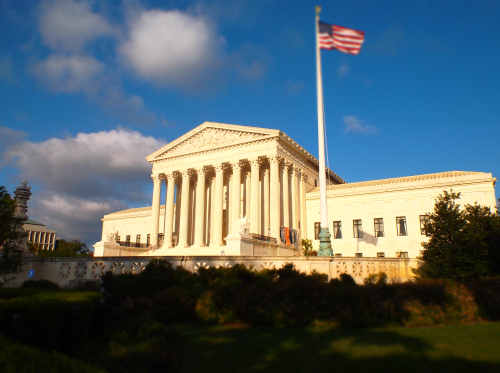
DSCF3357

Another takings opinion from the Supreme Court, this time in a (putatively) eminent domain case we’ve been following.

In PennEast Pipeline Co., LLC v. New Jersey, No. 19-1039 (June 20, 2021), the majority (Roberts, CJ, joined by an unusual, cross-aisle lineup of Justices Breyer, Alito, Sotomayor, and Kavanaugh) concluded that a private pipeline which has been delegated the federal power of eminent domain in the Natural Gas Act, may, in a federal court lawsuit, condemn property owned by the State of New Jersey. 

The case asked whether New Jersey – not some mere private landowner – can be haled into a federal court as a defendant in a NGA private pipeline taking. The issue isn’t the same as a typical NGA pipeline case in which a private landowner can’t assert Eleventh Amendment immunity. As a consequence, here we witnessed a much different result in the way the lower

Continue Reading SCOTUS: Eminent Domain Is Eminent Over Everything, Even A State’s 11th Amendment Immunity

In which we pay a return visit to Clint Schumacher’s Eminent Domain Podcast to catch up with Clint about our new gig, Cedar Point (briefly, since the opinion came down the day we recorded the podcast), just compensation and attorneys’ fees, assessing severance damages in appraisals supporting jurisdictional offers, public use, and our favorite cool courthouses (let’s just say that they range from historic courtrooms to converted doublewide trailers).

If you are not already a regular listener to the Eminent Domain Podcast, you should be! It’s a great one-stop convenient way to keep current on the latest goings-on in the takings business. Continue Reading We Pay A Return Visit To The Eminent Domain Podcast To Talk Takings

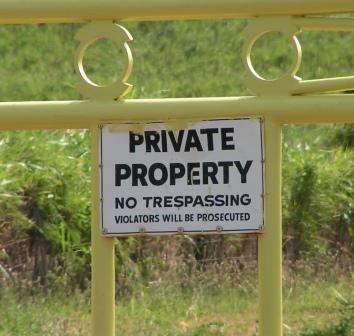
Keep out

In this post — the second in a series of deeper dives that we’re posting about last week’s U.S. Supreme Court opinion in Cedar Point Nursery v. Hassid, No. 20-107 (June 23, 2021) — we’ll be covering more on the “right to exclude,” how the Court treated our old frenemy Pruneyard, and how the majority dealt with that case’s holding that the California Supreme Court’s rule that shopping center owners must allow use of their properties as forums for public speech was not a judicial taking.

Here are all of the posts in our Cedar Point series:

And in case

Continue Reading Cedar Point Part II: Common Sense (Keep Out) And Common Law (The Right To Exclude)

Screenshot 2021-06-23 at 14-25-38 Takings and Eminent Domain After Cedar Point What Practitioners Need to Know

The ink’s not quite yet dry on the U.S. Supreme Court’s landmark decision in Cedar Point Nursery v. Hassid, No. 20-107 (June 23, 2021), but we’re already ready to roll with a program about what this decision means for you and your clients, and for takings law.

Find out from the experts in a one-hour webcast, “Takings and Eminent Domain After Cedar Point: What Practitioners Need to Know” from ALI-CLE. Registration and more information here.

In Cedar Point, a 6-3 majority affirmed a bright-line rule that physical invasions of whatever duration are takings, and held that “[w]henever a regulation results in a physical appropriation of property, a per se taking has occurred, and Penn Central has no place.” Questions about duration of the invasion “bears only on the amount of compensation.”

Our highly respected faculty will discuss the effect of this fascinating case on takings

Continue Reading Join Us Friday, July 16, 2-3pm ET: ALI-CLE’s “Takings and Eminent Domain After Cedar Point: What Practitioners Need to Know”

In this post — the first in a series of deeper dives that we’ll be posting about over the next few days about yesterday’s U.S. Supreme Court opinion in Cedar Point Nursery v. Hassid, No. 20-107 (June 23, 2021) — we’ll be covering the background of the case, and the heart of the majority opinion.

Here are all of the posts in our Cedar Point series:

And in case you missed the live webcast on Friday, July 16, 2021 that featured expert analysis of the case, please don’t miss listening to the recording of ALI-CLE’s “Takings and Eminent Domain After

Continue Reading Cedar Point Part I: SCOTUS’s Strawberry Letter 23 To Property Rights

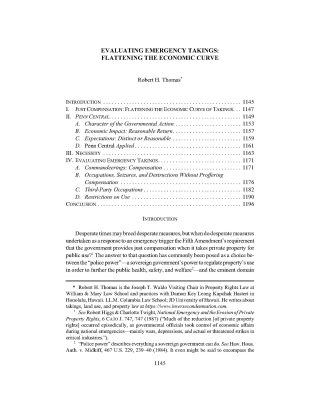
Title page

Wondering about so-called “covid takings” such as business lockdowns, seizures, commandeerings, eviction moratoria, and whether these might be takings?

If so, check out our latest article, Evaluating Emergency Takings: Flattening the Economic Curve, just published in the latest issue of the William and Mary Bill of Rights Journal.

Here’s the Intro to the article:

Desperate times may breed desperate measures, but when do desperate measures undertaken as a response to an emergency trigger the Fifth Amendment’s requirement that the government provide just compensation when it takes private property for public use? The answer to that question has commonly been posed as a choice between the “police power”—a sovereign government’s power to regulate property’s use in order to further the public health, safety, and welfare —and the eminent domain power, the authority to seize private property for public use with the corresponding requirement to pay compensation. But that should not be the question. After all, emergencies do not increase government power, nor do they necessarily alter constitutional rights, and an invocation of police power by itself does not solve the compensation question, but is merely the predicate issue: all government actions must be for the public health, safety, or welfare, in the same way that an exercise of eminent domain power must be for a public use.

This Article provides a roadmap for analyzing these questions, hoping that it will result in a more consistent approach for resolving claims for compensation that arise out of claims of emergencies. This Article analyzes the potential takings claims stemming from emergency measures, mostly under current takings doctrine. Which types of claims are likely to succeed or fail? In “normal” times, it is very difficult to win a regulatory takings claim for compensation. In the midst of emergencies—real or perceived—the courts are even more reluctant to provide a remedy, even when they should, and emergencies are a good time to make bad law, especially in takings law. Can a better case be made analytically for compensation?

Part I summarizes the economic “flattening the curve” principle that motivates takings claims for compensation. Part II sets out the prevailing three-factor Penn Central standard for how courts evaluate claims that a health, safety, or welfare measure “goes too far” and requires compensation as a taking, examining the character of the government action, the impact of the action on the owner, and the extent of the owner’s property rights. Deep criticism of the Penn Central standard is beyond the scope of this Article, and here, I accept it as the default takings test. But I argue that the government’s motivation and reason for its actions—generally reviewed under the “rational basis” standard—should not be a major question in takings claims. Rather, as this Article argues in Part III, the government’s emergency justifications should be considered as part of a necessity defense, not subject to the low bar of rational basis, but a more fact and evidence driven standard of “actual necessity.” Part IV attempts to apply these standards and examines the various ways that emergency actions can take property for public use: commandeerings, occupations of property, and restrictions on use. I do not conclude that the approach will result in more (or less) successful claims for compensation, merely a more straightforward method of evaluating emergency takings claims than the current disjointed analytical methods.

In sum, this article argues there is no blanket immunity from the requirement to provide just compensation when property is taken simply because the government claims to be acting in response to an emergency, even though its actions and reasons may satisfy the rational basis test. Instead, claims that the taking is not compensable because of the exigency of an emergency should only win the day if the government successfully shows that the measure was actually needed to avoid imminent danger posed by the property owner’s use and that the restriction on use was narrowly tailored to further that end.

One final word: the editors at the Bill of Rights Journal have been fantastic to work with to get this piece publication ready. Offering helpful comments, gently suggesting that certain parts are not working (but never insisting, and giving the author a lot of discretion), and getting the citations squared away: I could not have asked for more helpful editing. Congratulations on the publication of your latest issue. 

Thomas, Evaluating Emergency Takings: Flattening the Economic Curve, 29 Wm. & Mary Bill of Rights J. 1145 (2021)

Continue Reading New Law Review Article (Ours) – “Evaluating Emergency Takings: Flattening the Economic Curve,” 29 Wm. & Mary Bill of Rights J. 1145 (2021)