


With registration for the 2019 ALI-CLE Eminent Domain and Land Valuation Litigation Conference in Palm Springs well underway, we thought it would be a good time to post up some of the materials from this year’s Charleston conference. 

In “Alternative Dispute Resolution in Condemnation Cases: An Eminently Agreeable Solution,” an article in The Practical Real Estate Lawyer adopted from their conference materials, our colleagues Peter Buchsbaum (a retired New Jersey judge), and Cortney Young and Steve Silva (both from Nevada), discuss strategies which can be used to resolve eminent domain cases in ways other than trial. Well worth your time.

There’s a lot more like this on the Palm Springs program. This program and others like it are just a few of the reasons why attending the Conference is also well worth your time.

Register now.

Buchsbaum, Young, & Silva, Alternate Dispute Resolution in Condemnation Cases: Continue Reading New Article: ADR In Eminent Domain – “An Eminently Agreeable Solution”
Get ready. In this and upcoming posts, we’re going to be featuring the items on our agenda for the upcoming ALI-CLE Eminent Domain and Land Valuation Litigation Conference, January 24-26, 2019, in sunny Palm Springs, California. 

ALI-CLE has released the brochure, which those of you on the mailing list should have received — or will be receiving — in your brick-and-mortar inboxes. If not, download it here. Looking it over, you will see that we have assembled a great faculty with expertise in the range of issues that are driving our branch of the law, locally and nationally.

And, as always, one of the best aspects of this conference is the collegiality. Our attendees and faculty find that one of the most beneficial parts of the conference is to meet your colleagues from across the country, and talk shop about the issues we love.  

Of course we

Continue Reading ALI-CLE Eminent Domain And Land Valuation Litigation Palm Springs Brochure Is Out

Here’s the amicus motion and proposed brief we filed yesterday in a Third Circuit case we’ve been following, and which we wrote about recently.

In the few short days since that post, the owners are now also represented by the Institute for Justice, and have filed a petition for rehearing and rehearing en banc. We thought that was a good opportunity to chime in to point out the panel’s fundamental misunderstanding of eminent domain. 

The issue presented by the petition is whether a private condemnor exercising the delegated eminent domain power under the Natural Gas Act may obtain prejudgment possession of the property to be condemned by way of a preliminary injunction, when Congress has not delegated the ability to obtain prejudgment possession. This is an issue of pressing national importance, on which the panel decision conflicts not only with established Supreme Court doctrine, but the ruling of

Continue Reading Amicus Brief: In Straight Takings, No Possession By Injunction Until Title Transfers

Retroactive continuity — or “retconning” — is, according to that authoritative source Wikipedia, a “literary device in which established facts in a fictional work are adjusted, ignored, or contradicted by a subsequently published work which breaks continuity.”

For example, compare the real-world explanation for why the 1960’s Star Trek show’s Klingons didn’t have butt heads, but the later-produced shows and movies did. The real-world reason was that the TV show had a bare-bones budget, so couldn’t afford the required intricate make-up. The later-produced stuff, having larger budgets, could. But to those concerned with an in-universe explanation that had to line up with the production realities, it turned out to be a big source of contention. Fandom as well as the later shows’ writers struggled to come up with a narrative that accounted for both Klingons with butt heads, and those without

Sorry for the impossibly nerdy

Continue Reading Knick And Klingon Foreheads: Retconning Williamson County

Here’s the motion for leave and proposed brief amici curiae we filed yesterday in an appeal pending in the U.S. Court of Appeals for the Eleventh Circuit. 

This is a pipeline case (another one!) involving land in Florida. The district court got it right, concluding that the property owner/condemnee was entitled to recover attorneys’ fees since state condemnation law governs the case, even though it was in federal court. The court also allowed the owner to testify about the fair market value of her property. The pipeline company appealed, arguing that the fact that Florida law allows recovery of attorneys’ fees in eminent domain cases is irrelevant in a federal eminent domain action because attorneys’ fees are not part of Fifth Amendment compensation. It also argues that the owner should not have been allowed to testify.

We filed the amicus motion and brief on behalf of Owners’ Counsel

Continue Reading “A Property Right It Shall Be” – Fifth Amendment Requires Compensation For Whatever Interests A State Recognizes As Property

An observation: courts seem to believe that in eminent domain, a taking, once it is instituted, is inevitable. Thus, the landowner should simply go with the flow, because this is going to happen. We get where that comes from. After all, most takings are completed and the property is acquired. But it isn’t necessarily so. As a general rule, a condemnor is free to walk away after finding out how much the taking might actually cost them. Only when title actually transfers from the property owner to the condemnor does the taking actually become final. 

With that background, check out the latest decision about an issue we’ve covered before, and which isn’t going away

Try as you might, you can read through the entirety of the Natural Gas Act and you will not find anywhere in the statute where Congress delegates to private pipeline companies the quick-take power — those

Continue Reading Third Circuit: If It Quacks Like A Quick Take, It’s Just A Preliminary Injunction

Knickrehearing

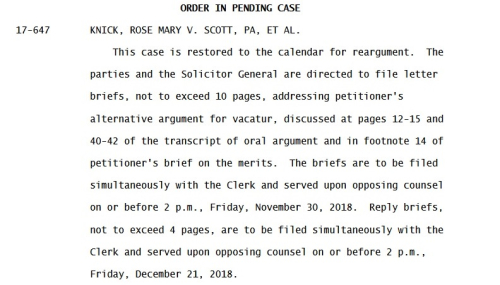
As we guessed immediately after arguments, today in this order the Supreme Court has set the Knick v. Township of Scott case for supplemental briefing, and reargument. 

Here’s the full text of the order:

This case is restored to the calendar for reargument. The parties and the Solicitor General are directed to file letter briefs, not to exceed 10 pages, addressing petitioner’s alternative argument for vacatur, discussed at pages 12-15 and 40-42 of the transcript of oral argument and in footnote 14 of petitioner’s brief on the merits. The briefs are to be filed simultaneously with the Clerk and served upon opposing counsel on or before 2 p.m., Friday, November 30, 2018. Reply briefs, not to exceed 4 pages, are to be filed simultaneously with the Clerk and served upon opposing counsel on or before 2 p.m., Friday, December 21, 2018.

This tells us that there was no clear

Continue Reading More Knick Briefing, Reargument

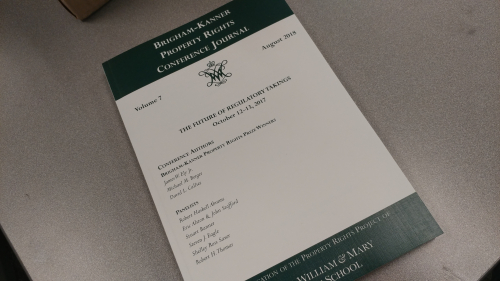
20181004_152311_HDR

Every year, at the Brigham-Kanner Property Rights Conference, the conference publishes a law journal with the articles, essays, and remarks presented at last year’s conference. So it was this year, and Volume 7, with the theme of “The Future of Regulatory Takings,” is now available

We contributed an essay, “Back to the Future of Land Use Regulation,” which focuses on the rational basis test in land use law — where it came from and where it might be going — as well as some other current issues in property law such as the recent trend of raising general environmental concerns as property claims. Check it out if you are so inclined. 

Here’s the Introduction:

As always, I bring you greetings from the land of Midkiff, the land of Kaiser Aetna. The jurisdiction in which the legislature thought it was a good idea to try and

Continue Reading New Article: Back to the Future of Land Use Regulation – From Hadacheck To “New” Property

Pipelines are a hot topic. So much so that we’re devoting a couple of sessions at the upcoming ALI-CLE Eminent Domain and Land Valuation Litigation Conference to the subject (“Where You Haven’t Gone Before: New Approaches to Challenging the Take,” and “Compensation Pitfalls: How to Avoid Problems,” for example). 

And, with this recently-filed cert petition in a case we’ve been following, the issue just got hotter. 

In Berkley v. FERC, the U.S. Court of Appeals for the Fourth Circuit held that the federal Natural Gas Act allows the Federal Energy Regulatory Commission to delegate eminent domain authority to Mountain Valley, and that any challenges to that authority must be done via the NGA’s administrative review process.

We predicted a cert petition because it didn’t seem that the constitutional question of whether a taking is for public use could be relegated for resolution to the administrative

Continue Reading New Cert Petition: Can Congress Delegate To An Executive Agency Appeals Process The Power To Decide Whether A Taking Violates The Public Use Clause?