As readers may know, we try to look for an eminent domain angle everywhere. So here you go.

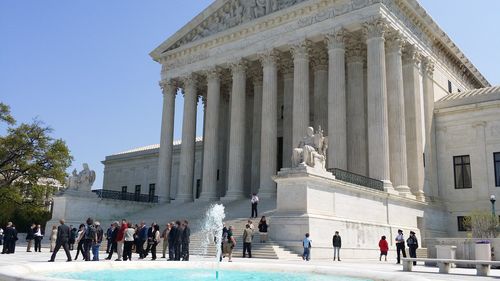
Today’s Supreme Court decision upholding the ACA‘s purpose over its text, reminds us of our favorite scene in any legal film, Dennis Denuto, Esq.’s oral argument in the Australian eminent domain comedy The Castle, in which he argues that the court should rule for his client based only on “the vibe” of the written law.

In response to the judge asking him what section of the Australian Constitution supported his case, he responds, “[t]here is no one section, it’s … just the vibe of the thing.”

Six Justices of the U.S. Supreme Court approve!

Continue Reading The Eminent Domain Angle In Today’s Not-Eminent-Domain Supreme Court Decision
Everyone is distracted today by the too-big-to-fail “Obamacare” ruling by the 6-3 Supreme Court (or, as Justice Scalia called it “SCOTUScare“), in which the Court concluded that the vibe of a statute matters more than its actual language, and the Court’s ruling in the “disparate impact” fair housing case (speaking of which, we wish the Court would apply the same standards to pretext in eminent domain), and we certainly wouldn’t want to divert your attention from that thrilling enterprise, so we’ll keep it brief with this post. 

In Teitlebaum v. South Florida Water Mgmt District, No. 3D14-0963 (June 24, 2015), the Florida District Court of Appeals held that there’s no such thing as condemnation blight in an inverse condemnation case. Teitlebaum and her neighbors among them have owned 3,550 acres of Ag-zoned land on the edge of the Everglades for decades, “apparently hoping that the land

Continue Reading Florida App: Inverse Plaintiffs Must First Show A Wipeout Taking Before “Condemnation Blight” Considered

Apa_2015_planning_law_review

On Wednesday, July 1, 2015, the American Planning Association is putting on the 2015 Planning Law Review, a program highlighting the most important and topical cases decided by the courts recently. Here’s the program description:

Planning feels the impact of decisions from the U.S. Supreme Court, federal district courts, and state courts. How will their rulings affect you? Get a briefing on the year’s legal developments, from First Amendment issues to environmental actions, housing, and equal access. Presenters also will discuss major legislative initiatives and APA’s amicus filings. Join in a lively, informative program you and your staff, colleagues, and officials won’t want to miss. This program is also suitable for planning commissioners.

Joining me on the faculty are Jason Jordan, Director, Policy and Communications, American Planning Association (Moderator); Nancy Ellen Stroud, Lewis, Stroud & Deutsch; John M. Baker, Greene Espel; and John Echeverria, Professor of

Continue Reading Upcoming APA Webinar: 2015 Planning Law Review

We are distracted today so haven’t had the time to write up our initial thoughts about Horne v. Dep’t of Agriculture, No. 14-275 (June 22, 2015), the California raisins takings case which the Supreme Court decided yesterday.

So instead we did this video, a take off on those goofy tech “unboxing” videos.

We’ll have more in the traditional format once we have a chance to write something down.  Continue Reading Unboxing Video: Horne v. Dep’t of Agriculture

In case you somehow missed it, takings junkies, today, June 23, 2015, is the tenth anniversary of the U.S. Supreme Court’s excreable 5-4 decision in Kelo v. City of New London, 545 U.S. 469 (2005), and just about anyone who is anyone in our field has weighed in with a retrospective. We don’t have much to add, since wiser minds than ours have some very cogent thoughts.

But here’s how we view the decision, ten years on:

  • Still stinks. A decade has not lessened the odor.
  • We filed an amicus brief in Kelo explaining why economic development wasn’t enough to support New London’s taking of a perfectly good home, and we still think we’re right. 
  • Many states and local jurisdictions reacted and adopted legislative reforms. Some helpful, many not. Guess which state did nothing, despite several proposals made over several legislative sessions? Hawaii, where we say we like the little


Continue Reading Kelo At 10: Still Stinks, And A Decade Has Not Lessened The Odor

… look no further than the above report from The Daily Show.

Yeah, it’s satire and does at times make light of a serious case, but the USDA was trying to defend a regulation that branded the Hornes as “raisin outlaws,” going so far as to hire a private security firm to “investigate the product” that the Hornes were defrauding the government of (dried fruit).

Top off “the world’s most outdated law” with the Ninth Circuit’s ridiculous avoidance after the Supreme Court’s earlier remand (the Takings Clause does not apply with equal force to personal property as it does to land) , and you have the recipe for success and an 8-1 ruling. 


Continue Reading Here’s Why The Supreme Court Held The Raisin Marketing Order Was Unconstitutional…

Update: here’s more Horne talk, in addition to our own initial thoughts in the above video and this post (“Magna Raisins: 8-1 SCOTUS Says There’s A Taking, But Not All Agree On Remedy“):


Continue Reading Raisin Round-Up

Here’s the podcast of our recent talk to the American Bar Association’s Section of State and Local Government Law about the (then) upcoming decision in Horne v. Dep’t of Agriculture, No. 14-275. Transcript here, if you’d prefer to read it.

This is a preview of the decision. But since we made some predictions — several of which bore fruit in today’s opinions — we thought we’d post it while we digest the Court’s opinions. 

As you may know, the Court today issued its opinions, with eight justices concluding that the raisin marketing order is a physical taking of property, rejecting the Ninth Circuit’s holding that the physical takings rules do not apply when personal property is involved.

We’ll have more analysis shortly, including a round-up of how other commentators view the case. Stay tuned. 


Continue Reading Podcast: Leviathan Shrugged? The Supreme Court’s Raisin Takings Case

As we predicted, the Supreme Court today held that personal property — here, raisins — is property protected from uncompensated acquisition, and that the USDA’s New Deal regulations pursuant to which the Department fined the Hornes for not turning over to the government a massive percentage of their yearly crop without compensation, is a physical taking under LorettoHorne v. Dep’t of Agriculture, No. 14-275 (June 22, 2015). 

Eight justices rejected the Ninth Circuit’s weird ruling that the regulations did not work a taking because raisins are personal property and not land, holding that “[t]he reserve requirement is a clear physical taking. Actual raisins are transferred from the growers to the Government.” Slip op. at 8. The Court cited [the] Magna Carta, noting it protected certain crops from appropriation:

The Takings Clause provides: “[N]or shall private property be taken for public use, without just compensation.” U. S.

Continue Reading Magna Raisins: 8-1 SCOTUS Says There’s A Taking, But Not All Agree On Remedy

Pic_shot_1429716535697

            “It’s Frank’s world, we just live in it.”

                      – attributed to Dean Martin, about Frank Sinatra

A narrowly drawn opinion from the Supreme Court in Horne v. Dep’t of Agriculture, No. 14-275, argued in April and to be decided by the Court sometime before the Term ends this month, could attract more than the needed five Justices to form a bare majority, and the initial reports from the arguments agree that the Hornes’ takings argument appeared to gain traction with at least a couple of Justices from the Court’s left bloc. Combined with the property-friendly Justices and Justice Kennedy (who appeared to view the government’s arguments with great skepticism), they could put the Hornes well over the top. 

There may be much more at stake, however, if any part of the government’s

Continue Reading Leviathan Shrugged: Oral Arguments In Horne Reveals The Taking, But Remedy Still Open