2025 San Diego

Get ready to join your colleagues and friends in San Diego for the 42d ALI-CLE Eminent Domain & Land Valuation Litigation Conference.

The 41st Conference was in New Orleans. Here’s a report of that event, and here are our reports from prior conferences in Austin and Scottsdale.

Here are some of the highlights of the upcoming Conference:

  • Property Rights at the Supreme Court: DeVillier and Sheetz and What’s Next
  • Slow Take: Possession, Rent, Relocation, and Offset
  • The Jury’s View: How Jurors See Your Case
  • From Penn Coal to Penn Central: How to Prove “Too Far”
  • Leveraging Expertise in Eminent Domain Litigation: Working with Land Planners, Engineers, and Other Predicate Experts
  • Kelo at Twenty: What Changed, What Didn’t, and What’s on the Horizon
  • Viva Las Vegas: How the Nevada Judiciary Upheld Property Rights in 180 Land’s Inverse Condemnation Taking
  • Ethics: Guiding the Trolley: Perspectives on Professional Ethics in

Continue Reading Registration For The 42d ALI-CLE Eminent Domain & Land Valuation Litigation Conference Is Underway (Don’t Miss Out!)

Sutherland_5
Justice Sutherland asks:
whadda mean, you don’t like apartments?

Check out this uncharacteristically-lengthy opinion from New York’s Appellate Division (and entire 6 pages!).

In Bennett v. Troy City Council, No. CV023-0709 (Oct. 24, 2024), the court invalidated a municipal upzoning (from single-family residential to Planned Development — which would permit apartments) because the city’s conclusion that the zone change would have no significant environmental impact under New York’s study-and-disclose statute.

Not content with apartments coming to the neighborhood, an adjoining owner, the “coufounder of The Friends of the Mahicantuck,” sued to challenge the negative environmental declaration. Under New York’s environmental study-and-disclose statute, the “environment” may include such things like historic or archaeological resources, and similar. 

Zoning and rezoning is generally subject to deferential judicial review under Euclid, with the courts applying rational basis review and generally taking a hands-off approach. But this was not a Euclid-like challenge

Continue Reading The Old “Neighborhood Character” Trope Dressed In Environmental Clothing

Following up on our recent post about the California Coastal Commission denying permission for Space-X to increase the number of annual launches from Vandenberg, comes this, the other shoe.

The Commission has now been sued, with Space-X alleging that the Commission denied permission due to CEO Elon Musk’s political leanings and his public statements.

I really appreciate the work of the Space Force,” said Commission Chair Caryl Hart. “But here we’re dealing with a company, the head of which has aggressively injected himself into the presidential race and he’s managed a company in a way that was just described by Commissioner Newsom that I find to be very disturbing.”

Here’s the complaint, filed in the U.S. District Court (Central District of California). 

Was the Commission’s denial a product of concern for “wildlife like threatened snowy plovers,” or the Commission members’ dislike of Musk?

Continue Reading Apparently, The “Final Frontier” Isn’t Space, But The California Coastal Zone

Check out this decision, entered by a Rhode Island Superior Court (a general jurisdiction trial court) denying the State’s motion for summary judgment. The court concluded that a recently-adopted statute shifting the boundary between public and private property on RI’s beaches is a taking.

We won’t be commenting in too much detail because this is one of ours (PLF colleague Dave Breemer represents the plaintiffs). But here’s what you need to know:

  • Until recently, RI law used the high water mark (mean high-tide line) as the boundary between the public beach and private property.
  • In 2023, the RI Assembly adopted a statute that redefined that boundary, and moved it shorewards to where “the land held in trust by the state for the enjoyment of all of its people ends and private property belonging to littoral owners begins.”
  • As a consequence, the public may enter and use “where


Continue Reading Statute Allowing Public To Access Formerly Private Portions Of Rhode Island Beaches Is A Taking

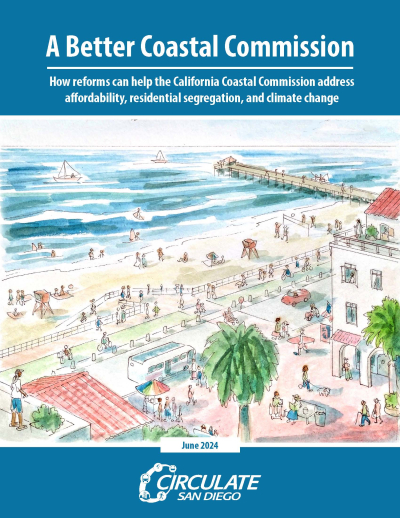
BetterCoastalCommnReportCover

The California Coastal Commission is infamous for being the most out-of-control governmental agency in the nation. This regulatory leviathan fancies itself the undisputed czar of land use and other activities in its fiefdom, the California coastal zone.

Created in 1976 as an agency with regulatory authority across California’s 1,000+ miles of coast (and land in a defined shoreward zone), it has since expanded to its current role as a government-outside-the-government, whose main role it often seems is more about wielding an iron fist over anything that happens in the coastal area, than protecting coastal access and resources while also respecting property rights as its governing statutes require.

The Commission has been blessed with procedures that appear insanely unfair to anyone not familiar with how things work in California. For example, any two Commissioners may file an administrative appeal of a municipalilty granting a development permit to get it

Continue Reading Can The California Coastal Commission Be Reined In?

PXL_20240422_045016733.MP
There are some rewards for working late in the 808

Yesterday was the last day of instruction for the Spring 2024 semester at the University of Hawaii Law School. Did these last few months ever go by fast. 

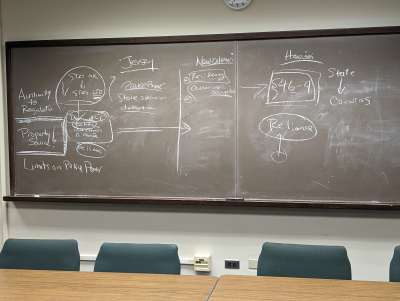
A big thank you to Professor Mark M. Murakami, with whom I guest-lectured at the Old School (both of us earned our JD’s at the Law School) over the semester, on such topics as Euclid, vested rights and development agreements, and of course limitations on the police power such as takings.

Although our students have another couple of weeks to finish up with their final papers, we can say with certainty that the future of Hawaii land use law is in good hands. We had some very intriguing and educational discussions over the past few months. 

PXL_20230426_222214630

Law of the Splintered Paddle

PXL_20240423_050055849.MP       
Old School chalkboards remain in some of the classrooms.

Continue Reading Aloha To Another Semester Of U. Hawaii Land Use

ALI-CLE brochure cover page

When it comes to the longstanding ALI-CLE American Law Institute-CLE Eminent Domain and Land Valuation Litigation Conferences, we’re always ready to go. You know that. But this year’s version — the 41st — was buzzing like no other in recent memory.

Maybe it was the New Orleans venue with its atmo, food, and music for our after-class activities, or even the timing (the second-to-last week on the Mardi Gras parade season, and our conference hotel was right on the routes). It might have been the nice weather (oh, it rained buckets one evening, but there wasn’t an ice storm like we experienced in Austin in 2023). Or maybe it was the capacity crowd, and new topics and speakers on the agenda. Or maybe it was just the prospect of seeing our friends and colleagues again after a year.

Here’s a photo essay of some of the Conference highlights.

And

Continue Reading Pass A Good Time: Our Report From The 41st ALI-CLE Eminent Domain & Land Valuation Litigation Conference, Feb 1-3, 2024, New Orleans

Don’t miss out!

We promise: this is the last time we’re going to try to entice you to the upcoming ALI-CLE Eminent Domain & Land Valuation Litigation Conference in New Orleans. We are getting close to capacity, but there is still room. In recent years, we have standing room only in the Conference halls, and have sold out the hotel block. After all, this is a pretty niche area of law. So what gives?

When we were in Austin last year, we thought it might be nice to try and answer that question. We asked Conference participants why they come, year-after-year (and in Austin, despite massive travel disruptions). Yes, it is the various venues (Nashville, Austin, Scottsdale, Palm Springs, to name a few recent locations), and yes, it is the excellent and useful programming.

But as we suspected it is more than that.

Continue Reading No FOMO: There’s Still Room For You To Join Us In New Orleans Feb 1-3, 2024 For The 41st ALI-CLE Eminent Domain & Land Valuation Litigation Conference

Conf-2024-flyer
Bismarck in January is looking pretty good.

Here’s what we’re reading today:

  • Christian Britschgi, Court’s Wild Zoning Decision Blocks ‘Montana Miracle’, Reason (Jan. 2, 2024) (“In an eyebrow-raising decision, a Montana judge has halted the implementation of two laws legalizing duplexes and accessory dwelling units on residential land across the state, writing that they’d likely do ‘irreparable’ damage to residents of single-family neighborhoods.”).
  • Richard Frank, The U.S. Supreme Court & Environmental Law in 2024, LegalPlanet (Jan. 3, 2024) (“First up before the Court in 2024 is this “regulatory takings” case from California…. Over the past four decades, U.S. Supreme Court decisions have developed the so-called ‘unconstitutional conditions’ sub-doctrine of regulatory takings law, but to date have only applied it to individually-negotiated land use permit conditions and fees. California state courts–including in the Sheetz case–have consistently refused to extend the doctrine to broadly-applicable fees and conditions imposed on landowners


Continue Reading What We’re Reading Today, Property Rights Edition

PXL_20230223_024826759

Starting in January, we’ll be helping our friend and former law partner Mark M. Murakami with the venerated and oh-so-important Land Use course (Law 580) at the University of Hawaii’s Law School.

We’re temporarily stepping into some mighty big slippers (this is Hawaii, so we don’t always wear shoes), as this is the course that our mentor Professor David Callies taught for decades. And is there a better venue in which to teach and study land use law and regulation, and its limits? After all, Hawaii may be the most heavily-regulated land on the planet, and is a focal point for every issue you can think of, from zoning to environmental restrictions to takings to public trust to subdivision to admin law to … well, you get the drift.

We’ll cover those topics, as well as the fundamentals. And we have a few surprises up our sleeves — some impressive

Continue Reading Hawaii Five-80: More Land Use (Law 580) At The University Of Hawaii